
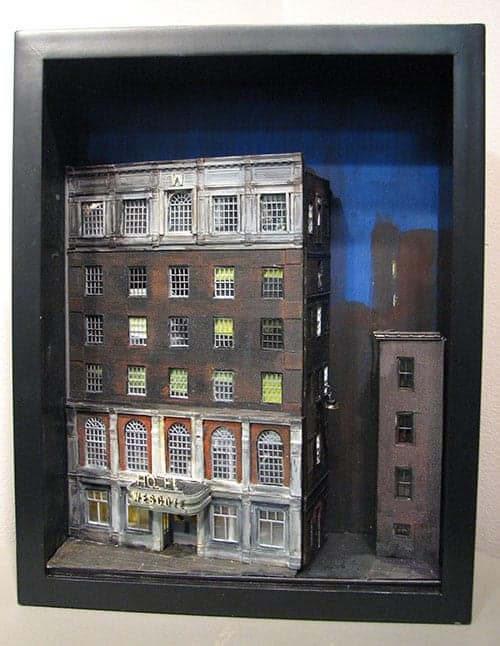
On Thursday we brought you an interview with Margaret Huddy, who won the Carol Zakaski Memorial Award for best watercolor in this month’s all-media show. The other award winner this month was Samuel Miller, whose unique sculpture — or three-dimensional still life — won the Adam Wishnow Memorial Award for Creativity and Innovation. Samuel mentioned painters Edward Hopper and Charles Burchfield as inspiration for the fictional hotel, which includes tiny figures and dynamic lighting on the inside. We asked him to tell us more about his work.
Does this depict a real place?
No. The hotel facade is invented, but in the style of W.L. Stoddart, an architect who designed mid-sized urban hotels in the first half of the 20th century. The former George Mason Hotel building, still at Washington and Prince Streets, is one example of his work.
Your sculpture won the Adam Wishnow Award for Creativity and Innovation — what is your creative process like? How is this piece different from others of its kind?
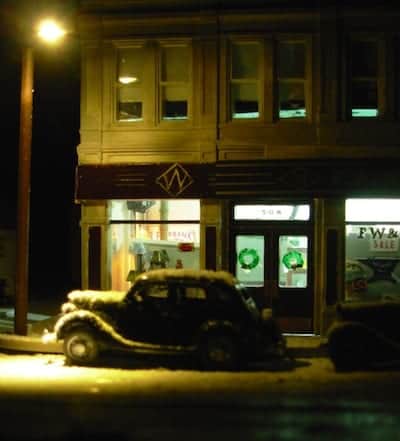
I have had a long term fascination with the world of my grandparents, which has spawned various pieces over the years. Early on, I built models and painted pictures of them in the style of a still life artist. Below is a photo of a model which I turned into a series of paintings. According to my mythology, the Hotel Wescott, like several of the three-dimensional pieces in my “Night Windows” series, has a specific time and date: 14th of December, 1938 at about 8:00 pm. Since I wasn’t alive then, I am left somewhat freer to imagine what it was like.
What materials did you use to create Hotel Wescott?
Various plastics, glass, wood, painted with Golden acrylic paints, LEDs and PIR motion sensor circuitry that turns on the lights in response to the viewer’s approach.
How do you describe your art? Is it model building, or sculpture, both, something else?
I consider myself a painter; here a painter of a three dimensional still life with lighted interiors and restricted viewing angles. The process is additive and subtractive like traditional painting with the extra aspects of determining viewing angles and lighting design.
Continued after the jump: Continue reading Q&A with Creativity Award Winner Samuel Miller