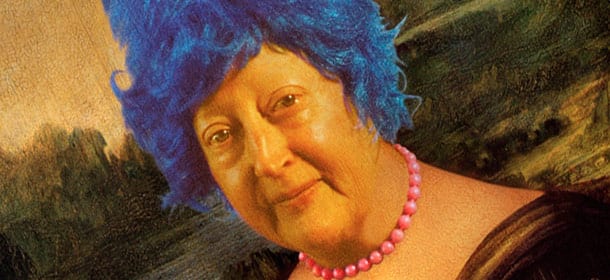
Mona/Martha/Marge by Martha Wilson. The feminist artist, gallery director, and founder of the Franklin Furnace will speak May 22 during the exhibit “The Feminist Movement in Art.”
As our 60th Anniversary exhibit series continues, we’re excited to announce a new slate of speakers to continue the accompanying lecture series. These talks began in January with Dr. Claudia Rousseau speaking on the Abstract Expressionists, and in March, Joyce McCarten spoke on the Washington Color School. The next three talks accompany “ColorField,” “Pop Art,” and “The Feminist Movement in Art.”
These talks are all free to attend, but space is limited, so click on the links to RSVP!
Color Field & Art History
with Timothy App
Saturday, April 5, 10:00 am
Painter and MICA art professor Timothy App, who juried the “ColorField” exhibit at The Art League Gallery, will speak on the Color Field movement from an art historical perspective. He will also talk about how the work in the current exhibit that he selected relates to that movement.
Pop Art and Beyond
The Art of Tom Wesselmann
Thursday, April 24, 7:00–8:30 pm
Robin Nicholson, deputy director of the Virginia Museum of Fine Arts, will discuss well-known pop artist Tom Wesselmann. In the 1960s, Wesselmann (1931–2004) — along with Andy Warhol, Roy Lichtenstein, James Rosenquist, Claes Oldenburg, and Jim Dine — formed the core of the Pop Art movement in the United States. Long after Pop Art’s crest, in a career spanning more than four decades, Wesselmann continued to create a highly original and accomplished body of work. Nonetheless, he is the last of this group to have a major U.S. exhibition and is perhaps the least known of these artists. Following on from the successful retrospective at the Virginia Museum of Fine Arts in 2013, this talk explores the artist’s diverse career and inspirations.
Martha Wilson and the Franklin Furnace
Thursday, May 22, 6:30–8:30 pm
Martha Wilson (b. 1947) is a pioneering feminist artist and gallery director, who over the past four decades created innovative photographic and video works that explore her female subjectivity through role-playing, costume transformations, and “invasions” of other people’s personae. Wilson will discuss her work and the work of the Franklin Furnace, an artist-run space that champions the exploration, promotion and preservation of artist books, temporary installation, performance art, as well as online works.
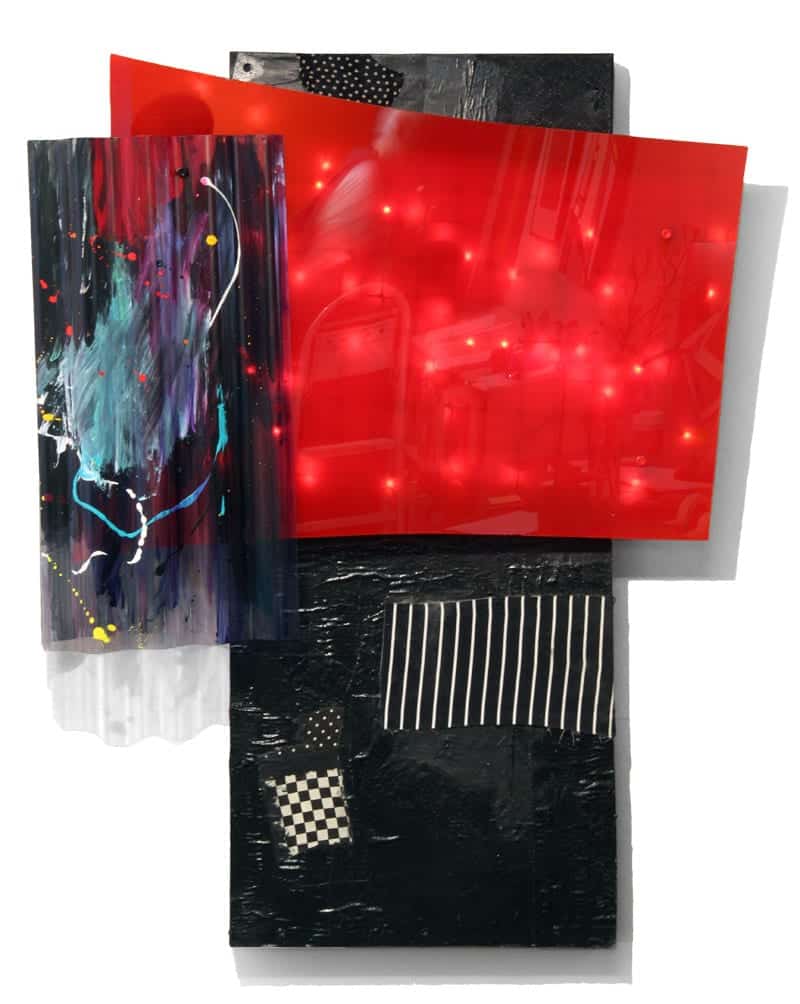
The mixed-media Red Lights Construction won the Adam Wishnow Award for Creativity and Innovation.
This month’s “ColorField” exhibit includes a special award for artists taking things in a new direction. It’s called the Adam Wishnow Award for Creativity and Innovation, and it went to Victoria Cowles, a painter branching into the third dimension.
Red Lights Construction, also titled #756, is constructed of wood, fabric, plexiglas, clear roofing, acrylic paint, plastic fencing, and lights. We asked Victoria, or Tory, to tell us more about her constructions and her career in general:
Since this month’s theme was the Color Field movement, how do you think about and work with color?
Tory Cowles: Bright colors make me happy and give me energy. Subtle natural colors in found materials are rich in unexpected colors and textures. For me colors talk to each other and change each other. I pay a lot of attention to how each color affects the other colors and the overall composition.
What is your creative process like — how does an idea start, develop, and finish?
My process is for me to start painting or constructing and then respond as directly and honestly as I can to each step. I don’t have a preconceived idea of where the painting or construction is going. My work doesn’t come alive unless I can reach a state of stream of consciousness. For me the stream of consciousness is an expression of what is most important to me emotionally. I try to allow as much chaos and spontaneity as possible with just enough structure to hold it together.
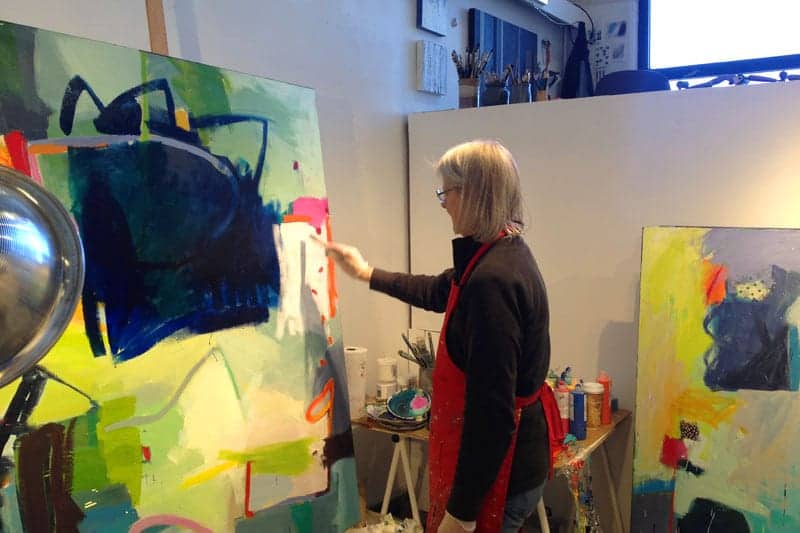
Tory Cowles painting in her Torpedo Factory studio.
I work on 8–12 large canvases or 3–4 constructions at a time. The size allows me or encourages me to paint with abandon. Their large size also encourages the viewer to fall into the painting and travel around inside seeing and enjoying different things depending on the viewer’s mood and the vicissitudes of the light. The 8–12 paintings or the 3–4 constructions often come together at about the same time with certain common elements that evolve through, and are unique to, the series.
What was your goal with this piece?
My goal for #756 was to try to combine strong bright colors, in this case deep red, with some subtler elements. I tried to do that by adding the plastic fencing and the lights behind the plexiglas so that the light came through the layers.
How are your constructions different from your paintings?
So far, I’ve found that, compared to my paintings, I have to simplify my constructions tremendously in order to make them work. It’s so much easier to set off strong colors using paint because you can more easily add subtler colors and shapes that set off the stronger colors without it becoming too busy. Thinking in three dimensions is a different mindset. These constructions are mostly bas relief which is somewhat three dimensional, but still mostly two dimensional. I think I am moving slowly into a more three dimensional direction.
What role does interactivity play in your work?
Some of my work in the past have been highly interactive in a playful way. I would like to go back to that but experiment with using the interaction to illustrate and manipulate abstract concepts, shapes and colors. For instance, a viewer might move a colorful object on a rope across the piece and see how the composition changes and how the colors look different, actually change, when they are next to or on top of different colors.
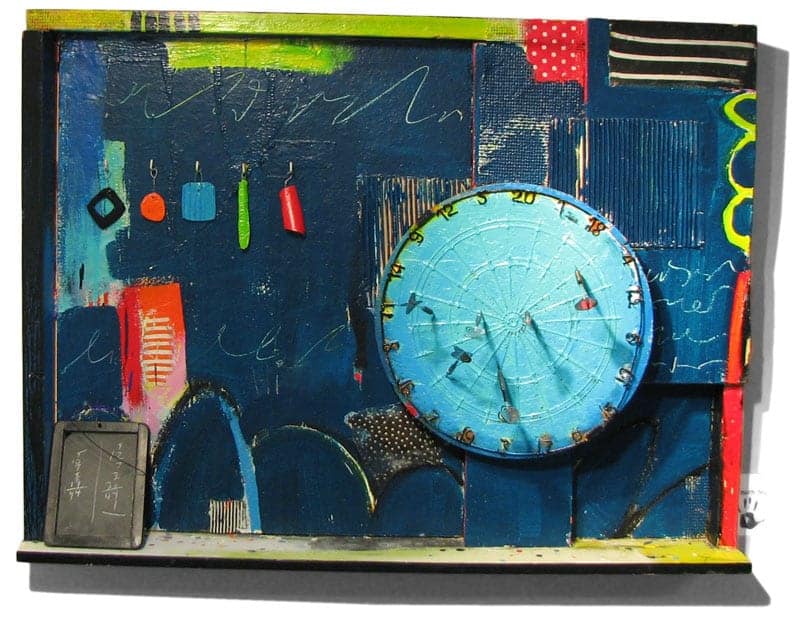
#576 by Tory Cowles from the Gallery’s 2012 interactive-art themed exhibit, “Play.”
How did you start incorporating lights?
I’ve done a number of light pieces over the years — my first pieces were a series of boxes with electric light coming through various materials. About 5 years ago I made a piece which consisted of a bas relief abstract painting with a box of sand across the front. You could take out a long thin candle and a match, light the candle and place it in the sand in front of the painting – similar to some church altars except that you could say that you were lighting a candle for the painting, or for painting in general, or for abstract painting, or for anyone who you may be mourning. The candles were very thin, leaning in different directions and at different heights. I like lights and their impact on colors. Lights inside a construction are like the spirit that animates a body.
What artists have influenced you most?
Robert Rauschenberg, Thaiwijit, Tapies, Richard Diebenkorn.
What are you working on now?
I’m making some more constructions. I feel like I am just scratching the surface of what interests me with using different materials. I will continue to paint which is very enjoyable and seems easy after struggling with the three dimensional pieces.


 Color Field & Art History