Guest Post: Stone Sculptor John Ploch

This is a guest blog post by sculptor John Ploch, whose sculpture Khaivani won Best in Show in the juried exhibit, “Gatherings.” We asked him why he is a sculptor.
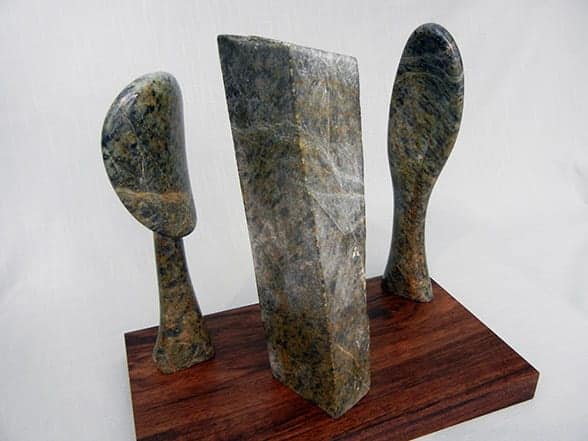
Khaivani by John Ploch

Over 40 years ago I was watching the Winter Olympics and they showed a profile of a female American speed skater. She carved alabaster in her free time as an artistic outlet. I remember thinking at the time how interesting that was, but although I never pursued it at the time, the memory stayed with me.

Fast forward to the fall of 2002. My wife and I were walking through the Torpedo Factory and I got to talking to an artist who at that time had a studio there selling her stone sculptures. I relayed my speed skater story and said that it was something that I had thought would be interesting to do but I didn’t know how to go about it. I think her exact words were, “Why don’t you take the class through The Art League, that’s what I did!”

So I started taking the Wood & Stone Sculpture class in the Winter of 2003 and have taken it every term since then. I’ve been lucky enough to have three very good teachers, especially Nick Xhiku and currently George Tkabladze. The are both world-class artists in their own right, superb at teaching, and I feel blessed to call them my friends.
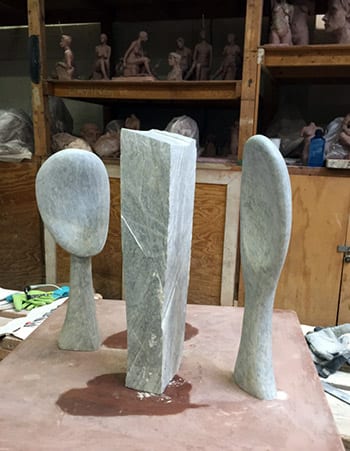
Khaivani in Studio
Khaivani in progress in The Art League’s sculpture studio. The carving was done at this point, but not the wet sanding and polishing. I was working on finding the right placement for the three pieces.

I really enjoy the process of finding the perfect line or curve in the finished sculpture. Working in three dimensions, you always need to be aware of how the piece looks and is progressing from all points of view. I constantly look at the piece to make sure that the surface or line on which I’m working speaks well and compliments adjacent lines and surfaces. It’s hard to define, but when it’s right, it’s right and is clearly seen. I don’t always get there, but it’s the journey that is so enjoyable.

I also love the class experience. There are others in my class, some who have been there almost as long as I and some who I’ve known for five or ten years and we’ve become a family. We know and care about each other and our wives, husbands, and children. I miss them as much as the creative process in the class during the between-term breaks.

I usually work in alabaster or else a Virginia soapstone called steatite. Alabaster comes in a variety of colors and the steatite finishes to a lustrous black color, so when I saw the green in the soapstone I thought of doing some trees.
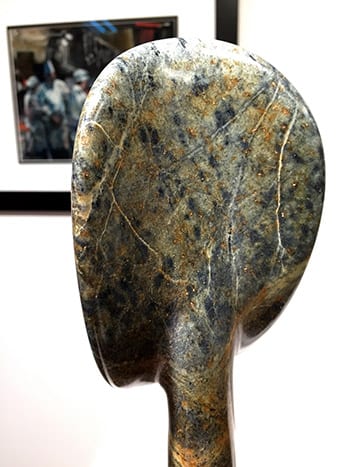
Khaivani (detail) by John Ploch

My teacher, George is originally from the country of Georgia and “Khaivani” is the English phonetic spelling of the Georgian word for forest. The stone from which the three pieces came was originally twice as large. I first cut it in half and used the remaining half for a piece that I have submitted for annual the August “Taking Shape” sculpture show. The class that I take is called “Wood & Stone Sculpture” and this is first sculpture that I’ve done that incorporates both stone and wood, so I entitled it “Saturday Morning” in honor of the class.

The right way to go about creating a sculpture is to draw the sculpture on paper first, and/or to make a clay model from which to work. I don’t do things the right way. I can’t draw to save my life and never had much luck with clay. I am able to see what I want the finished piece to look like in my mind though. I only do abstracts which helps, since I can change my mind as I go along. That’s not something you can do if you’re going for a representational sculpture. If you start out to sculpt a dog, for instance, you’re pretty much committed to completing a dog. With abstracts, the mind can flow as the work flows.

— John Ploch
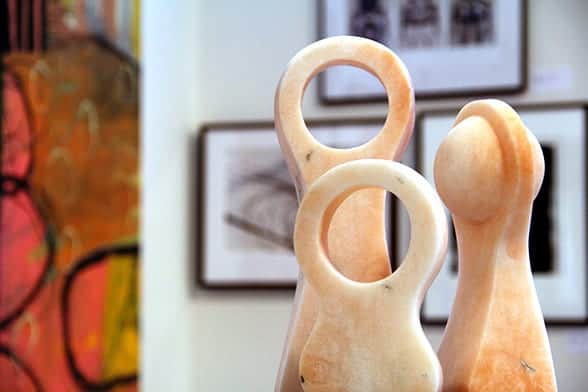
The Stones, alabaster, by John Ploch

Our Summer Art Reading List

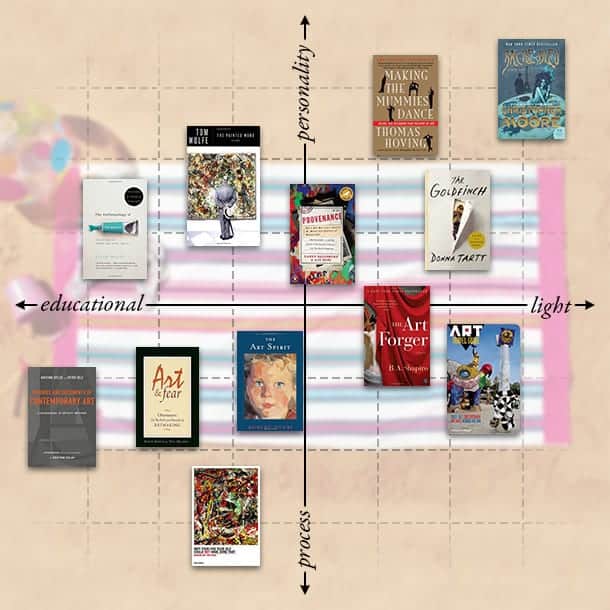
Ah, summer. A time when we can finally return to painting outside, pack our suitcases with sketchbooks … and regular books! Get your Kindle charging and find your library card, because we’ve compiled some of our favorite visual art-related books (and a few on our wishlist).

What are you reading this summer? Do you have any recommendations to share? Let us know in the comments!

Summer Art Reading

  • Why Your Five Year Old Could Not Have Done ThatWhy Your Five-Year-Old Could Not Have Done That
    by Susie Hodge (Prestel, 2012)

With the ambitious subtitle, “Modern Art Explained,” this book responds to the mutterings of museumgoers everywhere by illuminating the talents of some misunderstood artists from the past century. This one also has a companion book on photography, Why It Does Not Have to be In Focus by Jackie Higgins.

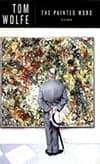
In the oldest book on this list, the author of The Electric Kool-Aid Acid Test and The Right Stuff takes aim at art criticism. Tom Wolfe’s 1975 book is number one on the list of local artist and art blogger Lenny Campello’s favorite art books. Whether you worship Clement Greenberg or you get the sense the art world has left you behind, Wolfe is sure to get you thinking and push a few buttons.

“Colors challenge language to encompass them,” writes artist Meloy in this poetic look at color. She puts a new perspective on the deep emotional connection we all have to color with an approach that is both scientific and personal (and, of course, anthropological). This book is also full of fascinating facts like this: “It has been shown that the words for colors enter evolving languages in this order, nearly universally: black, white, and red, then yellow and green … with green covering blue until blue comes into itself.”

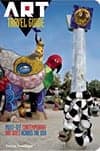
  • Art Travel GuideArt Travel Guide: Must-See Contemporary Art Sites Across the USA
    by Connie Terwilliger (ArtNetwork, 2012)

Take this along on your road trip-slash-pilgrimage, or just daydream along with the photos. The author identifies 120 places you probably haven’t heard of, including sculpture parks and performances.

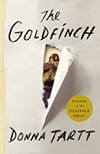
This well-loved novel and Pulitzer Prize winner tells the story of a teenager who comes into possession of a valuable painting that changes his life.

By the way, if you’re trying to pack light, be aware The Goldfinch is over 700 pages long.

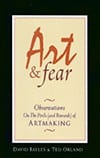
Among the huge number of advice and self-help books out there for artists, Art & Fear stands out for its clear writing and compelling premise: “Artmaking involves skills that can be learned” and “Art is made by ordinary people.” Written by working artists and teachers, this could be one to keep handy for when the realities of making art get you down.

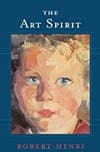
If you aren’t familiar with the name, Robert Henri was a beloved art teacher and a figure in the Ashcan School. You might have seen his paintings at the National Gallery of Art. Henri died in 1929, but you can still benefit from his advice, which this book collects in the form of his letters, articles, and sayings.

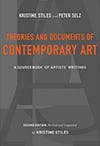
Chances are, you know if this is your kind of book after reading the title. It’s exactly what it says on the tin: essays, statements, and interviews by and with contemporary artists from Duchamp to Banksy. Installation artists, performance artists, and others are also included.

Both a murder mystery about Van Gogh and “a novel about the color blue,” according to its author, the novel’s main characters are a fictional baker-painter and Henri Toulouse-Lautrec. Moore is a hilarious writer, so expect this one to be very funny and very weird.

The Art Forger

A novel about art, theft, and forgery, with a backdrop of the real-life art heist from the Isabella Stewart Gardner Museum in Boston. Starting with a newspaper clipping about the anniversary of the thefts and the main character picking paintings for a studio visit, the two threads come together for a tale that, hopefully, isn’t too familiar to Art League readers. This is a past pick of The Art League Book Club, which recommended it to us.

  • ProvenanceProvenance: How a Con Man and a Forger Rewrote the History of Modern Art
    by Laney Salisbury and Aly Sujo (Penguin, 2010)

Art-related crime is always a sexy topic for a book (or a movie), but we limited ourselves to two choices on this list. Unlike The Art Forger, this tale is nonfiction: the real people John Drewe and artist John Myatt are the main players. But just like the other book, it’s a captivating story thrillingly told.

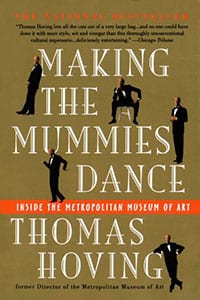
Another Art League Book Club pick, this is for those of you who wonder what goes on in the inner circle at places like the Met. It’s a memoir by a former director of the museum, with some gossip and behind-the-scenes details. For other books about the Met, see this blog post.

That’s our list! Oh, and for those rainy days, we have another list you might like.

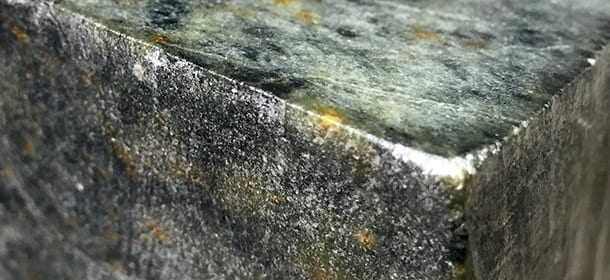
Cover image: detail from a photograph by Art League instructor Pete Duvall