4 Kinds of Videos Artists Can Make Right Now

Artist videos

Artists and videos: it’s a match made in heaven. People love watching visual art in progress, whether you’re documenting, demonstrating, or just talking about it. As of November 2015, there were an average of 8 billion views daily of videos on Facebook.

Making your first artist video can seem daunting, but the truth is that you probably already have your video camera in your pocket, and free editing software on your computer.

Why bother? People spend a lot of time watching videos online (8 billion views daily, remember?), so it’s an excellent way for fans and collectors to discover new artists. More importantly, including a video on your website can increase sales and make you more memorable to visitors. It’s a great investment for a small business — like yours!

You’ll find ideas for videos at the beginning of this post, and tips for first-timers at the end.

1. Demonstrate a technique

By far the most popular subject matter on our own YouTube channel, demo videos can take a number of forms.

They can be narrated or set to music. They can be in real time, sped up, created from time-lapse photography, or edited down to just the highlights. Show off your skills!

(1b. Livestream)

A livestream — a live, unedited broadcast watched online — is great for demos, because you can answer questions from the audience. You can use YouTubePeriscope, or take advantage of your Facebook following by livestreaming there. (These are all easy to do right from your phone or webcam.)

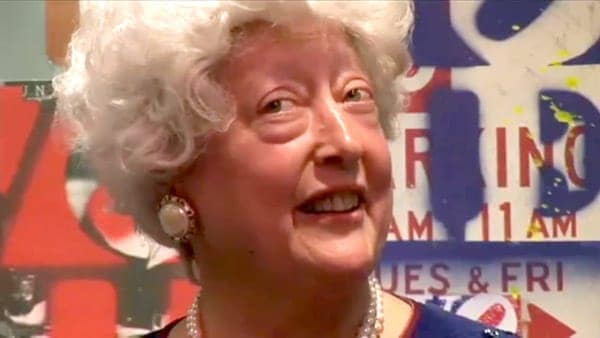
Martha Wilson as Barbara Bush
Martha Wilson performed as Barbara Bush in 2008 and documented the performance. (Watch the video here.)

2. Document an event

Got a performance or an installation to share? Make a video! A time lapse is a great way to show a long process — like an hours-long studio session, or an installation process.

The iPhone, iPad, and GoPro all have built-in time lapse functions. Or, use your regular video camera, then use any editing software to speed up the footage (and take out the slower parts). If you go this route, you’ll need new audio: think music, or narration.

3. Interview yourself

Whether you are responding to questions from a real interviewer, or answering imaginary questions, a video is the perfect outlet for talking about your art. Include images of your artwork to create visual interest.

Frames from a Scott Hutchison animation (see i don’t know, below)

4. Other

We hardly need to say this to artists, but: get creative! How can you use video to add to your art?

  • Peter Draws combines sped-up footage of Peter drawing with rambling, unrelated narration.
  • i don’t know is an animation using oil paintings by Scott Hutchison

Tips & Resources

  • Be compelling: Does your video inspire, inform, entertain? If not, back to the drawing board!
  • Gear: Not as important as you’d think. Our most-watched video was shot at The Art League using an inexpensive Flipcam, and your phone probably shoots higher quality footage than that. The most important thing is the content of the video.
    • Tripod: If you’re both the artist and the videographer, you’ll need something to hold the camera for you. There are plenty of options out there for tripods to hold your phone or camera.
  • Editing: Editing makes the video. In your case, it’s probably as simple as cutting down clips and stitching them together, and the free software that’s already on your computer can do that. (Try iMovie on your Mac or iPad, and Windows Movie Maker on Windows.)
  • Music: Sound and music can do wonders! For public domain and Creative Commons music, we like to look on youtube.com/audiolibrary and freemusicarchive.org
  • Duration: On our videos, the average watch time is three minutes. After that point, it gets harder to hold the viewer’s attention. Try to make your video as short and concise and possible, and grab the viewer’s attention at the very start. (This isn’t necessarily true for livestreams.)
  • Where to upload: Your video will probably live on YouTube or Vimeo, and from there you can share it on your website, in emails, etc. If you are on Facebook, upload the video directly onto that platform for optimal engagement.
Andrea Cybyk: What’s On the Surface

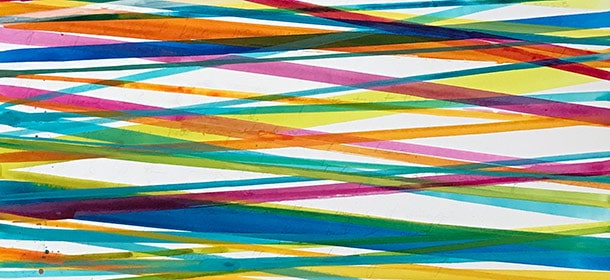
If Only, acrylic and graphite on cradled Ampersand Gessobord, by Andrea Cybyk. Winner of the Gallery Director’s Award. (Sold)

This month’s juried exhibit asked our artists to consider “Habits” in all their forms: rituals, addictions — or something as simple as repeated strokes of the paintbrush.

Andrea Cybyk won the Gallery Director’s Award for her painting If Only, a twist on her long-running “Color Strands” series. She told us more about how this fits into her work, why she’s a “nomadic, social painter,” and how she moved from engineer to artist:

What was your goal for If Only?
Andrea Cybyk: I’m interested in repeated lines, shapes and marks, so I use these as parameters to unify each painting or series. I’m very process-driven, preferring a certain viscosity to the paint, a rhythm & variation in the lines, & a balance of color and white space.

How did you arrive at this color palette?
Creature of habit, really. I gravitate to the same colors over and over, favoring transparency over opacity. Each line is left to dry before another crosses it. Where one strand intersects another, they build unexpectedly lush, complex colors, not mixed on my palette. I love the way the pigment is backlit by the pure white surface. The colors are fresh and happy, but hide a darker secret.

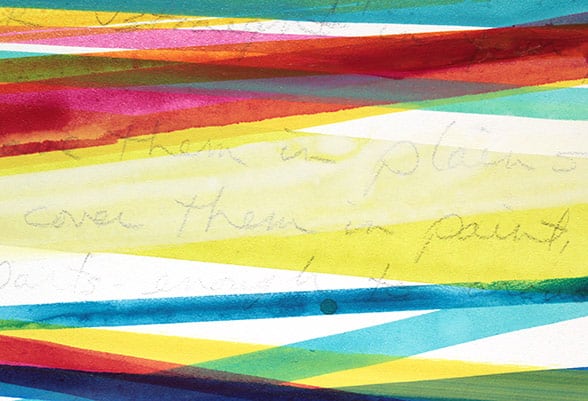
If Only (detail) by Andrea Cybyk

Is this part of the Color Strands series? How does it fit in with, and differ from, that series?
If Only is definitely part of my Color Strand series — long, exacting diagonals that tangle into a bit of chaos, echoing the hectic pace of our busy lives. This particular painting is different, though, in that I’ve included handwritten messages of longing and uncertainty. Written in pencil before I began painting, it was a personal outpouring of a very emotional time for me.

If only things were different.
If only I could…
If only you knew…
If only…

My challenge then was to conceal much of what I’d written, mostly with paint, but some by erasing. From a few feet away, you can barely see the words, much in the same way that we’re all “fine” on the surface even if, underneath, we’re not.

What is your creative process like? How do you know when a painting is finished?
I have a perfectly good studio in my basement, but I’m more of a nomadic, social painter. After years of Art League classes, my supplies tuck happily into a rolling carry-on suitcase, and off I go.

I’m an Artist-In-Residence at Palette 22 Restaurant in Shirlington, so I’m in the studio there a couple times a week and with my studio group in Herndon on Fridays. I’m super productive at P22, despite all the noise and people. It’s forced me to think more independently and to adapt my process to the peculiarities of that environment.

I always work flat on a table, not on an easel. I want the paint to pool and dry rather than dripping. It’s a control thing. I’m always working on more than one piece at a time, moving one forward while another is drying and alternating between positive shapes and negative space.

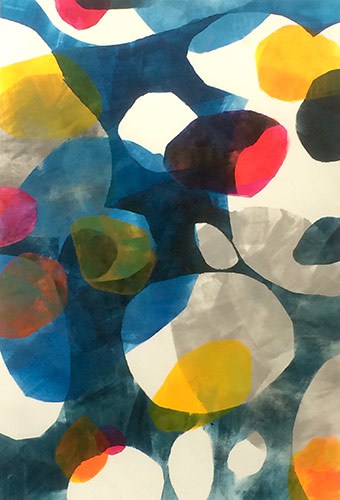
Floating Forms 12; acrylic on paper, mounted on cradled wood panel; by Andrea Cybyk.

Knowing when a painting is finished is tricky and fraught with doubt and indecision. All the classic principles of design and composition apply in abstract painting as well, so that helps. I leave a lot of white space in my paintings and use it both as a pathway to move the eye through the painting and as a resting place from potential color overload. Step back, walk away, leave it alone for days, and finally solutions become clear, or I realize it was already complete.

How did you get started in painting? How has your art changed over time?
I was a software engineer. After college, my friends and I frequented the First Friday gallery openings at Dupont Circle, lured by free food and wine. Along the way, I got hooked on bold, intoxicating colors, though it was years before I had the courage to pick up a brush and take my first painting class. The engineer and the abstract artist battled it out in my head for a long time. Eventually the artist won, but my engineer side still likes to have a say in the order of things.

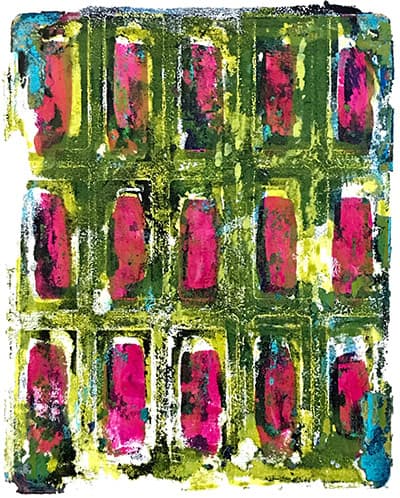
Openings 31, acrylic on paper, by Andrea Cybyk.

I studied painting, turned to printmaking for several years, and later returned to painting, bringing with me the brayers which I currently favor over brushes and a love of the luminous glow of pigment on paper. I’ve done a lot of loose, expressive abstraction, but currently prefer more structure in my paintings, hence the focus on repeating shapes.

What are you working on now?
Three different series all at once: Color Strands, Floating Forms, and the newest, Openings. This latest obsession is a series of small works on paper with a grid reminiscent of old windows and ancient buildings. I’m using a gelatin plate, brayers, and a template rescued from the recycle bin. Each acquires a delicate, time-worn patina composed of dozens of layers of acrylic paint.

I’ll show at Artomatic Crystal City in March/April because it’s always fun, and I’m a guest artist at the Vale Arts Spring show April 28–30. In October, I’ll be the featured 2-D artist at the Cooley Gallery in Leesburg.

“Habits” is open through Sunday, February 5. If Only is sold and has been shipped.