6 Steps To A Beautiful Art Display!

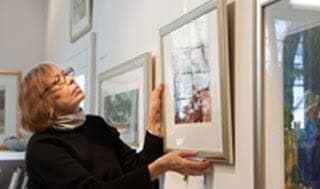
Watercolor artist and gallery owner Marilyn Swift. Photo by gallerysystems.com

Beautiful art arrangements in galleries, museums, art stores and even private homes are never accidents (no matter how effortless they might look). There’s a simple yet solid process to follow when displaying art that many creative businesses follow in order to maximize appeal. The good news is that anyone can do it!

We found a great interview with Marilyn Swift, a Massachusetts  painter and gallery owner, on gallerysystem.com. She breaks the process down into these 6 simple steps. 

1) Choose the right height. Create an imaginary horizontal line for consistent vertical placement of the works, at a viewer-friendly height. Large items will be hung so that this line divides them in half across their midsection. Smaller items can be “double hung” in two rows, above and below, with the centerline halfway between.
“Many people tend to hang their work too high, especially if it’s in a room where people will be sitting when they look at it,” notes Swift. “Probably a good rule of thumb is to start at around 54 inches off the ground, and adjust from there.” Among the factors to consider: Will people be standing or sitting? Are there low sofas or high stools? How high are the ceilings? Who will be using the space – children? Seniors? Basketball players?

2) Edit. Decide how much will really fit on the wall or walls you’re working with. It’s easy to overcrowd, which can be visually overwhelming, and detracts from each individual piece. The two-row technique can be useful for putting more pieces on a wall, especially if they are smaller in size; it can also work to put a smaller piece over a larger one.

3) Experiment and Observe. To find the right arrangement, lay the works out along the floor at the foot of the wall, and try different combinations. “They shouldn’t fight,” is how Swift puts it. “You need to step back and look, and constantly readjust with a fresh eye that you only get from a distance. A wall can be too chaotic, or it can be too quiet. If the lines are all similar, you might need something to jazz it up.” Another hint: don’t fill an entire wall with works that are the same size with the same frame – “you start to only see the frames,” cautions Swift.
Marilyn Swift, courtesy of gallerysystems.com

4) Adjust. Try different spacing to give the works room to breathe. Proper spacing depends on many factors, including the size of the work, and how it is framed. “If you have watercolors with a four-inch matte around them – maybe they can hang just six inches apart, because you have that space plus the matte,” explains Swift. “If you’re hanging things in ornate frames, they may need more space.”

5) Wait.  “If you’re not strapped for time, come in the next day with a fresh eye, and often you can see where you need to make adjustments before you commit,” says Swift

6) Hang!  After going through this process, you can plot the exact locations for the pieces in your display and hang with confidence. Swift notes, however, that the desire to tweak is virtually universal, and that the use of a wall-mounted hanging system rather than nails in the wall can be a huge help, and a great way to take stress out of the hanging process.

To read the rest of the article and interview with Swift, visit the Gallery Systems website

Maryland Individual Artist Awards!

 
Do you have what the Maryland State Art Council is looking for? If ya do, there’s a grant waiting for you! Every year, the MSAC chooses a few categories and puts out a call for entries. 

2011’s categories are:

  • non-classical music composition
  • non-classical music solo performance
  • playwriting
  • visual arts: crafts
  • visual arts: photography

Deadline is July 28, 2011. Visit the website for guidelines and the official MSAC application. 

The Art League’s Monthly Plein Air Painting Event

Jack Dyer

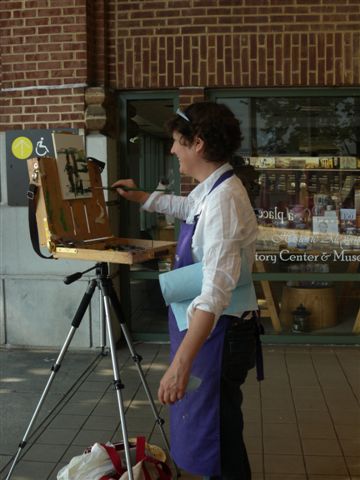
Once a month on second Sunday mornings this summer, a group of painters can be seen setting up shop by the Alexandria waterfront. They pull out their easels, arrange the canvases, spread out their paints and brushes, and get to work immortalizing the beautiful scenery. 

Vicki Blum

This group of artists is known as The Art League Plein Air Painters. They came together for the first time this month with a common purpose: to share their talents, not only by documenting the breathtaking views, but also by letting the public experience their creative process as it unfolds. Patrons are welcome to stand by and watch the paintings come to life or to come back periodically and check in on the works-in-progress. So far, the event has drawn crowds from all over the area as people watch the masters at work, with some hoping to snag a few tricks of the trade. 

Jill Banks

The idea started with a meeting held by the Alexandria Waterfront Planning Committee. The Art League’s executive director, Linda Hafer, was asked to help liven up the water view spread in front of The Torpedo Factory Art Center by getting a few painters to start working outside. 

“The idea to breathe a little life into the neighborhood was going to be the undertaking of four different Alexandria groups,” says The Art League Gallery director Rose O’Donnell.

Those four groups included the Alexandria Archaeology and The Seaport Foundation, along with The Art League and The Torpedo Factory Art Center. The Art League’s contribution was the plein air display. 

Artists Sketching in the White Mountains by Winslow Homer

“Plein air” is French for “open air,” a practice which found a huge following among the impressionist artists of the 1870s. With the invention of tube paints and the box easel, which were easily portable, painters took their operations outside to capture nature on their canvases. Legends like Claude Monet and Pierre-Auguste Renoir were the most famous advocates of the practice, as several of their famed works were created outside, usually under a large white umbrella. 

 Yet with Monet and Renoir unavailable to lead The Art League’s outdoor movement, painter Jean Schwartz took over planning the monthly event. Last Thursday, she updated her official blog with a post about July’s plein air party, even showing off her work from the day. 

Jean Schwartz

“Last Sunday was the very first paint out of the Art League Plein Air painters.  There were four of us, Jill Banks, Vicki Blum, Jack Dyer and me.  We met on the dock behind the Torpedo Factory around 9:00 (Vicki wisely started earlier) and painted until noon.  It was HOT!  Thank goodness for my umbrella because the scene that interested me required I be in full sun and looking right into it. The brollie did its job and without it I would have fried.  Lots of sunblock and water also helped.”

From the Torpedo Factory Dock by Jean Schwartz

August’s event is scheduled for the 14th from 9am-noon on the waterfront in Old Town Alexandria. The Torpedo Factory Art Center is located at 155 North Union Street.