
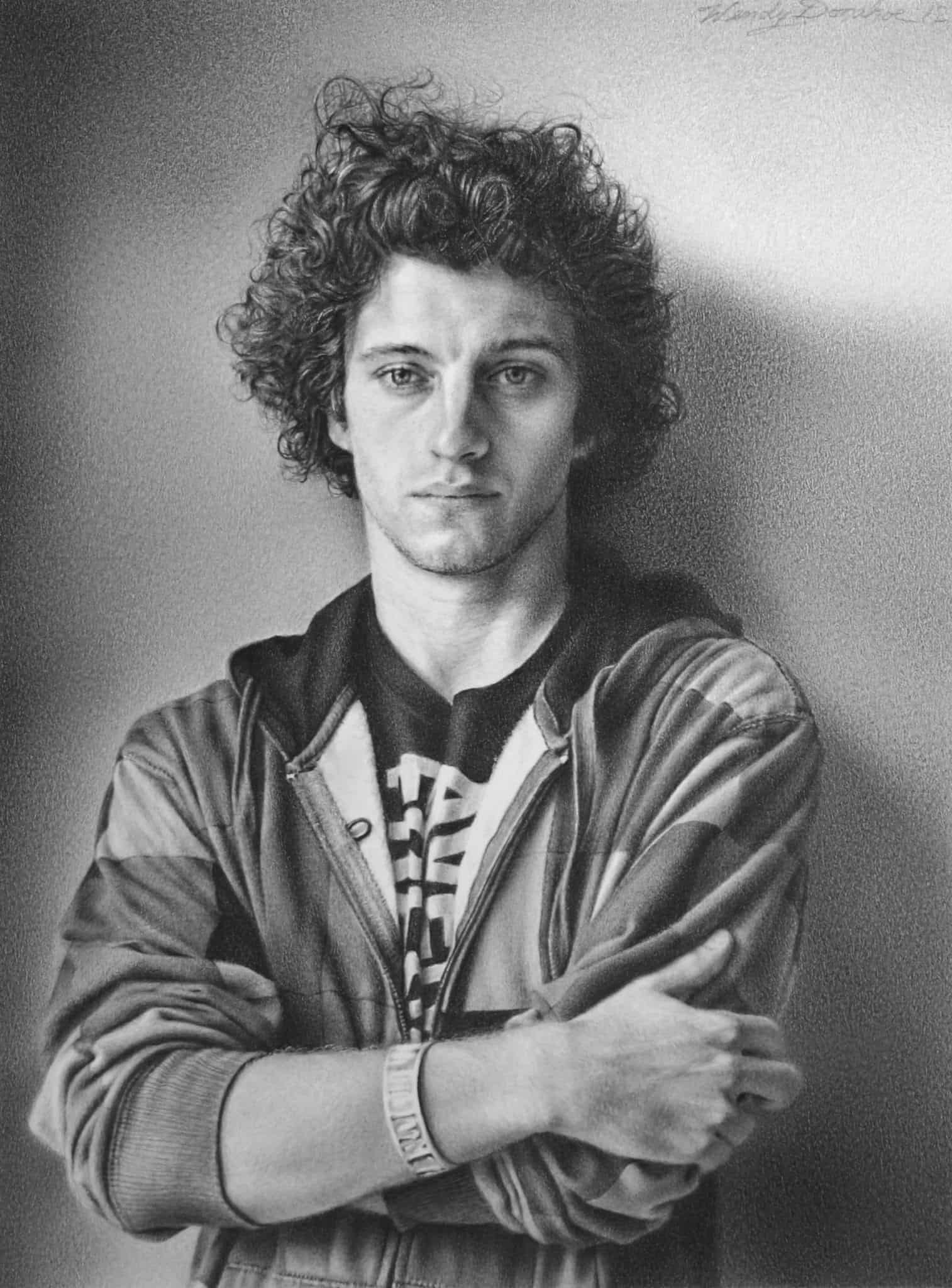
Earlier this week we brought you an interview with Elizabeth Loftis, whose pastel and watercolor painting Procession won best in show in the December All-Media Exhibit. The Second Place Marker Award went to Nicholas, a graphite portrait of the artist’s nephew by Wendy Donahoe. The juror, Linda Hafer, said she chose the “beautiful and quiet” piece for its detail and technical expertise.
We asked Wendy to tell us more about Nicholas, portraiture, and her artwork in general — read our Q&A, below, and don’t miss the opening reception today (December 13) at 6:30!
What’s your creative process like, from an idea to a finished piece? How long does a piece like Nicholas take?
Wendy Donahoe: Once I have a concept for a new drawing, there is much to consider before I begin. First I need to decide which medium would best suit my vision. I primarily work in graphite, charcoal, and colored pencil, each requiring a different paper selection, the next step in my process. For graphite, I generally use the Strathmore 500 series in the vellum surface, but in the case of Nicholas, I used the smooth surface for finer detail. I then determine the size and scale it needs to be, a very important consideration. Because I work differently with graphite and charcoal, a much smaller drawing such as Nicholas can take as much time to complete as a much larger drawing in charcoal. I began the drawing of Nicholas in early October with the intention of entering it into the “Small Works” show, but was not close to finishing it come receiving. I realized however that the smaller size frame requirement was not right for the piece and completed the drawing December first.
How did you develop your photorealistic style?
Although not the intention, my work has often been described as “photorealistic,” which is just one style a contemporary realist artist might strive for. I received my BFA from The University of Delaware where I was taught a “continuous tone” method of drawing, which I have worked in and developed ever since. Gradations of tone are overlapped and blended moving the sharp point of the pencil in a tight circular fashion. Keeping my highlights paper-white, I lay down my mid-tones into which I layer my darks and shadows for subtle transitions, always trying to keep a soft edge, forming lines as varying tones meet.
Read more below!