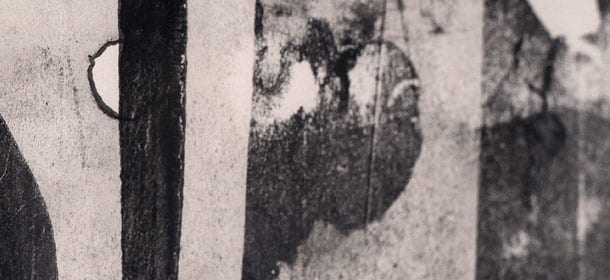
Danger Lurks, gelatin monoprint by Katherine Rand. Winner of the Third Place Award in the January All-Media Exhibit. (click for a larger image)
Katherine Rand, one of three first-time award winners in the January All-Media Exhibit, juried by Paul Reuther, told us how gelatin monoprinting works and about finding inspiration in the figure and art history in this Q&A:
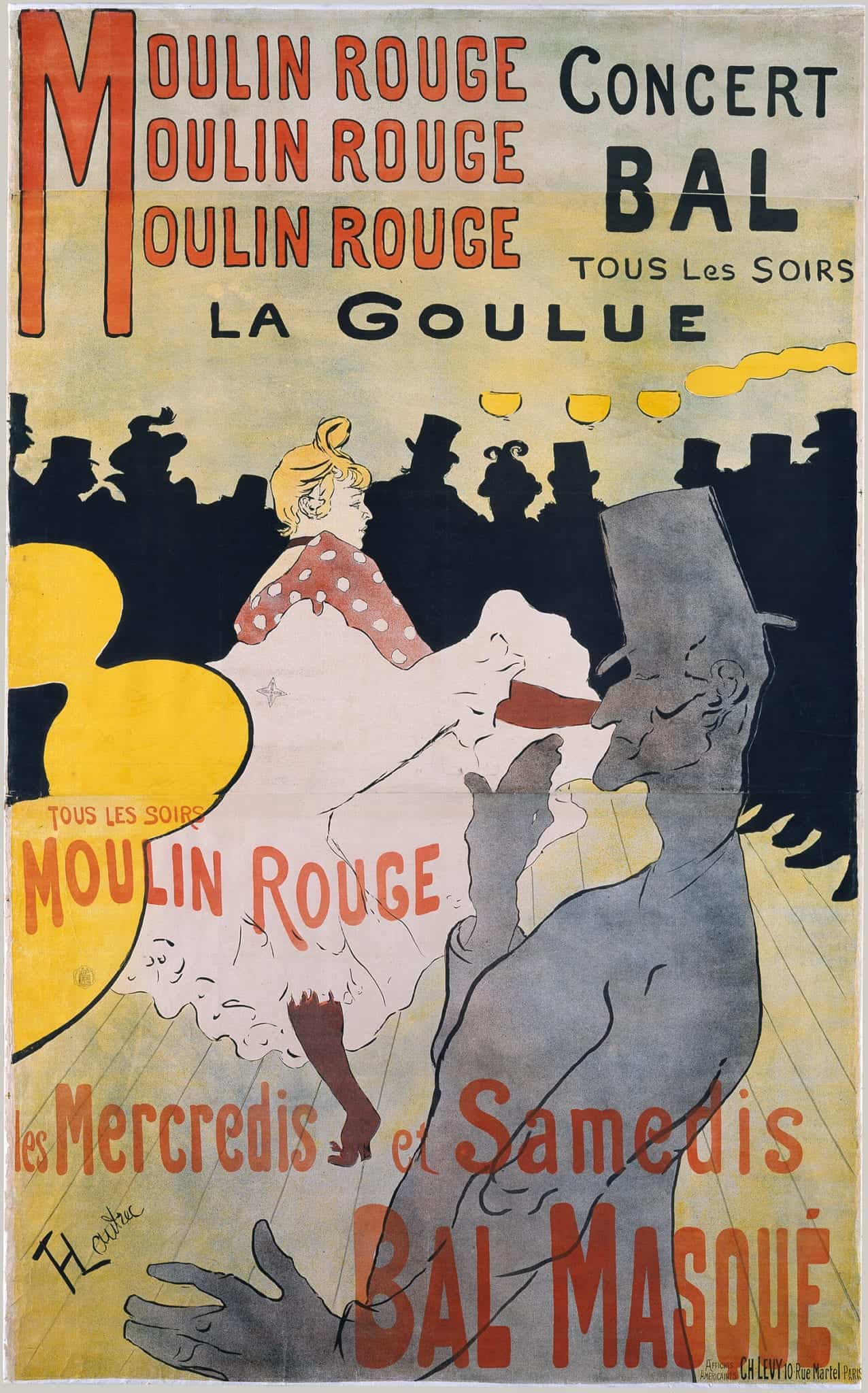
Moulin Rouge: La Goulue, lithograph by Henri de Toulouse-Lautrec
What was your goal with Danger Lurks? Did you have any particular inspiration for the figures and the composition?
Katherine Rand: When I created Danger Lurks I was starting on another series of prints that featured ballroom dancers. I was toying with the idea of incorporating other figures in with the dancers. I thought that perhaps the audience or an announcer might add something to the composition.
This brought to mind some of Toulouse-Lautrec’s famous posters. One in particular, Moulin Rouge: La Goulue, intrigued me. In the background is the silhouette of an audience, in the middle ground is the featured dancer and in the foreground is the shadowy figure of another dancer. This gave me a place to start.
I cut out some rough templates for background, middle ground and foreground figures, intending to use these to plan the layout for some of my ballroom prints. As sometimes happens, things did not go as planned. As I worked with these stand-in figures a new story line began to emerge on my gelatin printing plate. The middle ground dancer became a little girl next to the shadowy foreground figure and the background audience dropped out of the picture. Apparently my cast of characters was not interested in putting on a dance performance that day.
I did go on to create some ballroom dancer prints, without other figures. The dancers were happy to be the only featured characters. The Moulin Rouge-inspired characters live on only in this one piece, Danger Lurks.
Quick Step Trio, gelatin monoprint over ink drawing by Katherine Rand. (click for a larger image)
For people unfamiliar with the technique, can you explain how a gelatin monoprint is made?
Creating gelatin monoprints begins with making a thin sheet of gelatin to use as the inking surface. Once it has hardened, printing ink is rolled onto the gelatin plate. I use mostly Speedball water-soluble Block Printing Ink for this.
At this point, different effects can be achieved by removing ink from the gelatin in some areas and masking it in others. A piece of printmaking paper is laid face-down on the inked surface to produce the print. The soft, slightly damp surface of the gelatin releases the ink without the use of a press.
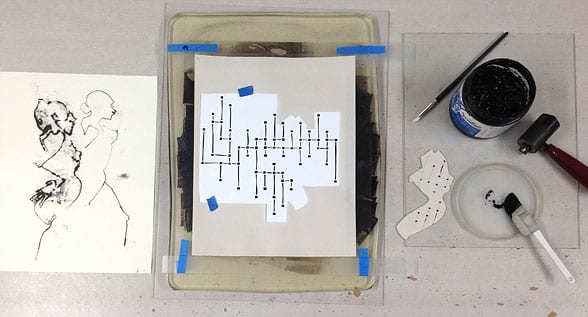
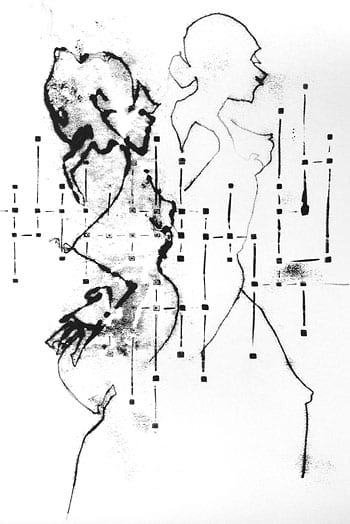
Before and after: top, a gelatin plate with ink removed and masked. Bottom, Dancing Pears No. 3 by Katherine Rand. (click for a larger image)
Why are you a printmaker? What is the appeal of monoprinting, specifically?
Printmaking has seemed a natural extension of the drawing I do. For the last seven years I have I have run the life drawing program for the Del Ray Artisans in Alexandria. My figurative prints have developed out of the figure drawing I do from our models there. I enjoy the one-of-a-kind approach of monoprinting because there is always something new to discover and learn with each print.
Above, a trace monoprint from life (left) next to an inked and masked gelatin plate. Below, the untitled work in progress.
What are you working on now?
Lately I have been doing a fair number of trace monotypes. This technique involves inking a Plexiglas plate, placing a piece of paper face-down on top of the ink and drawing on the back of the paper to transfer the ink. I often add some other elements to these trace monotypes using the gelatin plate. I usually use drawings I have done from life as reference for the prints I create. However, I recently did some these monotypes directly from our live models, which was a fun challenge.
Deadline: February 1. The Historical Society of Washington, DC’s juried competition and exhibition, “For the Record: Artfully Historic DC”, is accepting submissions of artwork and photography. Jurors will pick 75 artworks for the exhibit and the printed catalogue. The top five winning artists receive a financial award and their artworks will be formally accessioned into the Society’s permanent collection. More about “For the Record” →
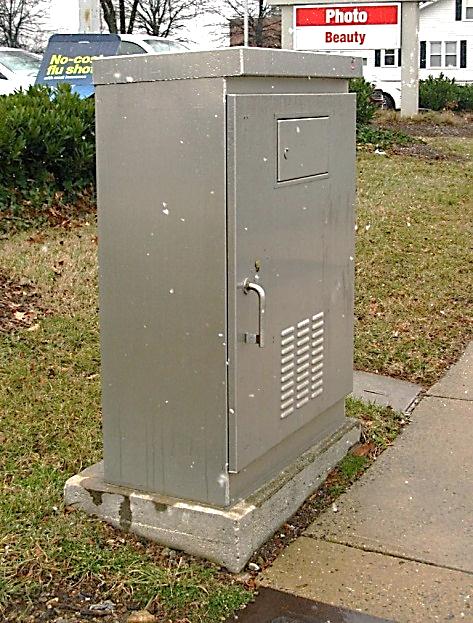
Wrap Alexandria’s Traffic Control Boxes
Deadline: February 6. Up to three artists or artist teams will be selected to design wraps for 12 traffic control boxes located at intersections along Duke Street in Alexandria. The wraps will cover all four sides and the top of each box. To develop their designs, artists are encouraged to use a variety of media, such as photography, painting, collage, digital imagery, etc. Selected artists will be required to submit their artwork in digital format. The City will be responsible for the printing and installation of the box wraps. More about the competition →
Virginia artists
Deadline: March 13 (early bird February 16). The Bay School Community Arts Center in Mathews, VA invites all adult Virginia artists to enter Art Speaks on the Bay 2015, a juried exhibit with $3,200 in prize money. More about “Art Speaks on the Bay” →
South Atlantic Juried Exhibit
Deadline: March 20. This exhibit will be at the Montpelier Center in Montpelier, VA. The South-Atlantic Juried Exhibition is open to all professional artists who reside in Maryland, West Virginia, Virginia, Washington, D.C., North Carolina, South Carolina, Georgia, and Florida. More about the exhibit →
“Red”
Deadline: March 30. Gallery Underground in Crystal City is asking artists to explore the color red for an exhibit opening April 27, juried by watercolorist Frank Eber. More about “Red” →
Philadelphia Craft Show
Deadline: April 1. The 39th Annual Philadelphia Museum of Art Craft Show, a juried exhibition and retail sale, will be held at the Pennsylvania Convention Center from November 12 to 15, 2015, with a Preview Party on November 11. The jury will accept 195 craft artists. More about the show →
Re-runs: the announcements below have appeared here before, but it’s not too late to apply!
Drawing & Print Competition
Deadline: January 31. The 26th National Drawing and Print Exhibition at Notre Dame of Maryland University: Drawings and prints (not photography) in any medium are eligible. All drawings and prints must be original works of art. Each artist may submit up to 3 works, online only. More about the competition →
2-D art
Deadline: February 12. Fresh Paint Magazine is looking for submissions from emerging and mid-career artists for our juried April 2015 Issue. Artists working in two dimensional fine art disciplines (except photography) are welcome to submit their work. Juror: Margaret Winslow. More about the magazine →
Bethesda Painting Awards
Deadline: February 13. The Bethesda Arts & Entertainment District invites eligible artists to enter the Bethesda Painting Awards. Artists must be 18 years of age or older and permanent, full-time residents of Maryland, Virginia or Washington, DC. More about the painting awards →
Lost & Found
Deadline: February 13. The Off-Rhode Gallery at Art Enables invites artists in the Washington, Virginia, Maryland area to participate in “Lost & Found,” a show featuring work created with found materials, or regarding items both lost and found. Off-Rhode Gallery at Art Enables is a gallery for self-taught and emerging artists however, this call is open to all artists working in all mediums (including photography) and preference will be given to self-taught artists. Read the call for artists →
Emulsion at East City Art
Deadline: February 15. This call for entry is open to all residents 18 years of age or over who reside or create art within 50 miles of East City Art’s headquarters located at 922 G Street SE. Artworks in all media are eligible; the theme is “Emulsion.” Download the prospectus (PDF) →
Emerging clay artists
Deadline: February 17. The May 2015 issue of Ceramics Monthly will feature the works of emerging clay artists. US and international clay artists who have been actively pursuing a career in ceramics for less than ten years are encouraged to apply. Read the rules (PDF) →
Art about first responders
Deadline: February 20. “Visions of Courage, Impressions of Service” at Lorton’s Workhouse Arts Center will express, through art, the values of the first responders and interpretations of police, fire and first responders from around the world. The exhibit coincides with the World Police and Fire Games in Fairfax. Entries are limited to 2-D art. More about the exhibit →
Paint Annapolis
Deadline: February 22. Paint Annapolis is a five-day juried plein air painting competition held June 8-14, 2015, that brings to Annapolis plein air painters from around the world. Artists are juried in to participate, and a judge awards prizes at the competition. More about Paint Annapolis →
Public sculpture proposals
Deadline: February 27. The Howard County Arts Council (HCAC) in Maryland is seeking up to 13 artists to participate in its Fourth Annual Juried Public Art Competition for a temporary outdoor exhibit from August 2015 – July 2016 . HCAC’s goal is to make art more accessible to the entire community by placing sculpture at sites throughout Howard County. Read the Request for Proposals (PDF) →
Richmond Gallery seeking proposals
Deadline: March 1. 1708 Gallery in Richmond, VA is currently accepting proposals for 2016 and 2017. National and international artists and curators are encouraged to submit proposals to exhibit work in all mediums (including but not limited to: video and film, new media, installation, sculpture, performance, painting and social practice). More about 1708 Gallery →
Hamiltonian Artists Fellowship
Deadline: March 2, 2015. The 8th annual open call to the Hamiltonian Artists Fellowship is now open. Advancing the professional development of emerging visual artists, the two-year program serves as a steppingstone for the next generation of contemporary artists in Washington, DC. More about the Hamiltonian Fellowship →
Torpedo Factory loading dock mural
Deadline: March 31. This is an open call for artists to design and execute a mural to cover the exterior of the Torpedo Factory Art Center loading dock. More about the mural →
Interactivity: Sight and Sound
Deadline: April 17. Sounds, music or voices seen as colors is referred to as synesthesia. Artists are invited to consider this concept and propose an exhibit of works that might connote or express it for an exhibit at Montgomery College. More about “Interactivity: Sight and Sound” →





 Wrap Alexandria’s Traffic Control Boxes