Welcome to Artful Weekend, our guide to fun and interesting ways to enjoy art in person or virtually.
This weekend: Bryan Sieling: Re|Context and the August Open Exhibit at the League; the 12th Annual Alexandria Sidewalk Sale; John Alexander Steele at Fred Schnider Gallery; and noted, mid-century D.C. artists at Pazo Fine Art.
August 2021 Open Exhibit
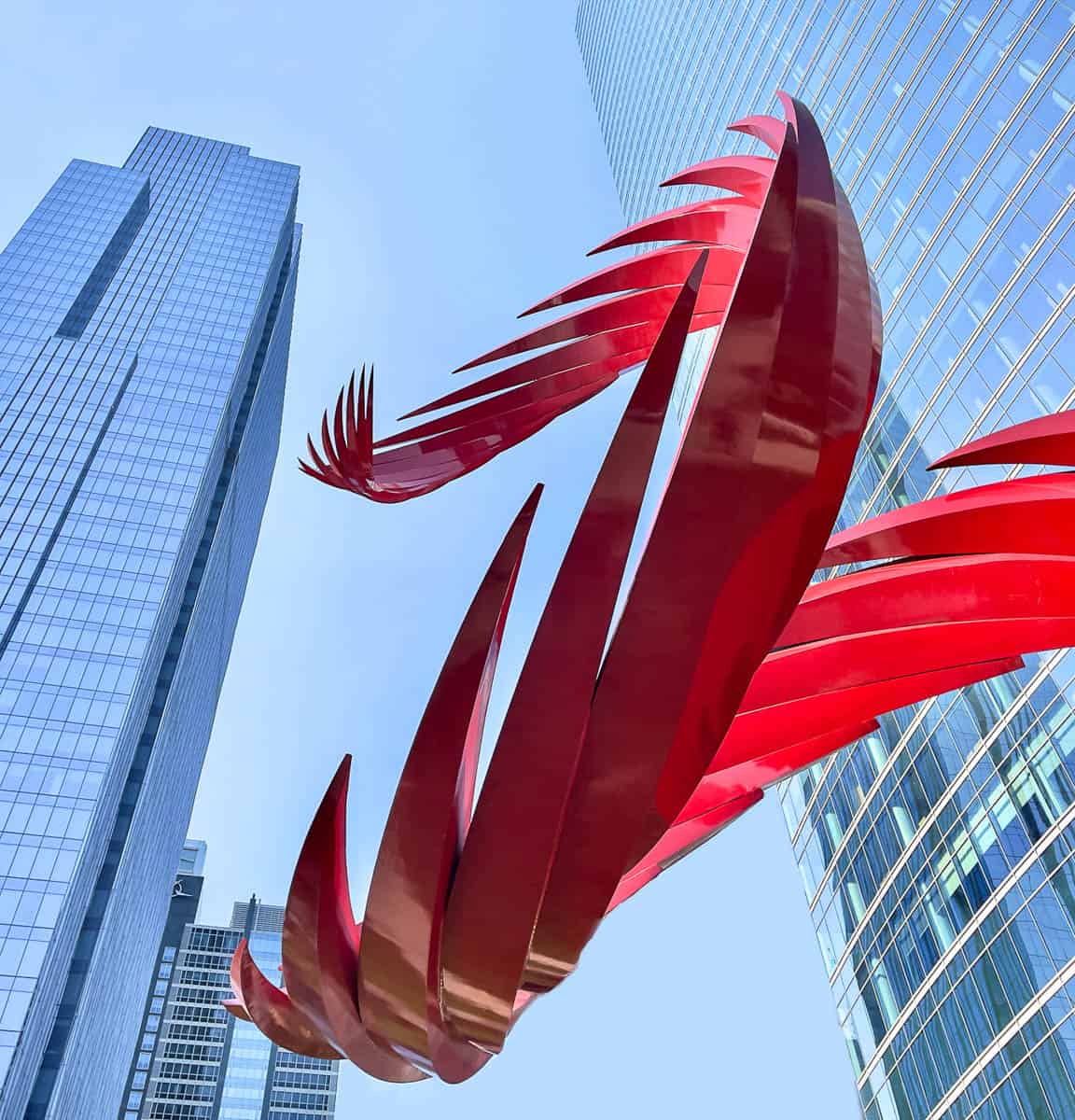
“Renewal,” by Ginya Truitt Nakata, is the August 2021 Open Exhibit Best-in-Show winner.
Our August Open Exhibit, juried by Eisner Award-winning author and former Library of Congress graphic arts curator Martha Kennedy, is now on view! Open exhibits are a great way to view the range of mediums and styles of our member artists.
This month’s show features some dynamic streetscapes, including Hidden Beauty, a photograph by Soohyun Kim that received an honorable mention; Chinatown, D.C., an oil painting by Sally V. Parker; Evening View of the City, an acrylic painting by Cecily Corcoran that also received honorable mention; and Baltimore Street, Cida Berry’s moody black-and-white photograph framed on vellum with gold leaf.
Portraiture is also prominent this month. They include The Wayfarer, an oil painting by Ann Wallace; Olivia, Edward Stolar’s red chalk drawing; Woman in Madina, a color photograph by Dian McDonald; and Lucy at the Beach, a gouache painting by Ralph Paine. See the entire exhibit in-person in the Gallery, through Sunday, September 5, or view it online.
Bryan Sieling: Re|Context
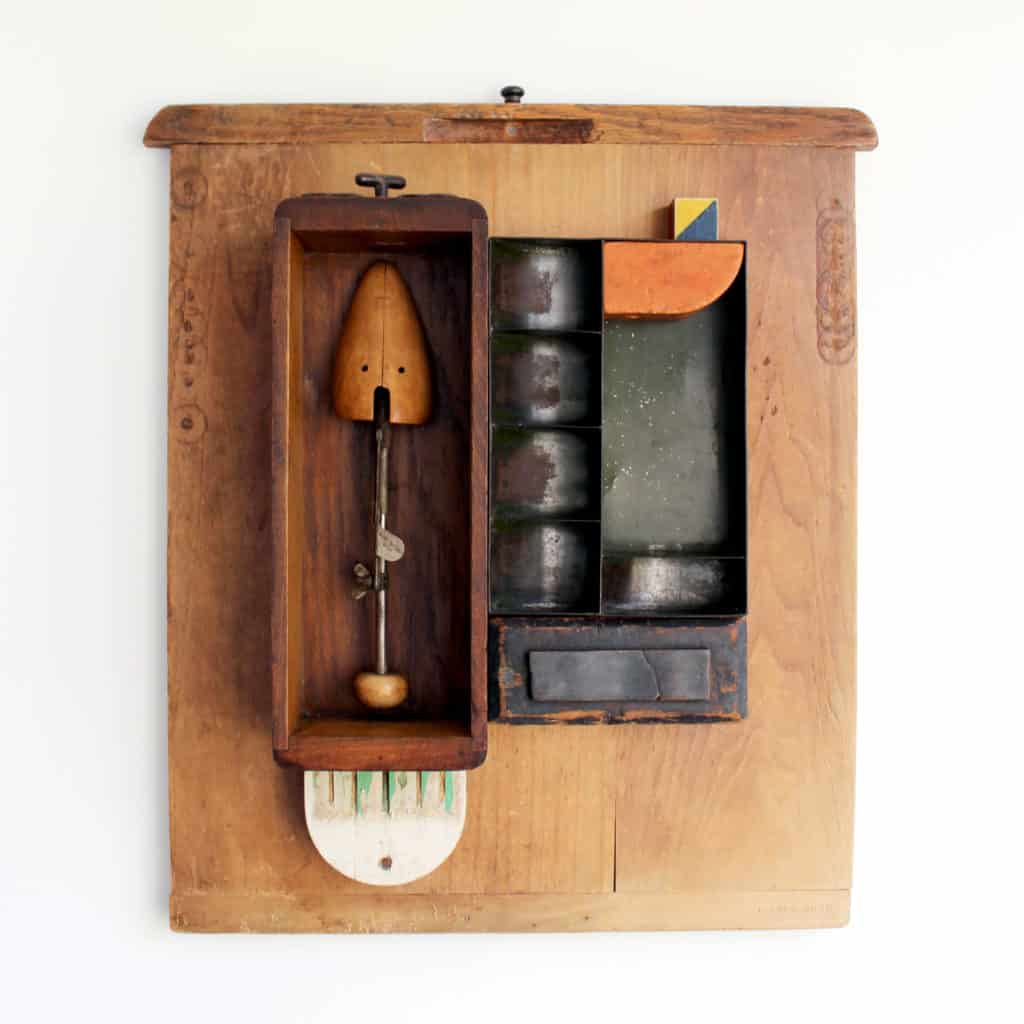
“Exact Change” by Bryan Sieling
Artist Bryan Sieling transforms found objects into wondrous works in Re|Context,his solo exhibit of assemblage art on view through September 5 at The Art League Gallery. Cabinet parts, old picture frames, tinker toys, mechanical innards, vintage game pieces, and used furniture are among the disparate materials Sieling used to create the sculptures, shadow boxes, wall reliefs, and what he terms “semi-functional furniture” on display. Says the artist, “I want viewers to be drawn in to study details, discover materials, and ponder possible motives and narratives.” He will be in conversation about his exhibit and artistry on Thursday, August 19 at 6:00 p.m. via Zoom; register here. Don’t miss our our article on Sieling here.
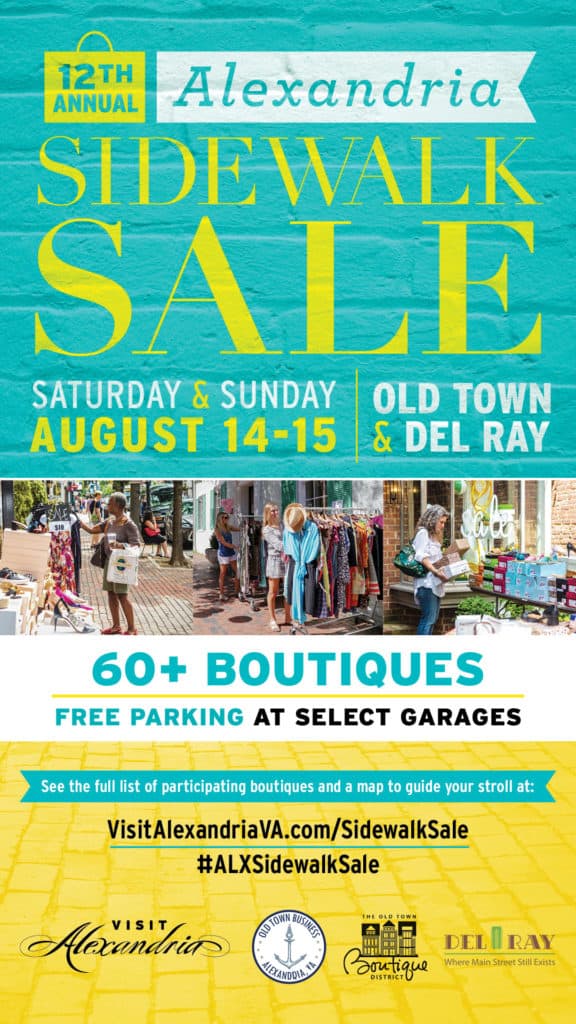
12th Annual Alexandria Sidewalk Sale
Join us at the Alexandria Summer Sidewalk Sale! We’ll be selling our popular ceramic ice cream bowls and small prints for sale. To sweeten the deal, each bowl purchase includes a certificate for a free ice cream from Kilwins (212 King Street), and a free cloth face mask while supplies last. Look for us under the window of the Hi-Tide Lounge at the Torpedo Factory arcade entrance at King and Union Sts.
John Alexander Steele: Chicago/Washington
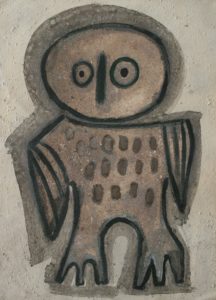
“Owl”( 1960) by John Alexander Steele. Ashes, Sand, Gouache on Paper. (Fred Schnider Gallery)
Chicago/Washington showcases the work of mid-century artist and premier art restorer, John Alexander Steele during two significant periods of artistic exploration: during his time at the Art Institute of Chicago where he created anthropological works of sculpture-like paintings inspired by the artist, Paul Klee, and the Washington Color School where he produced abstract studies of color and form; on view through August 21 at Fred Schnider Gallery, 888 N. Quincy Street, #102, Arlington, VA.
Colors of Confidence
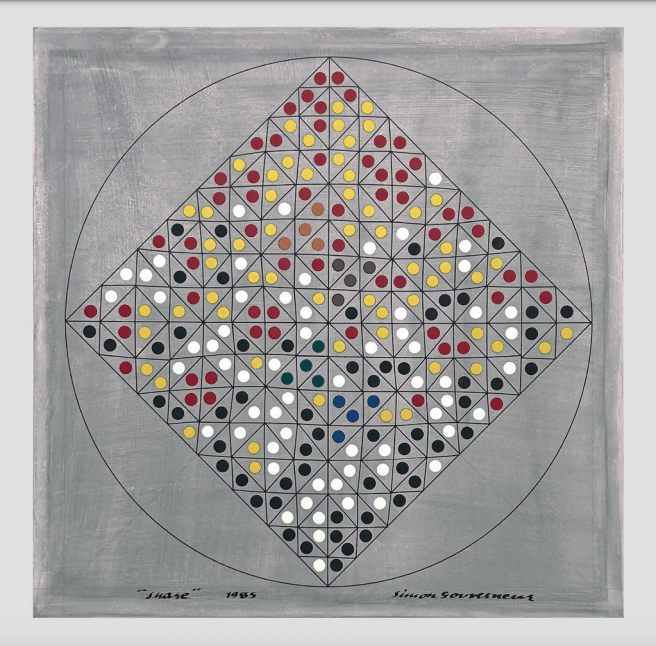
“Snare” by Simon Gouverneur; Egg tempera and acrylic and graphite on canvas
Color of Confidence presents a group of artists—Willem De Lopper, Thomas Downing, Tom Green, Simon Gouverneur, Jacob Kainen, Howard Mehring, Paul Reed, and Carroll Sockwell—who lived and worked in the Washington, D.C. area between the 1950s and the 1990s. Some are well known, others less so despite successful careers, yet they developed their art within the same parameters and constrictions of their time. This show presents offers a panoramic view of the artistic scene in the city around those decades, bringing back a vibrant and exciting time in this city in a new light; on view through August 22 at Pazo Fine Art, 4228 Howard Avenue, Kensington, MD.
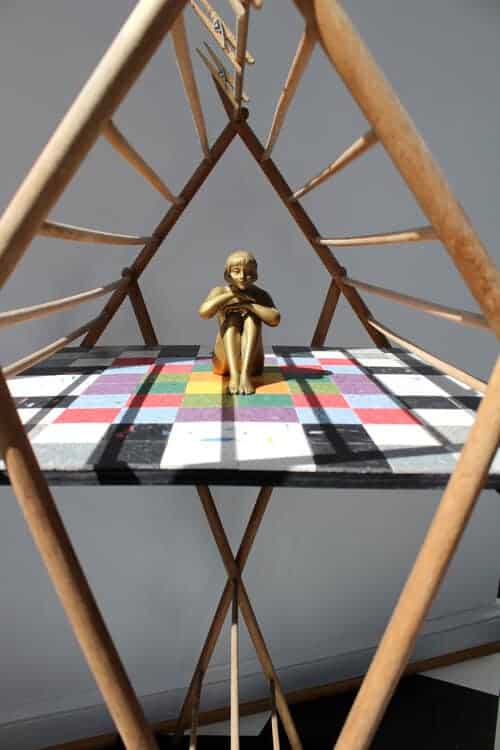
"Quarantine" by Bryan Sieling; Vintage folding clothes drying rack, wood clothespins, cast metal figure, linoleum tile samples, fabricated base.
Our August solo artist on assemblage,and collecting random objects for art sake.
By Julia Chance
As an artist whose medium is found objects, Bryan Sieling has trained his eye to imagine the possibilities. In his hands, cabinet parts, old picture frames, vintage tinker toys, mechanical innards, retro game pieces, and used furniture are transformed into assemblages where things familiar and odd are repurposed to fascinating effect.
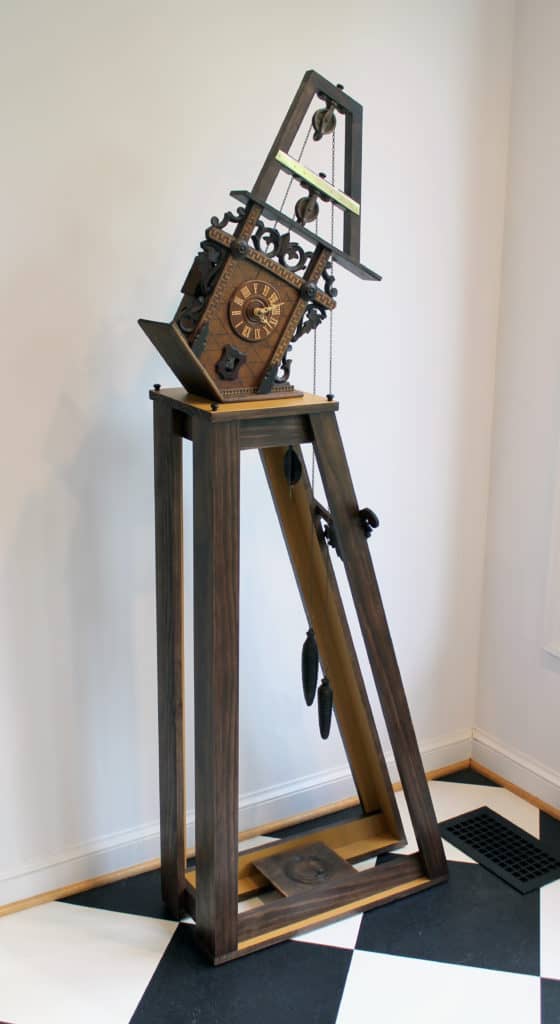
An ornately carved cuckoo clock, partially disassembled and festooned with metal pulleys, becomes a sculpture when angled upside down on a pedestal. A solitary seated toy figure placed on colorful linoleum that is sheltered by a wooden drying rack references the past year of quarantine. An assemblage consisting of a hi-hat cymbal, model airplane propeller, and vintage stocking stretchers appears poised for motion, by either flying or walking. These are among the 18 works in Re | Context, Sieling’s solo exhibit on view at The Art League Gallery through September 5.
“Time’s Up; Partially disassembled vintage cuckoo clock, metal pulleys, brass bar, wood finials, fabricated stand and pulley superstructure.
In order to master the art of assemblage it helps to first master the art of collecting. Sieling rarely passes up an antique mall or thrift store when he is out and about, and if he hears about an interesting yard or estate sale, he’s there. Having a network of friends and family who are familiar with his art style is bonus. “I will get random texts [from them] with photos of interesting things and I’ll respond with a thumbs up or down.”
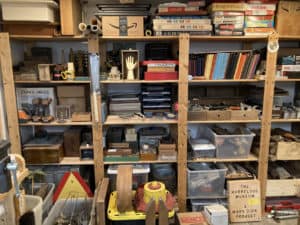
For him, spontaneity is key for finding good stuff. “I never hunt for a specific item. If something catches my eye and looks like it has potential, I’ll pick it up and file it away in my studio,” which he has done for 30-plus years. Just recently, “I’ve acquired a collection of foundry molds, a 1930s beveled glass oak kitchen cabinet, and a 1940s baby feeding table that I think will make a great shadow box.”
Sieling’s path to becoming an artist is unconventional. With few job prospects after earning a degree in Environmental Education from Ohio State University, he returned to his hometown of Portsmouth, Ohio, and discovered a new art museum had opened. “I walked in the door and my life and career were changed forever,” he recalls. “It immediately rekindled my childhood interest in art, and I was most interested in how exhibitions were organized, developed, designed, and installed.”
He volunteered at the museum for two years and was eventually offered a staff position. He then decided to formalize his newfound interest by earning an MA in Museum Studies from George Washington University. Since then, he has overseen exhibition design for the recently shuttered Newseum and most recently the National Museum of African American History and Culture from which he retired last fall. Those experiences have been helpful for his design-driven art practice.
The past year of quarantine, “has provided the luxury of time and a clearer head,” the Alexandria-based artist says, both undoubtedly beneficial in preparing Re | Context. Here, he reveals his strategy for collecting objects; explains why artists Joseph Cornell and Marcel Duchamp are such inspirations for him; and shares what he hopes viewers get from his assemblages.
Describe your artistry
I make assemblages with objects found in second-hand shops, estate sales, yard sales, and my neighbor’s trash.
What is your creative process like?
For each assemblage, I start with a single item. This is usually an empty box or drawer, an old wooden board or panel, or an interesting piece of old furniture. Then I begin the process of mining my 30-year collection of found objects, looking for pieces that work together physically and visually.
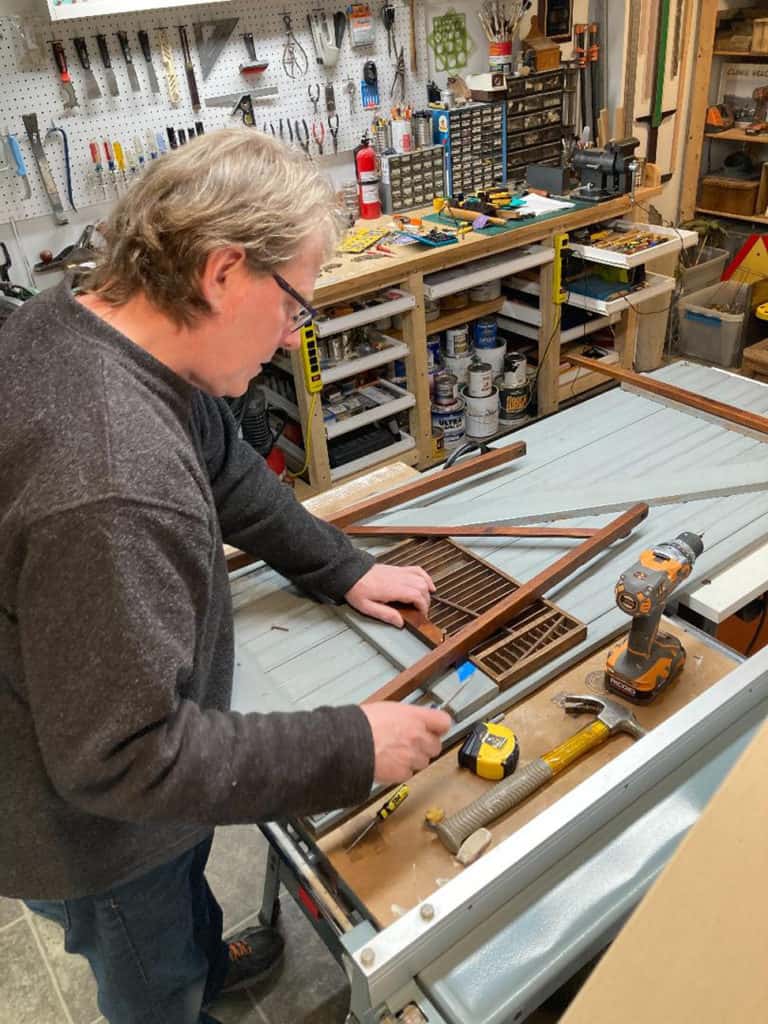
Bryan Sieling at work in his studio.
Do you make art every day?
I don’t make art every day. I often need to walk away from a piece in process and let it (and me) percolate about it for a day or two or more. If I have more than one piece in the works at the same time, I’ll set one aside and work on the other for a while.
Describe Re | Context.
Re | Context consists of 18 assemblages, rendered in the forms of free-standing sculpture, shadow boxes, wall reliefs, and what I call “semi-functional furniture.”
What are the questions or ideas that drive your artwork?
My work is not question or idea driven. It is object and design driven. A story or narrative may begin to emerge as I’m working on a piece, and if so, I will embrace and nurture that, but I let the objects speak for themselves and craft the aesthetics as I go.
What artists, contemporary or past, inspire you? Why?
Joseph Cornell and Marcel Duchamp. But let me back up to a time long before I discovered them as a young adult: My earliest recollection of artistic inspiration is not of an artist at all, but the cover art on my childhood set of Golden Book Encyclopedias. If you are old enough to remember these, you know that the cover of each volume is a wonderful, trompe-l’oeil-like arrangement of seemingly disparate objects contained within that volume: virtual assemblages in their own right. As a child, I was—and still a—mesmerized by these covers. I would study them for hours. I loved the 3-dimensional effect and the mysterious theatrical shadows cast by each object. I still have my original 16-volume set.
When I discovered Cornell’s work many years later, I was stopped in my tracks. His intriguing shadow boxes immediately rekindled my childhood memory of the encyclopedias. I felt the two were interconnected, like twins of different mothers. I was moved to begin collecting interesting and intriguing objects with the intent of making things with them when I had enough inventory (and time) to work with.
In addition to Cornell, I love the work of Marcel Duchamp. The whole idea of his “readymades,” where an off-the-shelf object is presented as art, makes me think and smile. It forces you to look at an object for its inherent qualities, rather than its mundane, manufactured purpose. I can’t help but think these influences somehow led me to pursue a career in museum work—exhibit design specifically—where I got to craft the public presentation of amazing objects for nearly 40 years.
What was the first piece of art you created that you were especially proud of?
It was probably a crayon drawing I did in elementary school of a rainstorm. I took the unusual step of drawing the rain drops first (long, white crayon lines to indicate a heavy downpour), then carefully coloring in the background around each raindrop with people, cars, and buildings. It won a blue ribbon in the school art show, and I still have it today.
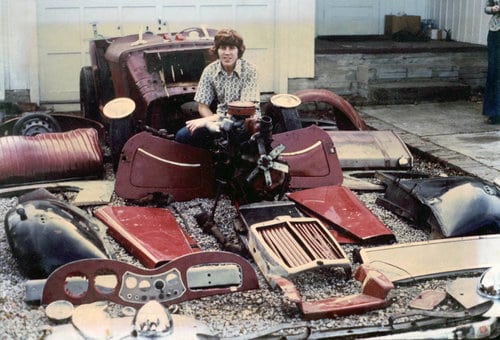
The artist at age 15 with his first assemblage.
When did you know that you were an artist?
I’ve been toying with art for as long as I can remember, but I never really considered myself an “artist” until recently when I started making assemblages full time. I was fairly good at drawing as a kid and got excused from class to create holiday-themed colored-chalk murals on the classroom chalk board (while my classmates continued studies in their seats!). So, everyone thought I was going to be an artist when I grew up. As I am wholly self-taught, I’m a bit shy about calling myself an artist—even today. I feel that term is more suitable for those with fine arts degrees who have paid their dues and earned the title.
What is something you have yet to achieve?
I’ve always wanted to do a grid or row of 16 shadow boxes inspired by my set of Golden Book Encyclopedias.
What do you hope viewers glean from Re | Context?
I hope viewers are drawn in, to study details, discover materials, and ponder possible motives and narratives and to just enjoy the intrigue or whimsy intended with each piece.
Bryan Sieling’s Top Three Creative Must-haves:
“A large inventory of objects to pick through as I work on a piece.”
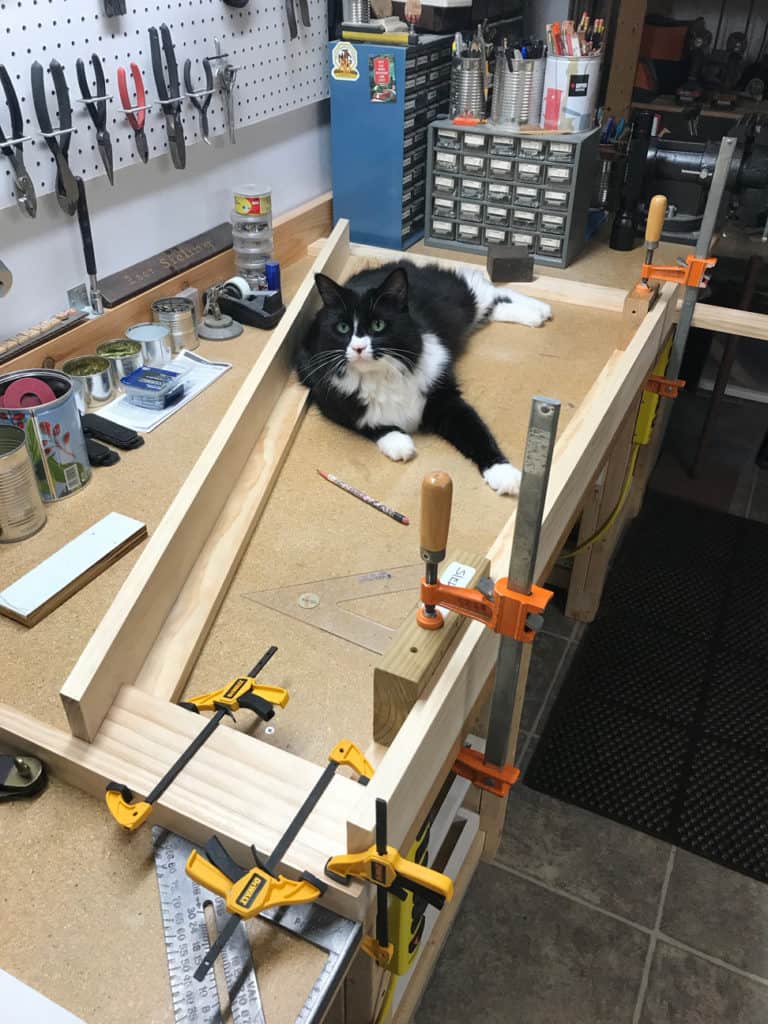
“Hanging out with my glorious bob-tail cat Gus while he watches me work (and sometimes gets in the way).”
“Listening to Radio Paradise while working in my studio.”