Welcome to Artful Weekend At Home, our guide to fun and interesting ways to enjoy and engage in art as you shelter-in-place.
This weekend: The League’s online bounty, Degas on your screen, artist ah-ha! moments, and more!
Art League Online Offerings
Drawing Animals, taught by Milena Spasic, is a family-friendly online art course.
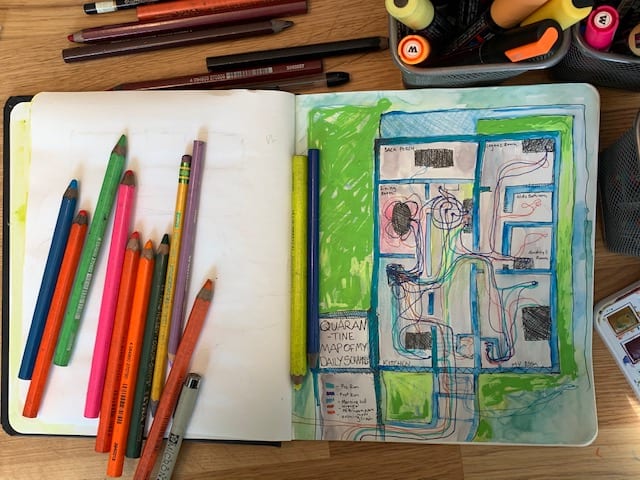
Spend some downtime this weekend checking out the cool things that we are doing online. To keep your creativity flowing, we now have online classes—drawing, painting, weaving, and more— that you can take from home. There is even a prompt for ordering the supplies you’ll need. Several of our instructors are creating short video demos in their areas of expertise. Here’s one by ceramics chair Blair Meerfeld. Stay tuned for more! Haven’t viewed our April Open Exhibit yet? You can see it in its entirety on our Flickr album. After you are done, read juror Dana Self’s comments about her award-winning picks, and Teresa Oaxaca’s explanation of her best-in-show painting. Stave off at-home boredom with fun and interesting art projects devised by our Creative Minds Squad. The latest one, Mapping Your Day, was created by gallery director Ali Wunder. Keep abreast of the latest open calls, fellowships and residencies on our weekly Artist Opportunities listing.
Artists at Work
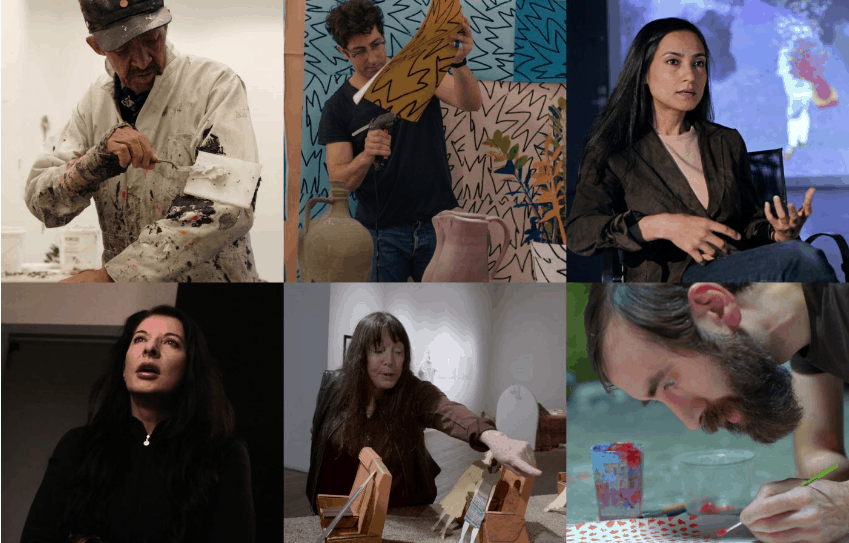
Jack Whitten, Daniel Gordon, Shahzia Sikander, Marina Abramović, and Eleanor Antin are featured in the six-series digital documentary “Artist Pivots.”
Art21’s digital documentaries reveal the working lives of today’s most innovative artists. Tune in for ArtistPivots, which captures the “big pivot” moments of six individual artists as they bounce between mediums, experiment with techniques, and introduce new approaches to their creative practices. Artist Pivots airs at 11:30, 3:30, and 7:30 Eastern Time daily on Art21.live through April 22.
Degas Virtually
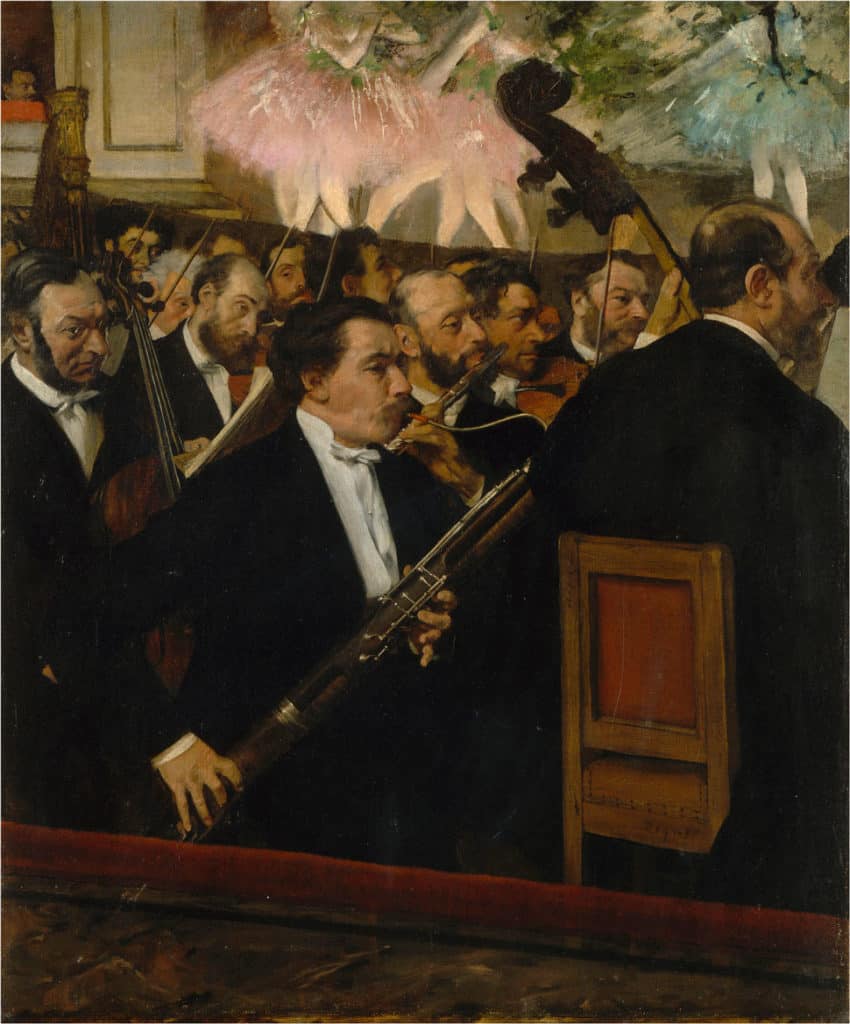
Edgar Degas, The Orchestra of the Opéra, 1870, oil on canvas, Musée d’Orsay, Paris
The much anticipated Degas at the Opera was open for less than two weeks before the National Gallery of Art closed. Fortunately, the museum has gathered a selection of opportunities to experience the first show dedicated to Edgar Degas’s fascination with the Opéra—its spaces, the music, and the people involved with the thriving theatrical life of 19th-century Paris. The online presentation includes research on the Gallery’s collection of works by Degas (the world’s third-largest), a video discussion with curator Kimberly Jones, and footage of the exhibit captured on the last day the Gallery was open.
An Artist Rediscovered
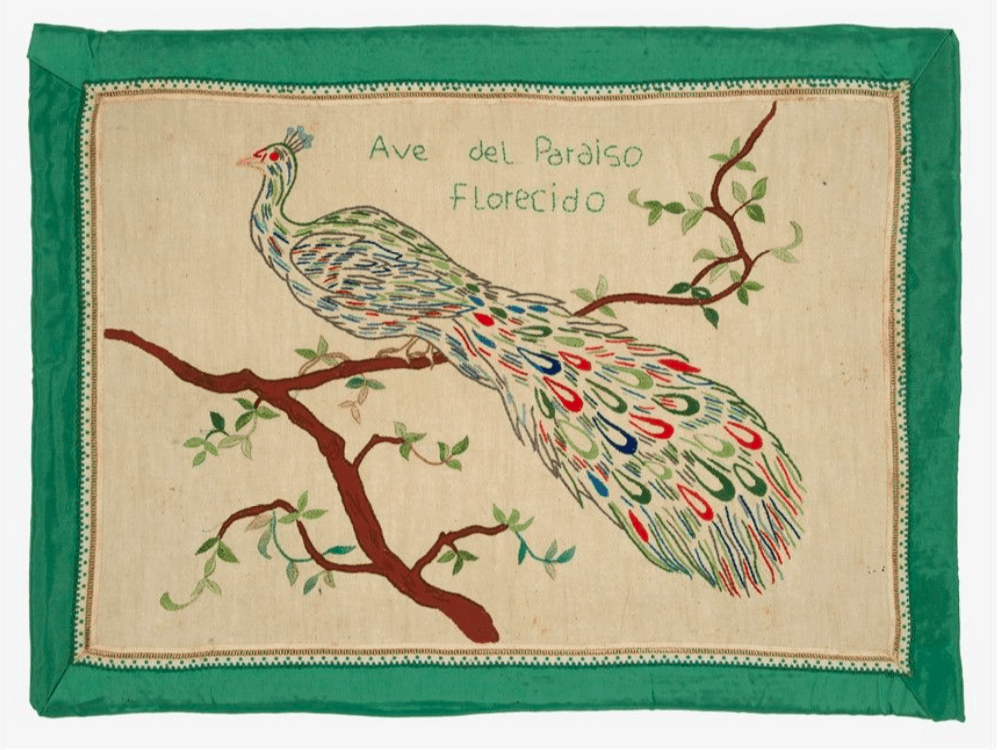
“Ave de paraiso florecido (Flowering bird of paradise)” by Feliciano Centurión
The colorful works of the late Paraguayan textile artist Feliciano Centurión have been largely overlooked until recently. He created textile works engaging with folk art and queer aesthetics in 1990s South America. Through the embroidery and painting of vernacular objects such as blankets and aprons, Centurión rendered poetic readings of his youth in the tropics, his love experiences in the metropolis, and his spiritual reflections before his untimely death of AIDS-related illness in 1996. See Abrigo, the first U.S. solo exhibition of his work, on virtual display at Americas Society.
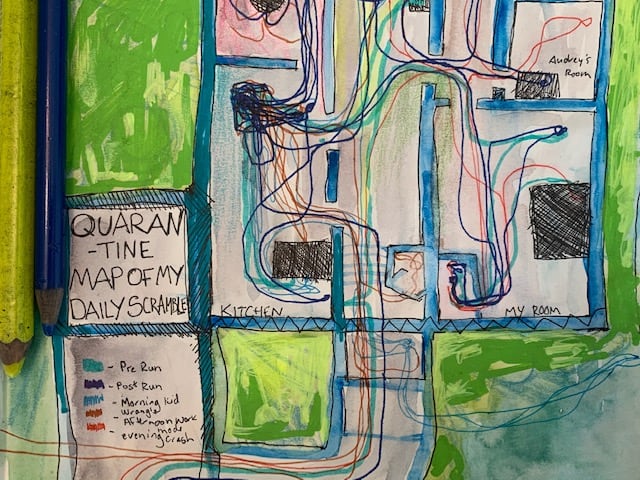
This creative exercise is all about mapping. Not maps in the conventional sense, but a map of your day to day experience in a time when there is no clear path to normal.
What would a map of your daily movements look like now that you are confined to one place? Do you find yourself moving more, or less? This exercise is a process oriented visualization of how you, and your family members move around your space.
Materials:
Sketchbook or blank sheets of paper
Favorite drawing or painting materials
A ruler (or not)
Draw a blueprint style schematic of your home, or where you are sheltered, including any outside spaces you have access to on a daily basis.
Select a different color for every person and or animal living in your space.
Create a key that displays the colors designated to each person.
Start with yourself at the beginning of your day and draw a continuous line that represents the path you make in, and around your space each day.
Continue by adding the other members of your household, overlapping lines and colors. Or you could draw your path over the course of a week, with a different color representing each day.
Ali’s completed map
I ended up choosing different colors to represent parts of my day. I find that my time is very compartmentalized now. My mornings are full of kid-centered activities and my afternoons are a flurry of work tasks and domestic chores. This exercise could potentially be the start of an abstract painting, or just a way to reflect on your day.
And while we’re on the subject of maps…
Here are some inspiring, unconventional maps that other artist are making:
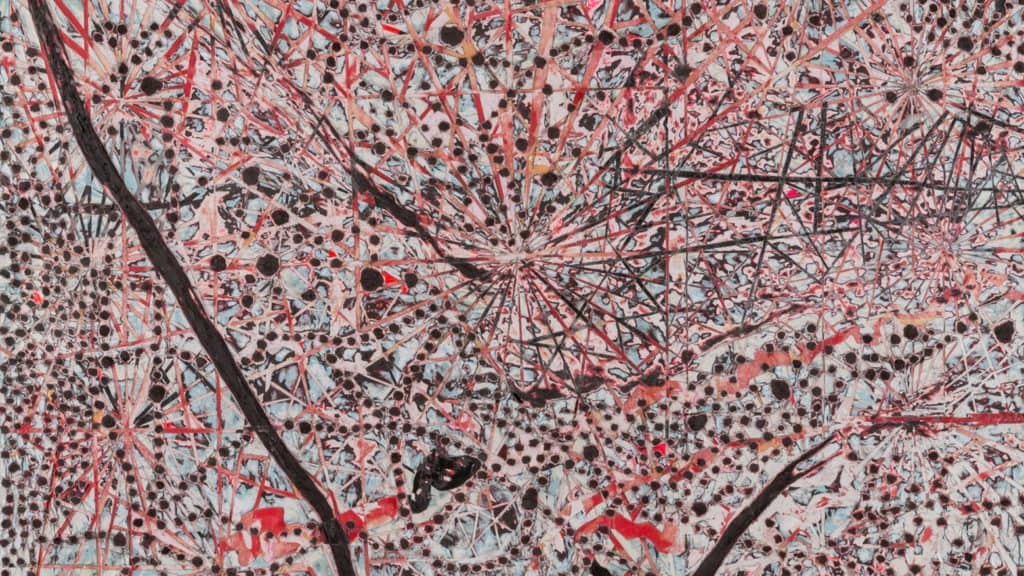
Mark Bradford
“Scorched Earth”
Mark Bradford creates lush abstract paintings that closely resemble maps of his hometown Los Angeles. Bradford constructs his works from signage and other materials found in his old neighborhood that create a physical manifestation of his memories of the place.
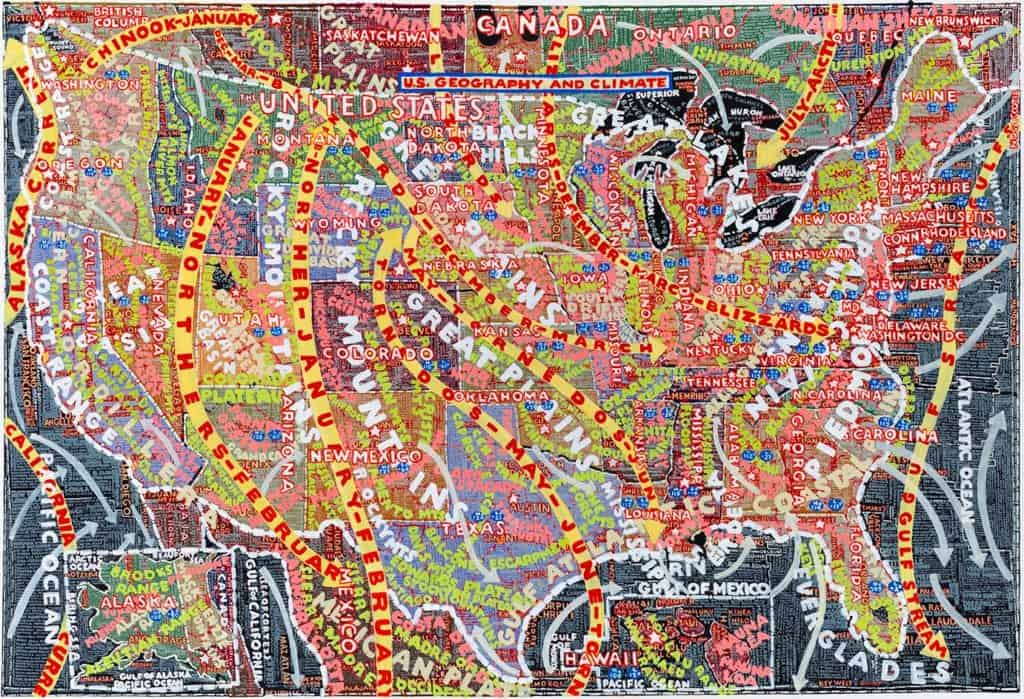
Paula Scher
“US Geography and Climate”
Renowned graphic designer Paula Scher has a series of painted maps that synthesize large bodies of information. In one she creates a map of the united states made entirely of the median home prices of each area and in another, counties and zip codes. She uses text and other typographic elements to construct these massive maps, each giving a different informational lens through which to view the country.
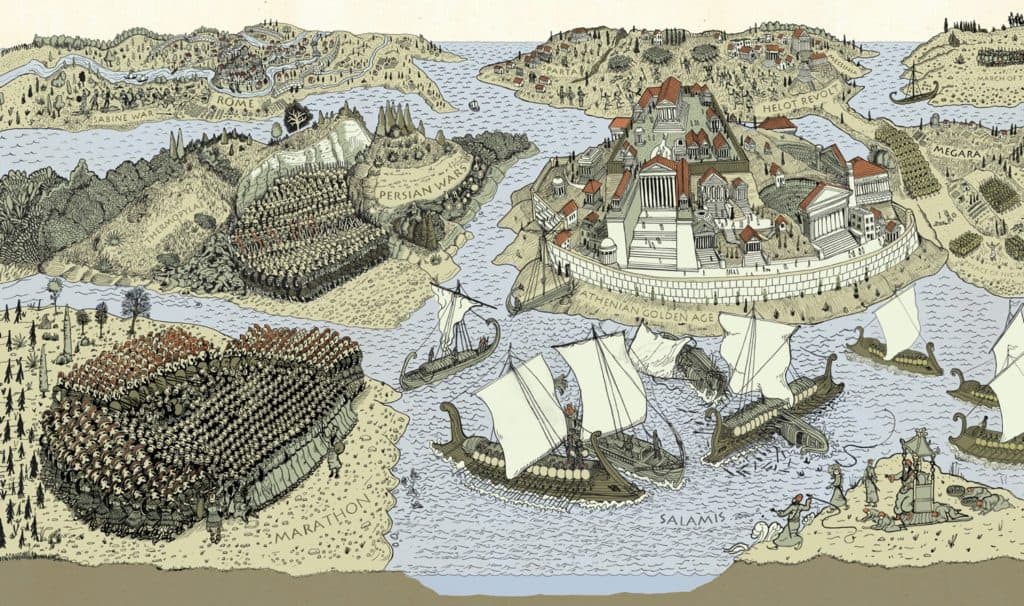
Chris Bonnell
“Persian War Map”
Finally, our very own Chris Bonnell, who teaches illustration at the League School, makes fascinating illustrated maps that plot out historical events.
Dana Self’s love of the arts has led her to careers where she promotes them in some form or fashion. Currently, she directs marketing at the esteemed University of Missouri-Kansas City Conservatory. Before that she spent over a decade as a contemporary art museum curator at the Kemper Museum in Kansas City, Missouri, where she resides, as well as museums in Wisconsin, Kansas, and Tennessee.
During her stint as a curator she organized about 100 exhibitions of emerging and mid-career artists. “Just working with art, and finding out what artists are thinking and talking about, whether it’s commentary on a general zeitgeist or a commentary on something internal that they are struggling with, is my passion,” Self says. Writing about art is another passion. She’s been a critic for the weekly alternative newspaper The Pitch, a reviewer for The Kansas City Star, and now covers art for KC Studio magazine.
Self says when she received artwork for the April Open Exhibit, “I thought, ‘Wow! There are a lot of submissions.’ There was good work in all media, so it was hard to narrow down.” In addition to Journey of Life, her best-in-show pick by painter Teresa Oaxaca, she selected ten works for honorable mentions. She spoke with blog editor Julia Chance about curating, writing, art in the time of corona, and what delighted her about April’s show.
The Art League: You were a museum curator for a number of years. What did you enjoy about it?
DS: I was a museum curator for about 15 years in contemporary institutions for the most part. I just love the process of working with living artists—getting to sit and talk to them and organize an exhibition of their work, then interpreting that work for the museum audience.
TAL: And now you write about art. What’s that like?
Dana Self: I love to think about what artists are trying to communicate and how whatever media they’re using and whatever message that they are trying to convey resonates with me and the greater culture.
TAL: Is there a particular art topic that you consider your specialty?
DS: What interests me most are artists who deal with, identity—their own identity, cultural identity, any kind of identity. How that is understood, how it’s interpreted, how people interpret an artist’s own self-identity has always fascinated me.
TAL: It is still early, but are you noticing any emerging art trends during this period of social distancing?
DS: I have noticed more positive imagery on a couple blogs that I follow. I don’t know if I can identify that as a trend. Maybe that’s just the people I pay attention to.
TAL: Do you think that this period will change or affect how we engage with art?
DS: I don’t know. I worry about lots of things with regard to the economy, but if we’re solely talking about art, I certainly worry about how any kind of arts institution is going to be able to go forward unless they’re an arts institution with a giant endowment, but we’re not talking about those. We’re talking about smaller museums, smaller galleries, smaller nonprofit arts spaces. How are they going to survive this economic problem created by this virus and how are the artists going to carry on? The main goal is to survive economically and physically, and then [figure out] how you move forward. I don’t know if everything will be different. I can’t help but think it will be, but how it’s going to be different is a big question.
TAL: What did you think about the artwork submitted for the April Open Exhibit?
DS: My general impression was that people were doing really good work. There was a lot of really passionate landscape that I enjoyed. I was really blown away by people’s watercolor skills. Watercolor is not easy. There was a lot of good in all media. Overall, the quality was quite high and that made me happy.
My process was just going through all of [the submissions] many, many, many times and thinking about media. I wanted to make sure that I was inclusive of three dimensional objects and try to get a good representation of all the various media because nobody wants to come in and see all [of one kind of medium]. You want a really holistic, well-rounded representation across the field.
TAL: What should artists be mindful of when submitting their work for exhibition?
DS: The main thing is make sure that you have excellent photography. You don’t have to hire a professional photographer because most people can’t afford that. But make sure you have taken excellent photos of your work, that you’ve cropped them nicely, that the lighting is good, the colors are as true as they can be, and images are crisp and not blurry at all. Be very careful about how you submit your images because people like me are just looking at photos on our screens and if they’re not good then that makes a difference.
Aside from that, keep working at your craft and keep the faith. It sounds cliché, but it is important for everybody to keep working at what they love and submitting their work to shows everywhere that they can.
Best-in-Show Award winner Journey of Life by Teresa Oaxaca
“This painting is very unusual and has a level of wild imagination that really struck me. She packed so much in to it, so much imagery that didn’t seem to be there just randomly. It is very deliberate. I like what she has said about her painting. I thought, wow, there’s something extra going on here, and that’s what made it extra special for me.”
Honorable Mentions:
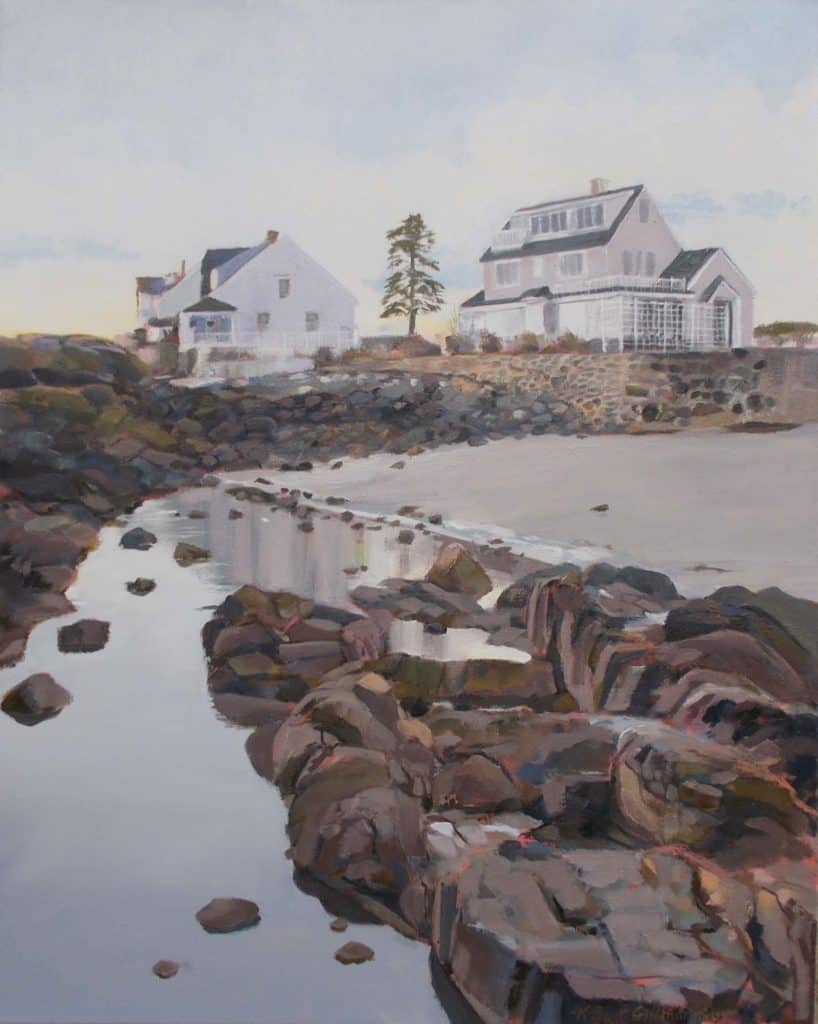
Tidal Reflections by Kathleen Best Gillman
“I love the perspective. I thought the color was really good and I thought it was really well executed. It has an emotional moodiness that I responded to.”
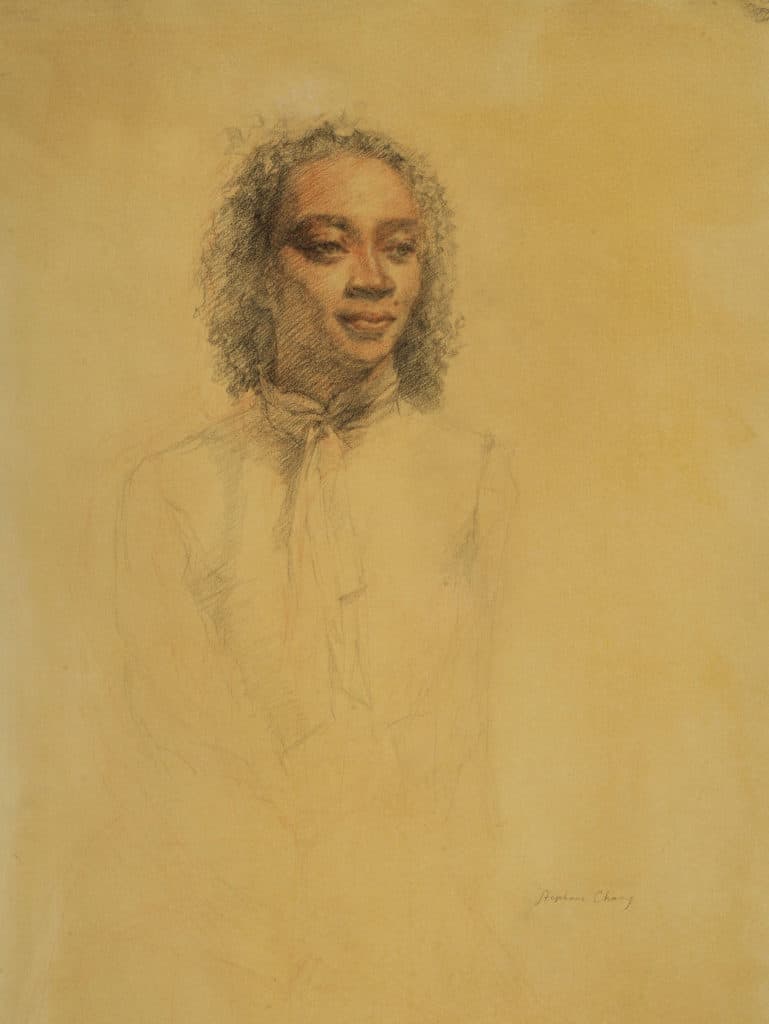
Gazelle by Stephanie Chang
“I have always loved drawing, and you don’t see a lot of just straight up drawing. This is really sophisticated and beautiful, and I loved the way she did the face and how the rest of the body just sort of faded away but it’s still there.”
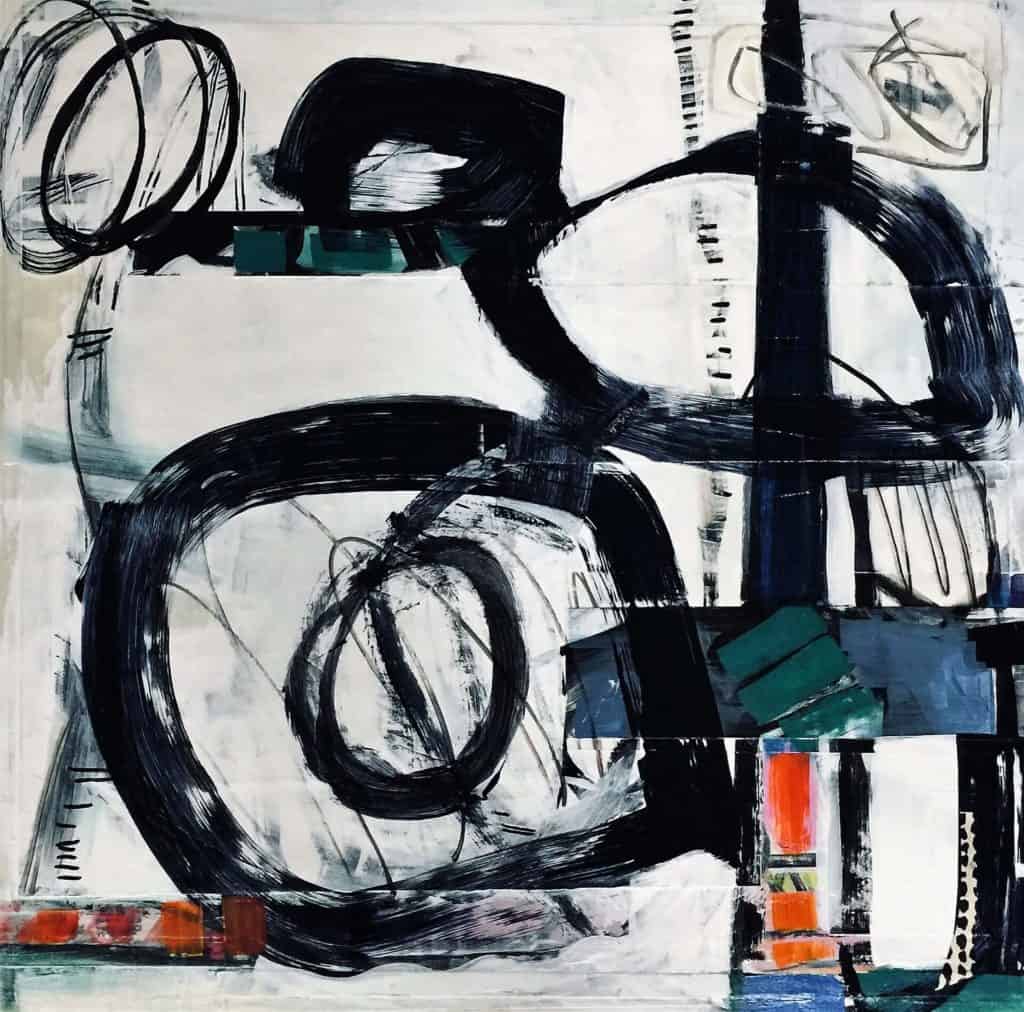
Round-About by Octavia Frazier
“I love the dynamic quality of this painting. It’s very strong. The composition is really exciting to me, and I like the color palette too.”
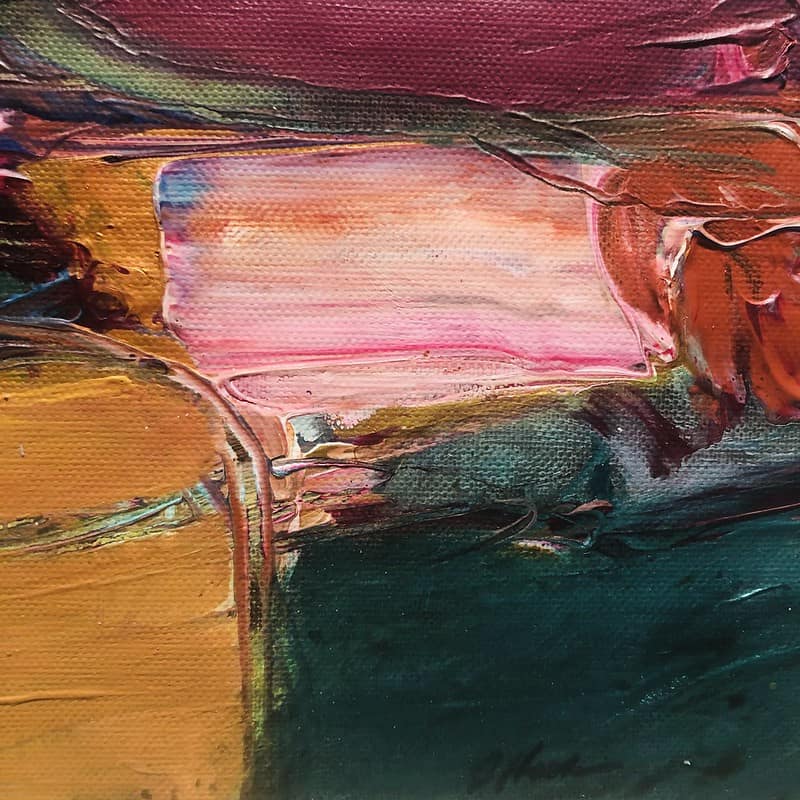
Blue Corner by Janet Hakeen
“This also has a very strong composition. I love the snappy little size, a giant abstraction on a small scale. It’s only 12″ by 12.” That’s what attracted me to it, and that little blue corner. That was clever.”
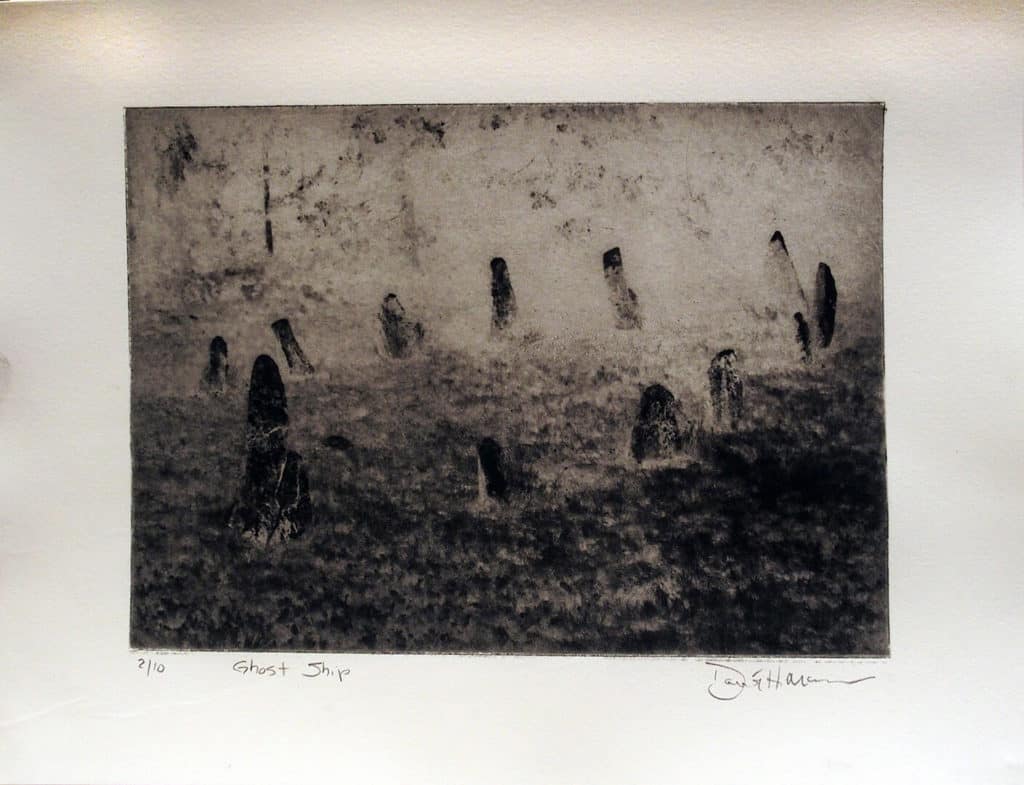
Ghost Ship by Dave Mann
“It’s print making, which I never see enough of. It’s an intaglio etching, so I liked that because I think it’s really well done, and it had an interesting story to it. There is something very haunting about it.”
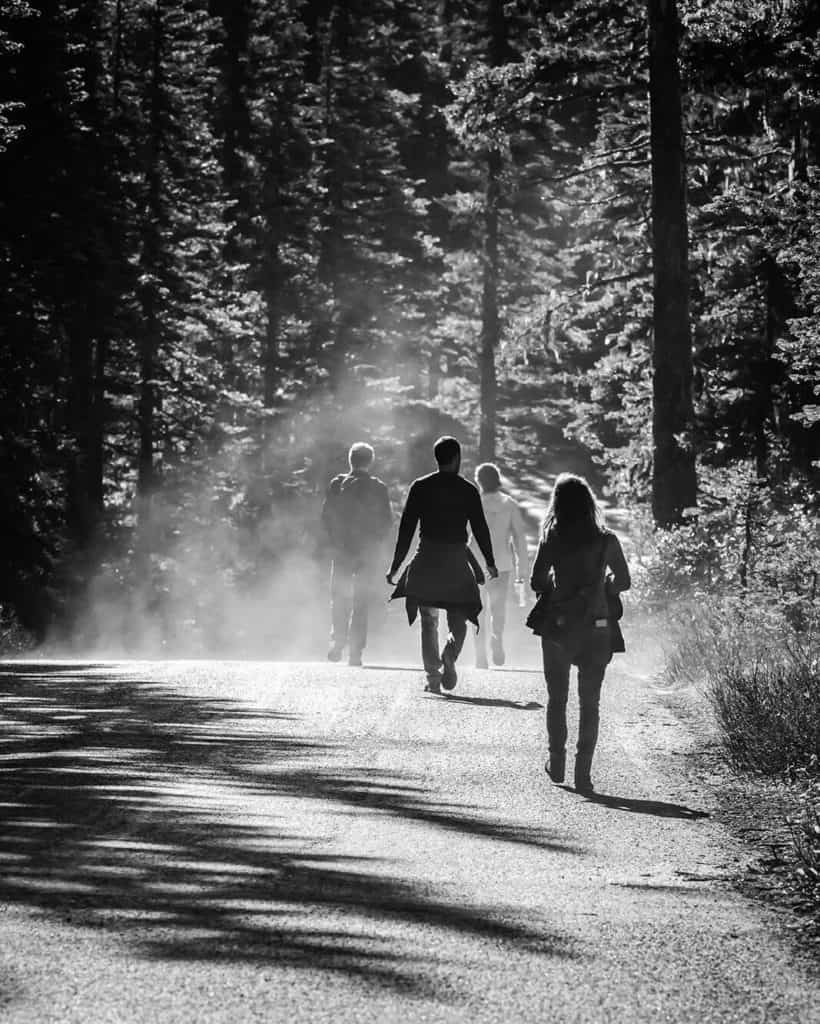
Here and Always by Marta Nammack
Though Nammack described what was happening, just looking at it you don’t know what’s happening. You can only guess at what’s happening. I found that really intriguing because it could be something really good or it could be something kind of frightening. I like the way that the triangle of light goes across the top third of the image and the darkness behind the trees.
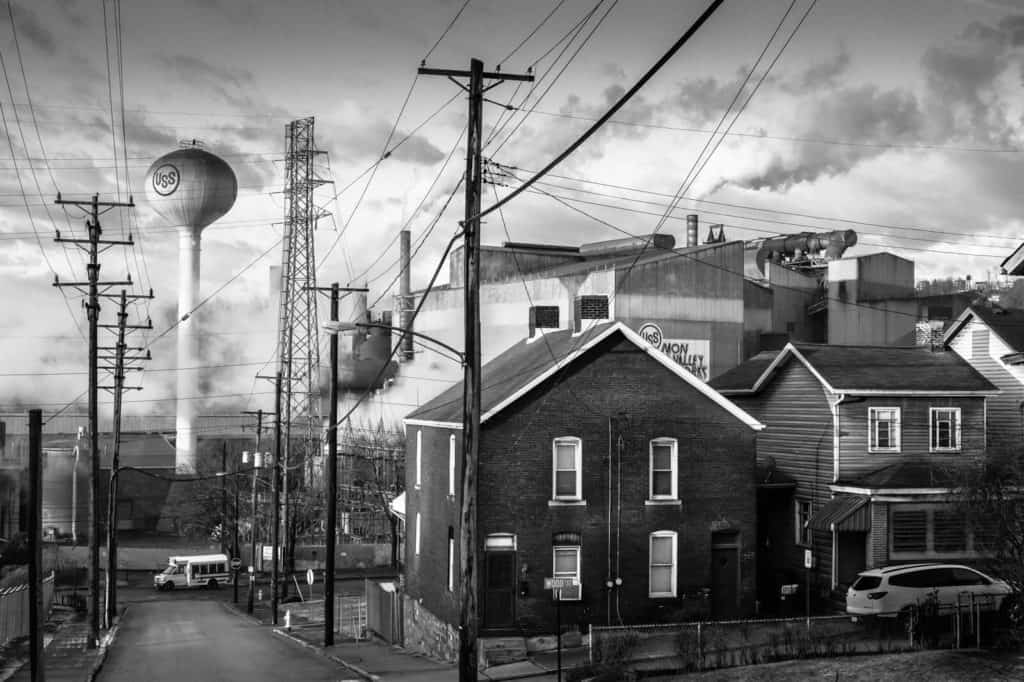
Steel Town by Craig Nedrow
“If you know anything about steel in this country, you already know part of this story. You can just feel the grittiness of the whole scene, and then apply what you know about steel in this country to it, and it tells a very interesting story. I love the color palette, the black and white and the power lines.”
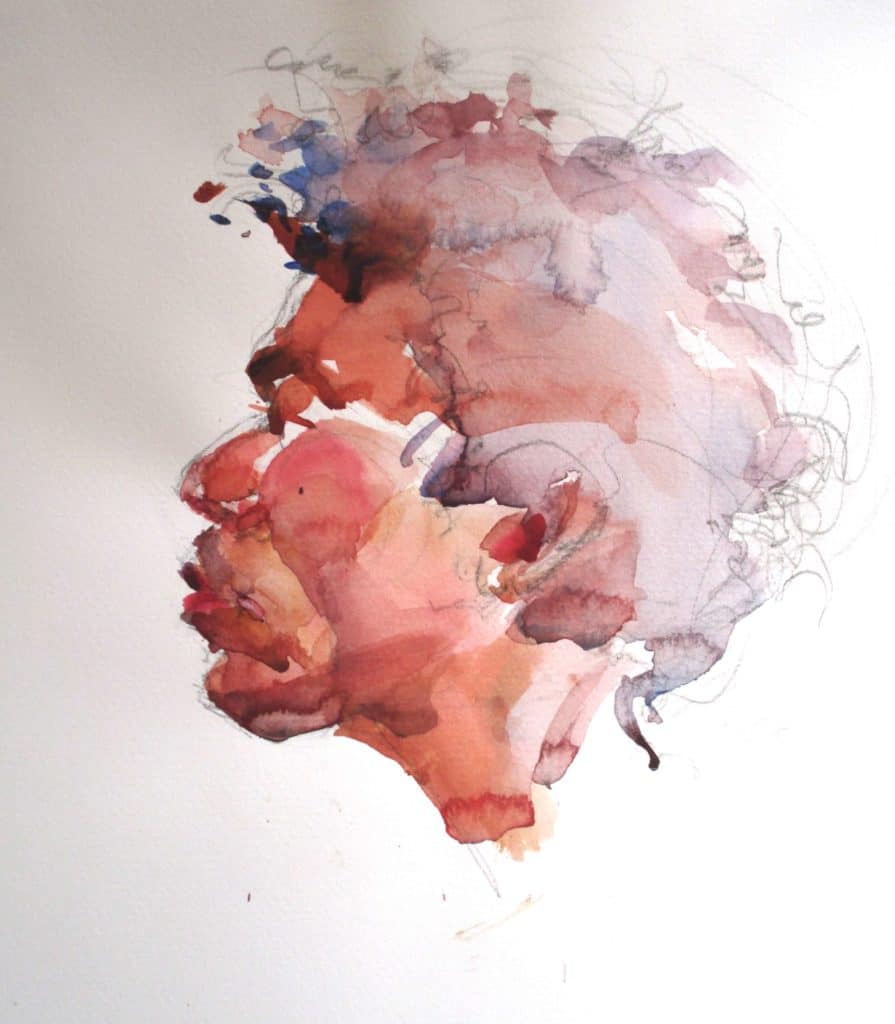
Desi by Jacqueline Saunders
“Portraits are hard to do. I love that with a few of these minimal strokes of watery paint and some pencil or charcoal, the artist completely shows me who this person is.”
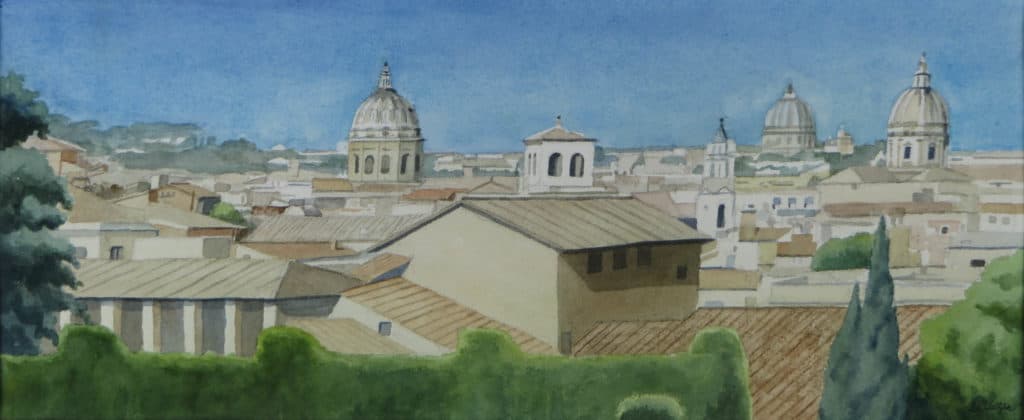
Roofs of Rome Florence Setzer
“Here’s another watercolor, but very controlled, completely the opposite [of the previous one]. It is a very good drawing and the control that Setzer has with her watercolor and the whole composition is very pleasing. Obviously she loves Rome. It’s a like a little love letter.”
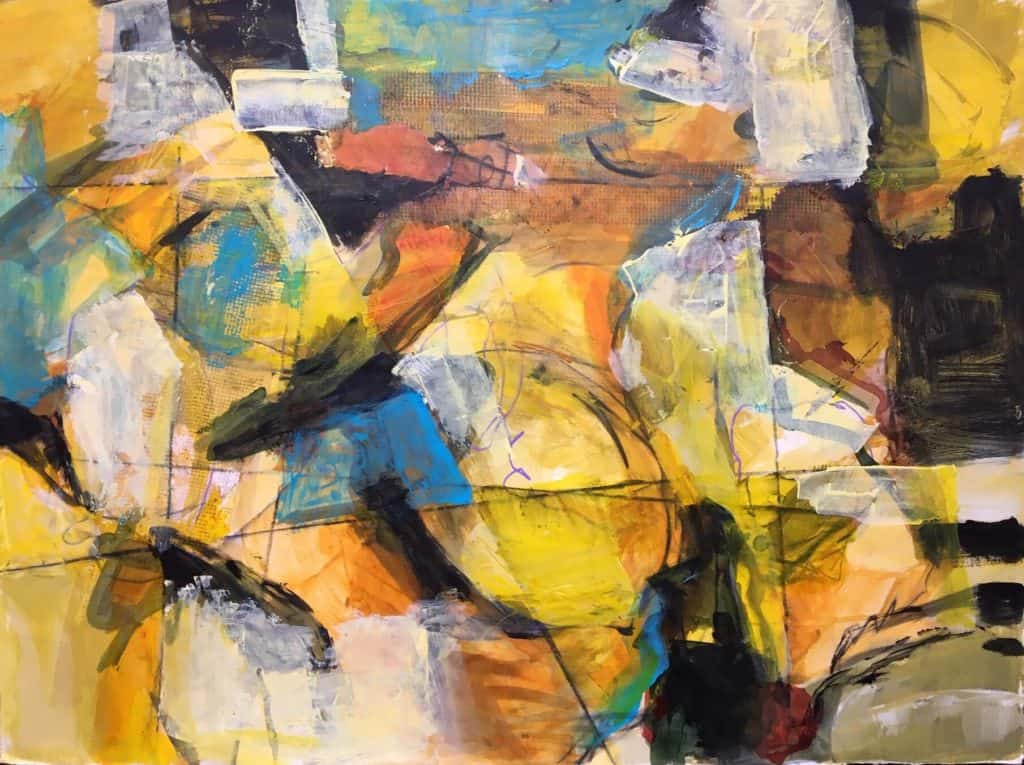
Moving Forward by Jan Sherfy
“Excellent composition. I love the colors and the detail in this work. I love there’s a whole lot of different textures. I think Sherfy really nailed it.”