The Majestic Cafe on King Street is offering a special deal with ACT for Alexandria: discounted meals and donations to Alexandria nonprofits (including The Art League)!
Sunday through Thursday, mention ‘ACT’ at the Majestic Cafe for:
a free appetizer
5% off your bill
5% of your total purchase goes to the Majestic Cafe Grant Fund for local nonprofits
You can also enter to win a $100 gift card for yourself and $500 for your favorite nonprofit.
Every so often, we like to share some of what we’re enjoying on the Internet. Recently we’ve been fascinated by some different takes on art history: reassessing authorship, peeking at old filmstrips, making paint by hand. Dive in and click away!
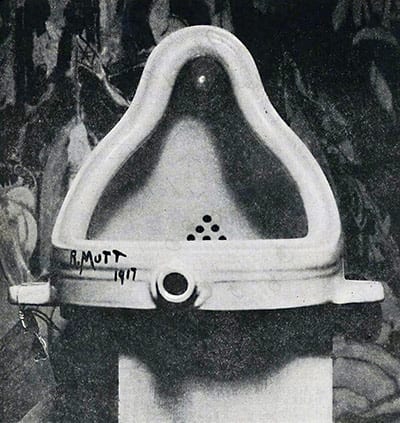
And hey — for those of you who enter our monthly shows, this is a good reminder that this important piece of modern art was rejected from the show it was submitted to.
Every once in a while, we’re contacted by someone who wants help identifying an unknown piece of art they’ve inherited or found someplace. For an expert guide to the process, you can use this guide from the Smithsonian American Art Museum.
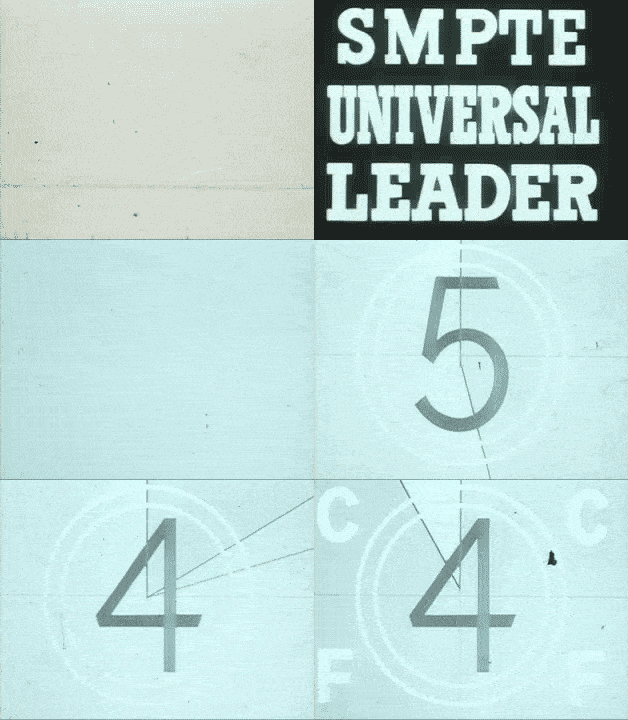
They lived so long ago that we tend to forget they were real people — but not so long ago that they weren’t captured on film. Renoir, Degas, Rodin, and Monet are all featured in these 100-year-old clips by Sacha Guitry, which show them at work and at leisure in their homes and around town.
What’s more fun than satirizing the art world? Parodying the classic Ladybird children’s books. We Go to the Gallery combines both in a fun little book that’s on its way to the United States.
‘Artomatic 2015 is a six-week long art festival in Prince George’s County, MD, right by the New Carrollton Metro Station that is “by artists, for everyone.” It is absolutely free to the public. This year’s event features more than 700 artists: Visual art, music, performance, film, and more. Workshops, tours, seminars and other events are held throughout the duration of the show.’
Find out how to participate by taking a look at the Registration Guide. If you’re not familiar with Artomatic, you can see some images from the 2012 show here.
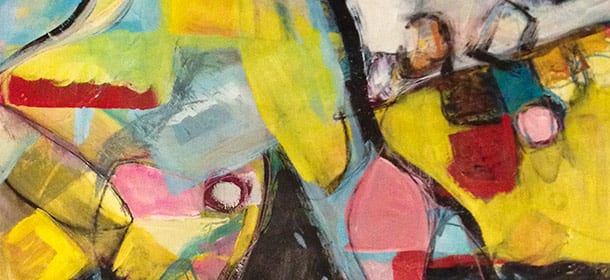
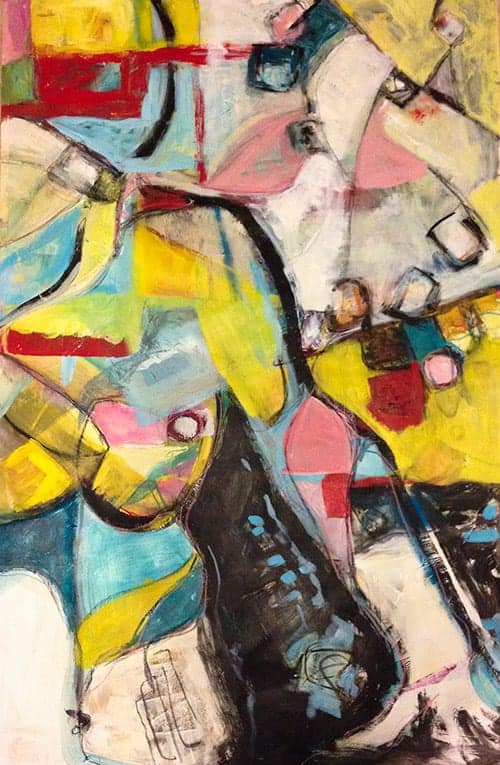
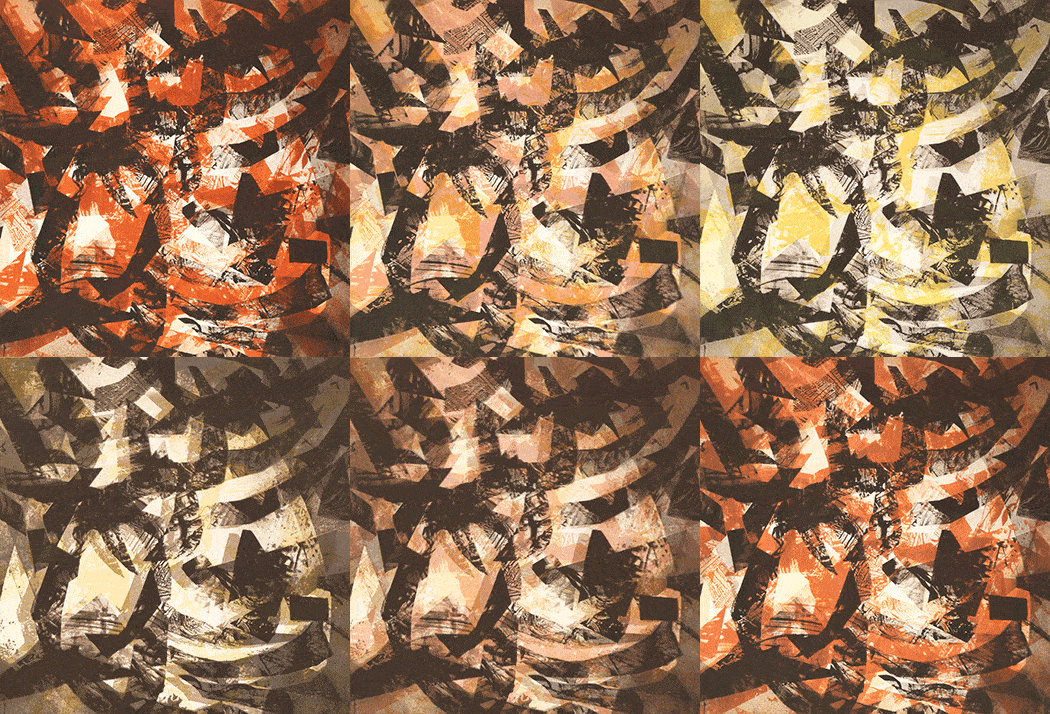
A “circus” of color, a “flurry” of paint — Ann Pickett’s latest painting to be accepted to an Art League show seems ready to jump off the wall.
That energy and flow caught the eye of juror Erin Devine, who awarded Tumbling Down the Shayna Heisman Simkin Award for Best in Show. The artist, a graphic designer by day, told us more about this piece and how she works:
How would you describe Tumbling Down?
Ann Pickett: Tumbling Down depicts a figure that appears among the shapes and forms on the paper. This figure seemed to spill out onto the paper, landing solidly on a heavy ground. Tumbling Down is light and circus-like, yet contains a greater metaphor: in life, you find yourself juggling many pieces, but will always find a place to land.
How do you start a painting and how do you end one?
Usually, I choose a few colors and start painting in a flurry. I like to put a lot on my canvas or paper all at once, bold expressive strokes, color, and line, before I really take in what is there. I work very quickly and intuitively, reacting to each stroke as it speaks to me. I paint layer after layer, rotating my canvas, hiding or exposing what is underneath in order to create depth and light.
My palette evolves with my painting; I tend to like lots of colors, and end up having to restrain myself. I always paint from something: landscape, figure, still life. I’m rarely sure when I am done with a painting, but I am very aware when I’m done painting. I usually sit with my painting for days or weeks before I decide if I like it, hate it, or am ready to go at it again.
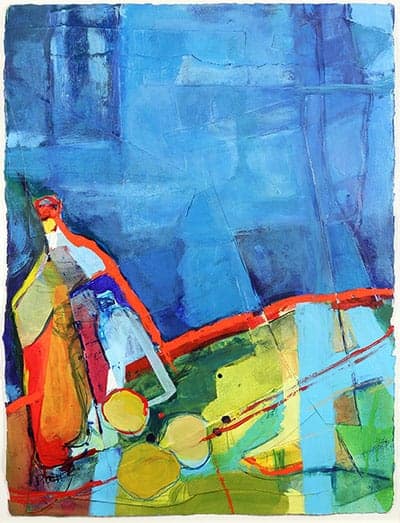
Still Life Abstracted by Ann Pickett (from the April 2015 All-Media Exhibit)
Do you listen to music while you work?
While I love music, I find that I only paint while listening to music on certain, rare occasions. When I am warming up or playing with paint, listening to something lively to move my brush to can help me get going, but I find that when I am really into a painting, I am so tuned in to what I am doing that music can be distracting.
Why do you paint?
I paint because I love to paint, to express myself in bold colors. Line and form just resonate with me, it feels good and right. I am a graphic designer by day, but painting allows me to let my artistic energy loose, to be brave and bold; it is just fun and freeing. I love the rush that moves through me when I am moving the brush and things begin to happen.
In Tumbling Down, what do you want the viewer to come away with?
I don’t paint with an agenda for the viewer. I want the viewer to look, be drawn into my painting, and want to look more. Really, I want them to step back and say, “I love it!”
What was your first experience with art as a child?
As a kid I loved to draw. My first showing was, of all things, Self-portrait in Swimsuit in 1st or 2nd grade at a parochial school. I can assure you it looked nothing like me! I remember being thrilled to have it displayed. Also, paint by numbers were a big favorite!
What are you working on now?
I am working large at the moment, inspired by landscapes. I am also back to class at The Art League this semester in an abstract class.
Deadline: October 2. These exhibits for Art League members are by online entry only. Work is restricted by size: under 48 square inches (MAX) or over 2,880 square inches (mini). Artists can enter up to three pieces in each exhibit; up to one may be accepted in each. Find the prospectus and enter these exhibits at https://theartleague.submittable.com/submit
Ceramics
Deadline: October 9. The exhibition “At Your Service” celebrates the serving vessel. Juror: Linda Arbuckle. More about this exhibit →
Questioning Beauty
Deadline: October 11. Is beauty objective or subjective? Can something elicit the idea of beauty without possessing the qualities traditionally associated with beauty? Entry is now open for the exhibit “Questioning Beauty” at the Cade Art Gallery in Arnold, MD. More about this exhibit →
Photography competition
Deadline: November 19. The Maryland Federation of Art (MFA) invites all artists residing in the United States, Puerto Rico, Canada and Mexico to enter its 5th annual Focal Point, an open-juried all photography competition. More about this exhibit →
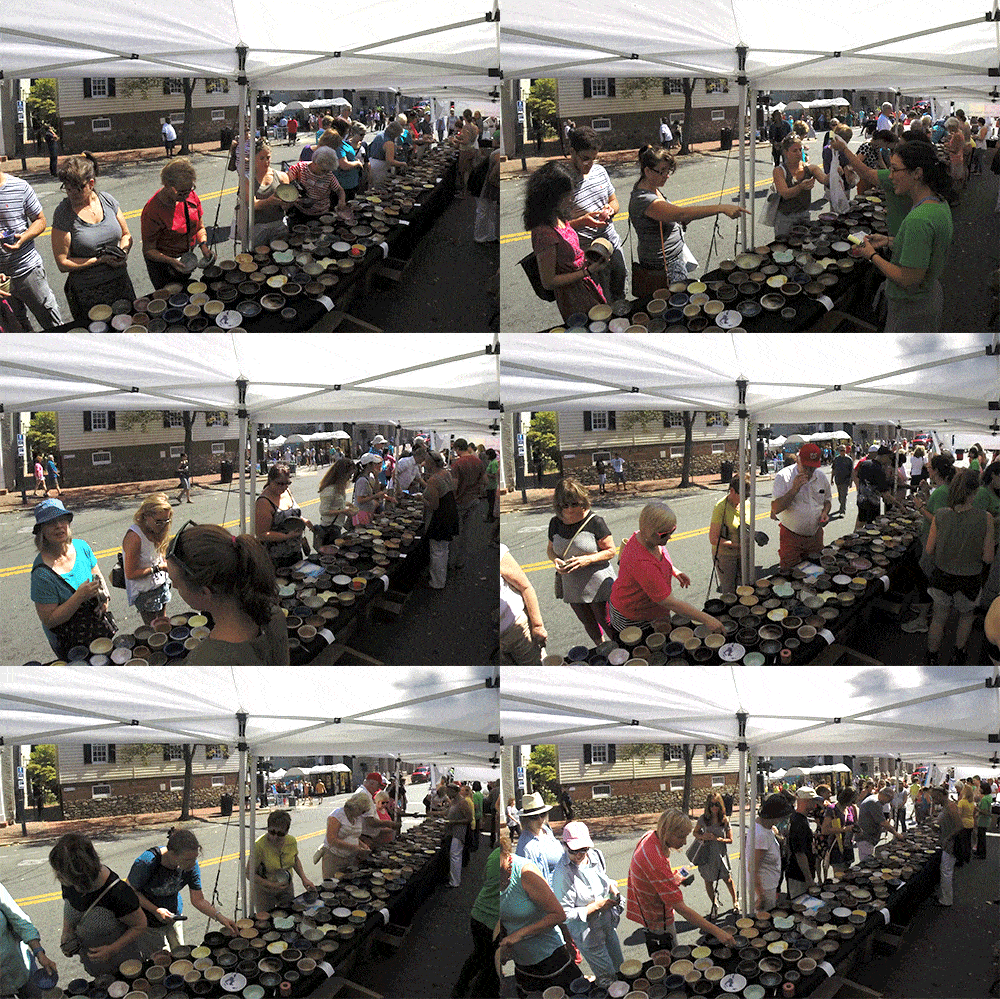
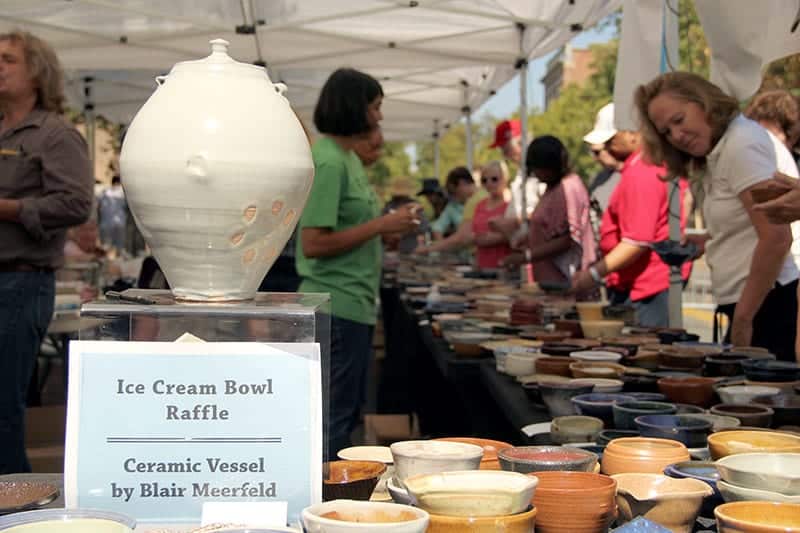
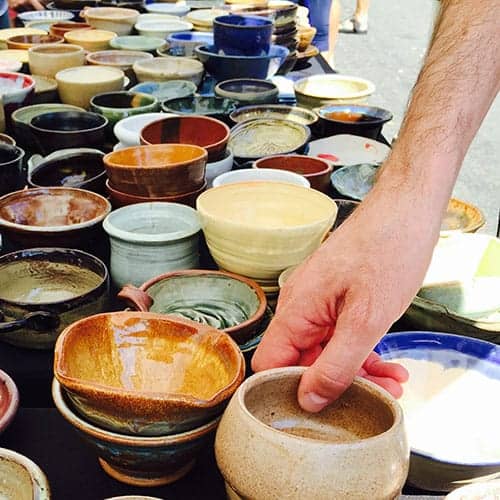
This past weekend’s Ice Cream Bowl Fundraiser was our most successful ever! Six years after we started, we’re really hitting our stride, thanks to the support of our community, our ceramics artists — and some very favorable weather.
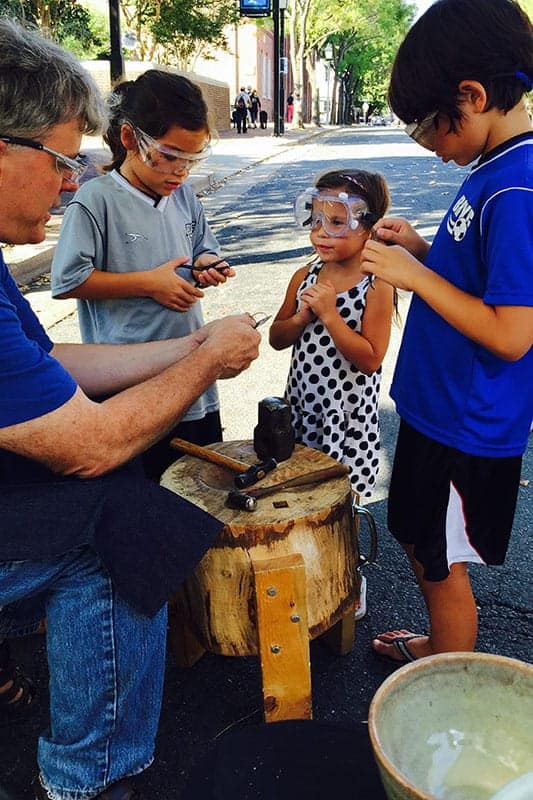
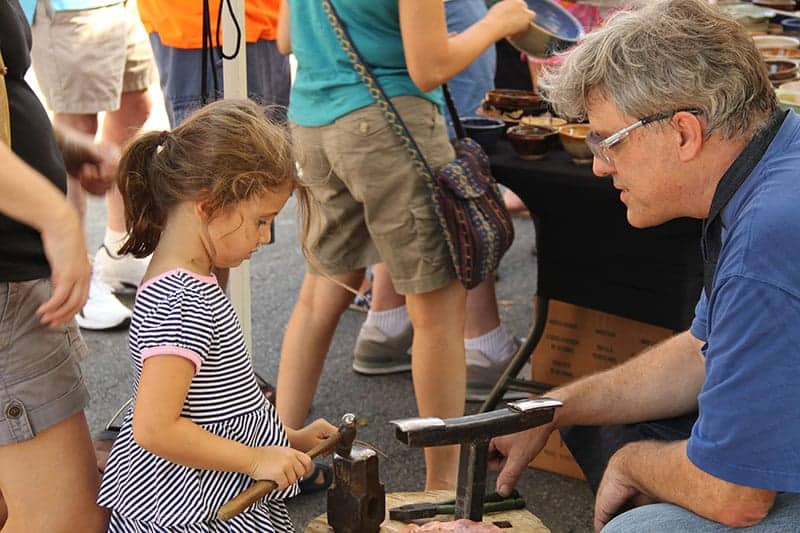
Art League instructor Michael Brehl demonstrated small-scale metal forming and forging, having the audience try it out with their own pieces of copper. Michael is teaching this technique and more this Fall in the jewelry classroom.
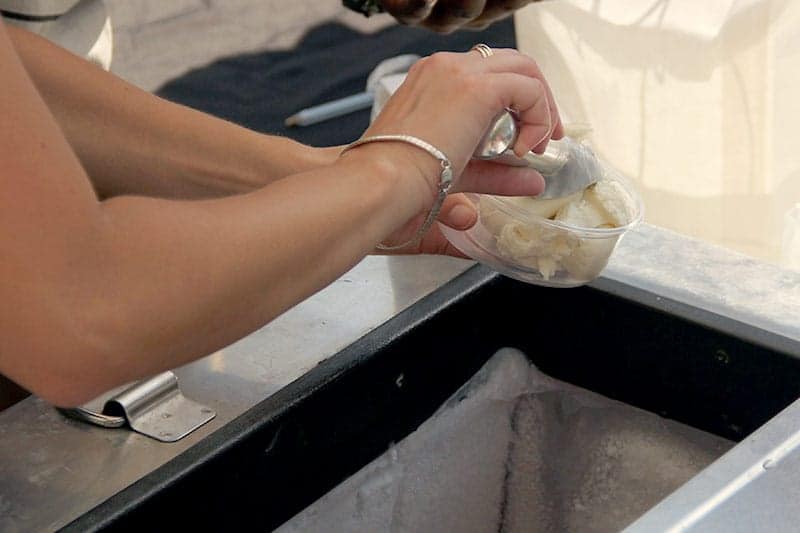
DRP Belle Haven brought their delicious, fresh frozen custard. Everyone who bought a bowl got a scoop! They also fed our staff and volunteers, which was pretty great.
Thanks again to everyone who came out to support us — including the canine ceramics fans — and we’ll see you next year!
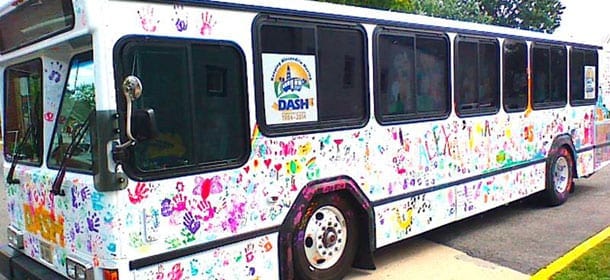
DASH will be painting the celebration bus (pictured below) once again at Art on the Avenue in Del Ray next Saturday, October 3. Here are the details:
Artists will be needed next week (the week of September 27) to paint scenes of Alexandria on the bus. Visitors at Art on the Avenue will be invited to paint on it during the event.
Supplies will be provided
4–5 artist volunteers are needed
For more information or to participate, please email [email protected]
Deadline: September 25. Three jurors will select proposals from artists to create exhibits in the 2017 exhibit calendar. Click here for details.
Fairfax County artists
Deadline: September 30. The Arts Council of Fairfax County is coordinating a holiday ornament to represent Fairfax County on this year’s tree in the Executive Mansion in Richmond. Read the request for proposals (PDF) →
Endangered art
Deadline: October 2. You are invited to enter the 3rd annual Endangered Art & Photography Contest. This global, juried, online art contest aims to focus attention on the plight of endangered and threatened species or habitats. More about this contest →
Re-runs: These opportunities were previously posted in this space, but it’s not too late to apply!
Hillyer Art Space
Deadline: September 27. Hillyer Art Space in NW DC is now accepting proposals for solo exhibitions for our 2016/2017 exhibition season. Hillyer presents monthly exhibitions and each accepted artist is given a room in our three room gallery space to present their work. Read the call for artists →
Painting residency
Deadline: September 28. Calling all artists working in paint! The Golden Foundation has just released the 2015 application for residency sessions in 2016. More about the residency →
Arlington artists
Deadline: September 28. The Waverly Hills Civic Association is hosting a Woodstock Park Festival in Arlington on Saturday, September 12, and is looking for to host artists who either live or work in Arlington to sell their products. The entrance fee is $20, and sales go directly to the artist. Interested artists should email [email protected] by September 28. More information about the festival is at waverlyhillscivic.com.
Photography portfolios
Deadline: September 30. Fifteen photographers will be chosen to have their twelve-image portfolios published in the Center for Fine Art Photography’s Annual Portfolio ShowCase book. There will be an accompanying online exhibition with links to the artist’s websites. Select images will be exhibited in Fort Collins, CO at The Center for Fine Art Photography for the Portfolio ShowCase Exhibition. Read the call for artists →
Contemporary art
Deadline: September 30. The Women’s Caucus for Art, hosted by Target Gallery at the Torpedo Factory with juror Elizabeth K. Garvey, announces a Call for Art: “Trending: Contemporary Art Now!” for January 23–February 28, 2016. “Trending” seeks works that are driving the direction of contemporary art. Read the call for entries →
Sculpture fellowship: Virginia
Deadline: October 1. The Virginia Commission for the Arts offers a limited number of fellowships in sculpture to Virginia residents 18 and older. More about the fellowships →
Art League exhibit: Mini MAX
Deadline: October 2. These exhibits for Art League members are by online entry only. Work is restricted by size: under 48 square inches (MAX) or over 2,880 square inches (mini). Artists can enter up to three pieces in each exhibit; up to one may be accepted in each. Find the prospectus and enter these exhibits at https://theartleague.submittable.com/submit
Theme: “Public”
Deadline: October 5. The Multiple eXposure Project will be curating “Outside the White Cube”, an alternative, traveling, curatorial project which aims to feature image-based works across different disciplines and media by emerging artists from the Philippines and elsewhere. We are inviting local and international artists whose works discuss the notion of the “PUBLIC” and its complexities. Artists working in a variety of media and disciplines are invited to participate and submit their works. We are seeking image submissions such as photographic series, video arts, short films, video mapping, recorded public performances, digital manipulation, animation, digital arts, new media arts, and others. Needless to say, any medium that can be projected to the screen will be accepted. Read the call for artists →
Washington Award
Deadline: October 15. Since its inception in 2001, the Washington Award has remained open to talented artists working in any medium. Each winner will be awarded the cash prize of $5,000. More about the Washington Award →
Open call for video art
New deadline: October 16. The Art League is seeking submissions for video installations to be on view in the main hallway of the Torpedo Factory from October 26 to November 6, the date of Art on Tap. All videos will be on loop without sound. The juror is Rory Sheridan, Senior Video Editor at the Travel Channel. Selected artists will receive one free ticket to Art on Tap, and Best Video will receive one year free exhibiting artist membership to The Art League Gallery. There is no fee to apply. To read the full call to artists, click here!
Paint the Beach
Deadline: October 30. The 6th Annual Paint the Beach returns to Fort Myers Beach, Florida, November 2 to 8. Events include a plein air painting competition and a quick draw event. More about Paint the Beach →
Delaplaine Visual Arts Education Center
Deadline: Ongoing. The Delaplaine seeks proposals on an ongoing basis for shows in five galleries as well as schools and community groups for the Community Art Wall. Proposals for large group, small group, and solo shows are reviewed by an exhibit selection panel and are scheduled two years in advance. More about exhibits at Delaplaine →
The Art League is proud to offer a series of travel workshops every year, designed by artists for artists. This school year’s schedule (2015–16) includes some new locations and favorite trips from the past. See the schedule below, and bookmark our travel workshops page for the latest!
Andrew Wyeth’s Studio & Brandywine Museum museum day trip
Location: Chadds Ford, Pennsylvania
Date: Fall 2015
Fine Art Collections & Mansions in Holiday Splendor museum overnight trip
Location: Newport, Rhode Island
Date: November 2015
Winter Painting Retreat with Susan Abbott plein air painting/open to all media
Location: Elbow Cay, Bahamas
Date: February 3–9, 2016
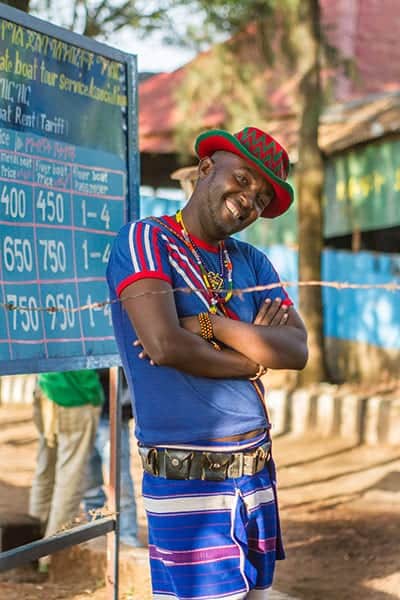
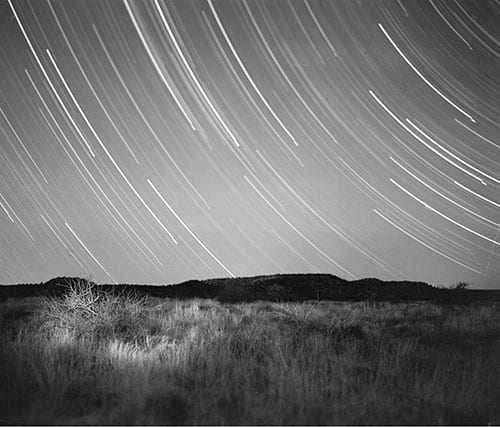
This photo and the cover photo are by Ethiopia travel workshop and photography instructor Andargé Asfaw.
Photographing the Wonders of Antiquity with Andargé Asfaw open to artists of all media
Location: Ethiopia
Date: Spring 2016
Amsterdam Through the Eyes of the Artist with Robert Liberace museum visits/drawing
Location: Netherlands
Date: Spring 2016
Longwood Gardens’ Spring Blooms day trip
Location: Pennsylvania
Date: Spring 2016
Plein Air Painting with Peter Ulrich
Location: Chesapeake area
Date: Spring 2016
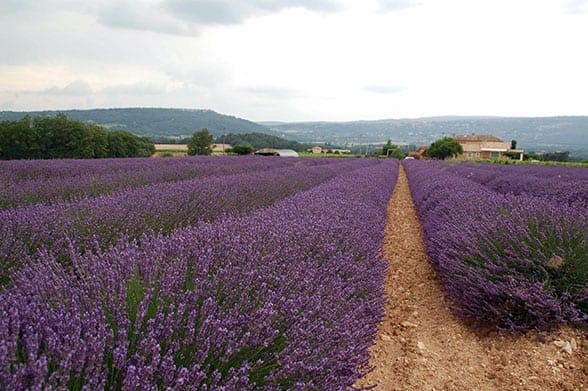
The lavender fields of Provence
Painting the Dalmatian Coast & Adriatic Sea with Matt Pinney plein air painting
Location: Hvar, Croatia
Date: June 2016
Provence with Susan Abbott plein air painting
Location: France
Date: June 2016
For more information about any of these workshops, and to sign up, contact Travel Workshop Coordinator Margaret Cerutti:
703-683-1780 x 13 or [email protected].
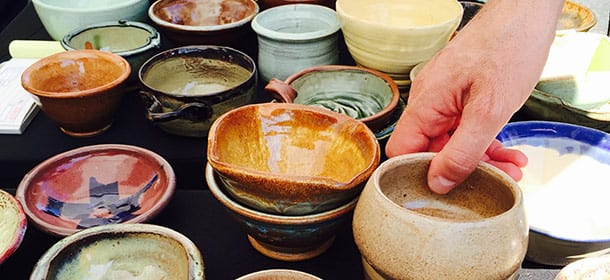
This weekend, September 19–20, find The Art League at the King Street Art Festival for some ice cream, 1,000 handmade bowls, and an art activity for the kids!
Where: King Street Art Festival, Market Square (corner of King and N. Fairfax Streets)
When: Saturday, September 19, 10:00 am-4:00 pm & Sunday, September 20, 11:00 am-4:00 pm
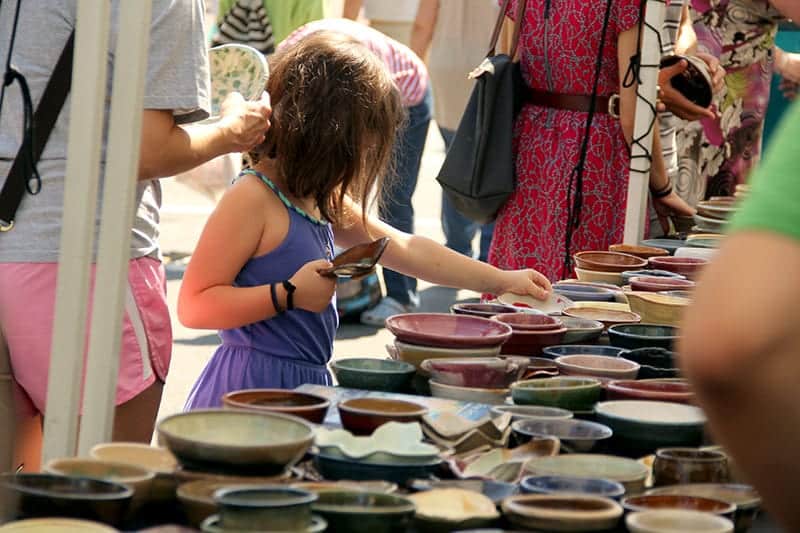
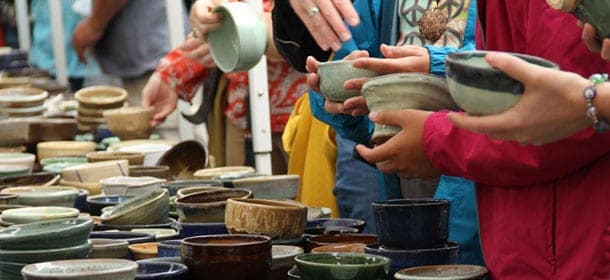
Instructor Michael Brehl will be leading kids in a free jewelry-making activity in the afternoon on Saturday and Sunday. And buy an original, handmade ice cream bowl ($15 for a bowl and a scoop of ice cream) and support The Art League’s ceramics department!
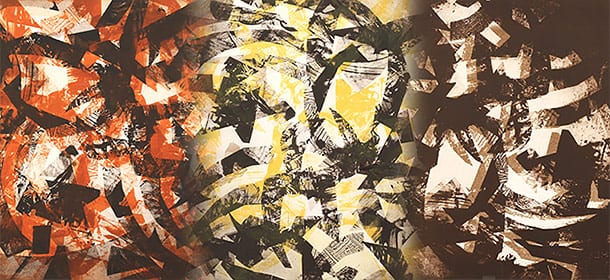
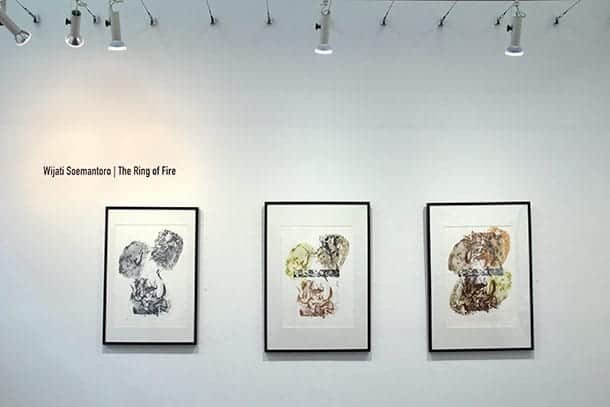
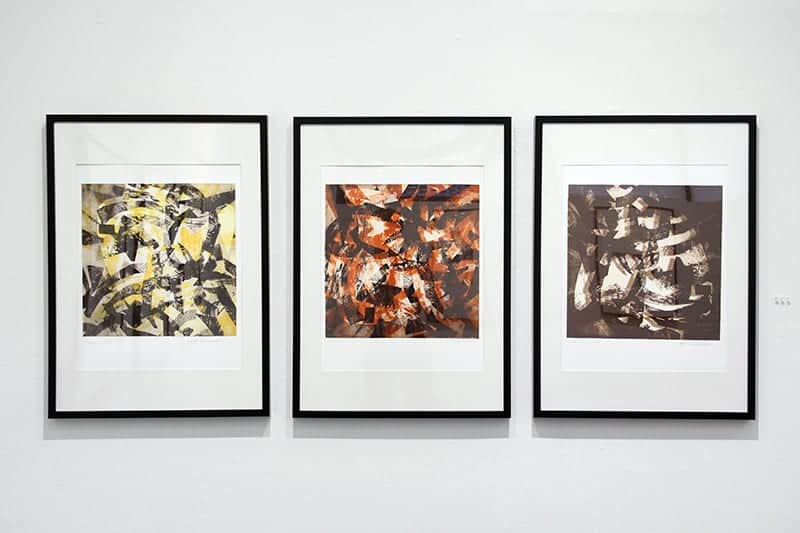
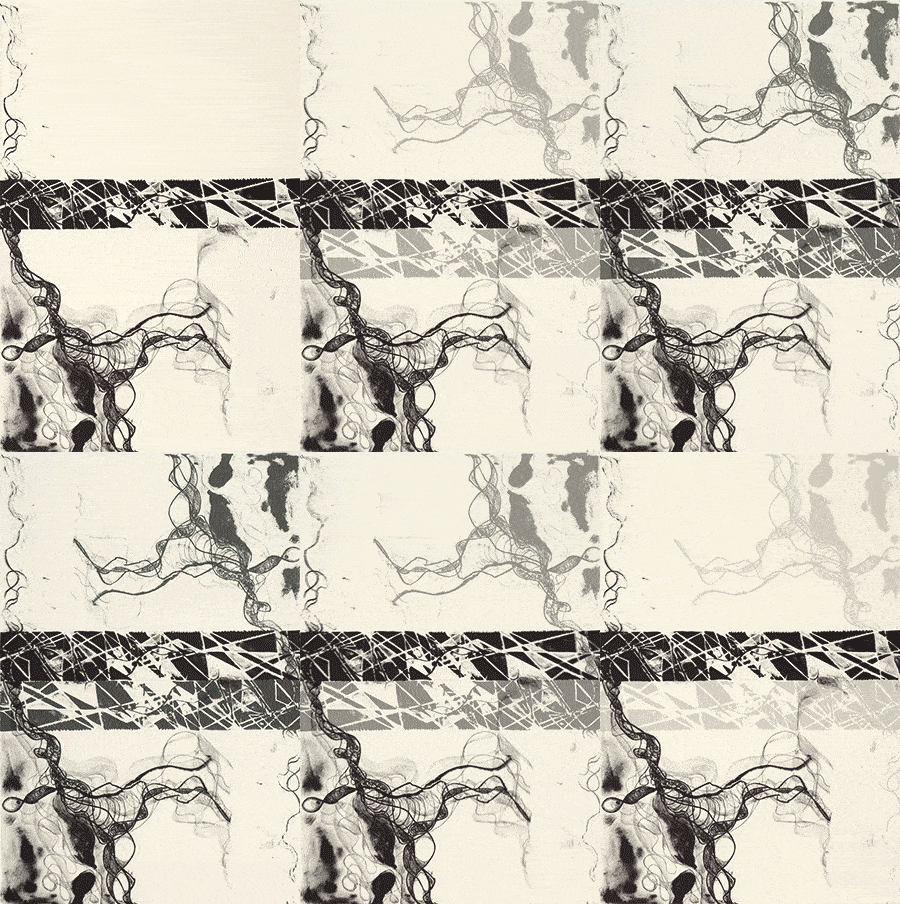
Indonesian-American artist Wijati Soemantoro created the series “The Ring of Fire” — on view as a solo exhibit through October 5 — as a response to her experiences with natural disaster. Abstract, multilayered, and interconnected, these are all lithographic prints that started out as drawings.
We asked the artist to tell us more about how it’s done.
Why did you start expressing yourself in this way?
Wijati Soemantoro: In my home country, Indonesia, natural disasters happen frequently.
Recently, Mt Sinabung, Tanah Karo, North Sumatra was active and erupted. Earthquakes, volcanic eruptions, mud slides, and floods are natural phenomena that impact my feelings directly and strongly. They are embedded in my long-term memory and need an outlet to be freed.
De-cluttering feelings stored in my memory takes time. It is impossible to depict unseen feelings of pain, sadness and hopelessness, unless we can find a way to release them through imagination or skill. The impact of natural disasters have been stored in my body and mind, creating chaos in me. When I am overloaded, then is a good time to create.
Why is lithography the best way to express these emotions?
The repetitions, timing, and patience of lithography is the best way to express my emotion, which comes from outside motion triggered by natural disaster. Layers of emotions, superimposing one onto another coming from different times and places, can be accurately represented by lithography. In the process of creating this theme, I draw from many different tools, involving chemistry, movement, emotion, and action.
Lava #1 through #3 in “The Ring of Fire”
What different tools do you use to draw/print?
Printmaking papers
Mylar and plastic transparency
Korn’s Litho pencils, crayons, Tusche, Ink,
Acrylic and Tempera
Exposure unit (Amergraph metal halide exposure units capable of exposing photo sensitive plate)
Positive plates (aluminum plate coated with photosensitive emulsion. When exposed to ultraviolet light through a film positive, the emulsion hardens. Further processing reveals a positive image.)
Deadline: September 21. “Skeletons” at Del Ray Artisans explores what is under the surface: the framework, the understructure. This call is open to all artists, not just DRA members. More about this exhibit →
Sculpture fellowship: Virginia
Deadline: October 1. The Virginia Commission for the Arts offers a limited number of fellowships in sculpture to Virginia residents 18 and older. More about the fellowships →
Open call for video art
New deadline: October 16. The Art League is seeking submissions for video installations to be on view in the main hallway of the Torpedo Factory from October 26 to November 6, the date of Art on Tap. All videos will be on loop without sound. The juror is Rory Sheridan, Senior Video Editor at the Travel Channel. Selected artists will receive one free ticket to Art on Tap, and Best Video will receive one year free exhibiting artist membership to The Art League Gallery. There is no fee to apply. To read the full call to artists, click here!
Delaplaine Visual Arts Education Center
Deadline: Ongoing. Housed in a former flour mill, the Delaplaine offers five galleries on two floors that showcase solo and group exhibitions on a rotating basis. Exhibit receptions are held on the first Saturday of each month. The Delaplaine seeks proposals on an ongoing basis for shows in five galleries as well as schools and community groups for the Community Art Wall. Proposals for large group, small group, and solo shows are reviewed by an exhibit selection panel and are scheduled two years in advance. More about exhibits at Delaplaine →
Art League members
Don’t miss your chance to apply for these opportunities for Art League members!
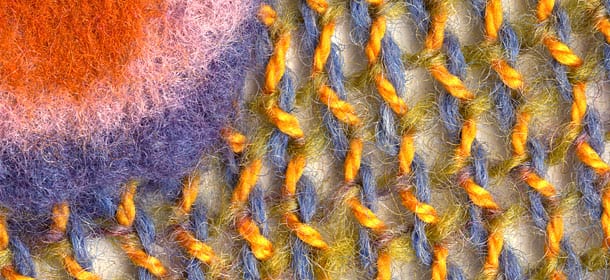
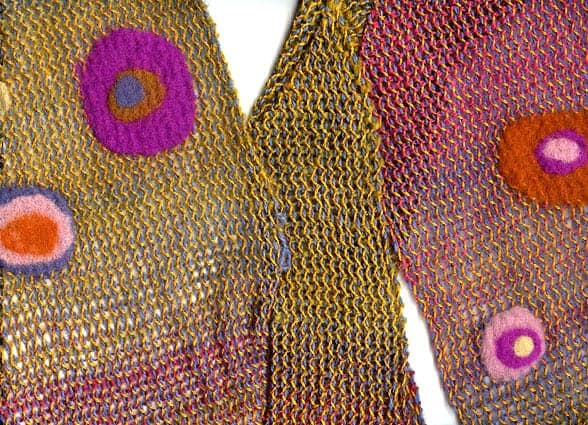
A piece by Linda Hurt incorporating woven and felted elements.
In our fiber arts studio, you can weave, felt, knit, dye, and hook your own wardrobe from head to toe. With classes including spinning and dyeing, you can learn about pretty much any part of the process, except for shearing the sheep. If functional art isn’t your style, you can also make fine art to hang on your wall. Class topics range from traditional to contemporary, and there are plenty of entry points for the complete beginner!
Our fiber arts department draws on a wide variety of traditions and cultures — not to mention a few thousand years of history — so there are lots of different terms in our class catalog that you might not recognize.
Here’s a quick guide to the fiber arts and a rundown of what’s in store this school year.
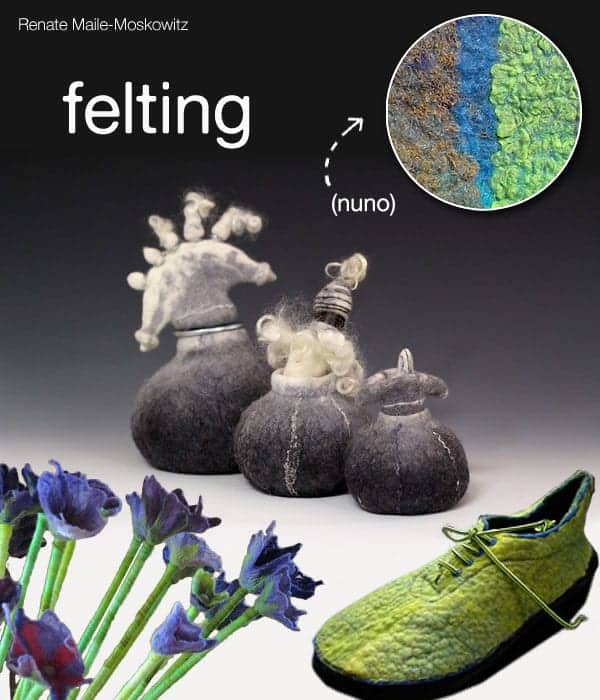
Everybody knows what felt looks like and feels like, but what is it? Basically, you take a bunch of loose fibers (roving) and tangle them up so they make a solid piece of fabric — either using hot soapy water and friction (wet felting) or a notched needle (needle felting). There’s a new method, nuno, below.
What does it make? Let’s see: flowers, slippers, sculptures, clothes, accessories, houses, …
Nuno felting was invented in the 1990s and exploded in popularity shortly thereafter. It involves felting a small amount of fibers onto some other fabric — silk, say — for a lightweight, flexible product with a distinctly textured surface.
What does it make? Clothes and accessories with “drape”
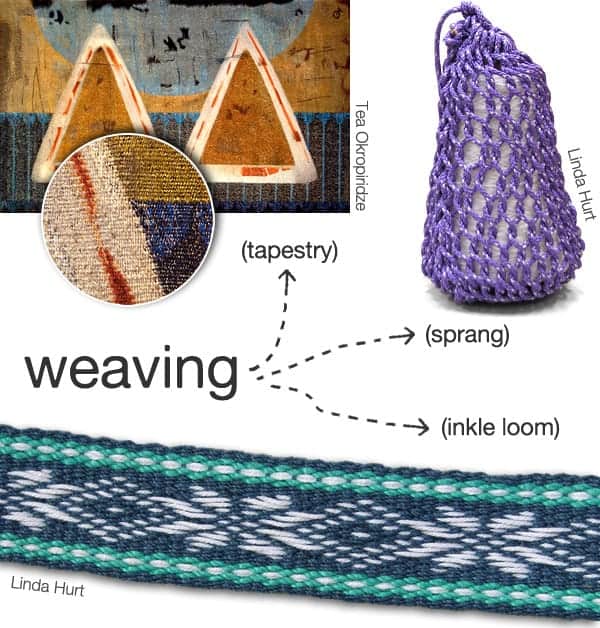
Weaving brings together multiple yarns, using a floor loom (like in this video), a card loom, an inkle loom, a frame loom, or any number of other ways. The warp thread runs the length of the fabric, and the weft thread runs back and forth across it. There are countless types of weaving — see the catalog for a rough idea. Tapestry is “weft-faced weave,” which means only the weft yarns are visible: perfect for weaving pictures. Our tapestry instructor teaches Gobelin techniques in a contemporary style. A sprang workshop was added to our catalog last year. It’s an old way of weaving that makes an elastic, net-like product.
What does it make? Scarves, towels, placemats, belts, tapestries, hammocks (sprang)
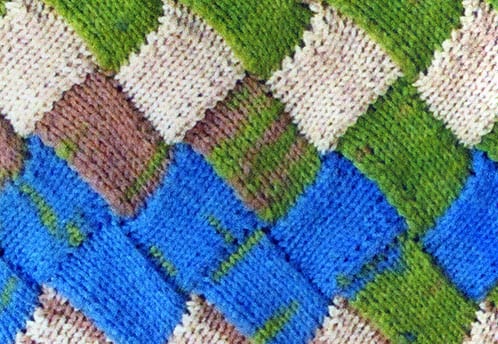
In contrast to weaving’s multiple threads, knitting uses one long yarn, looped on itself to build a fabric. (The word comes from “knot.”) Where woven fabric is stretchy on the diagonal, knits are stretchy along their length. This is also a good place to note that knitting and weaving aren’t necessarily limited to the fiber arts — check out knitted glass and woven photographs.
What does it make? Clothes, accessories, yarn bombs
Millinery’s a word that just means hat-making. Someone who makes hats is a milliner. Naturally, hats can incorporate many different materials, like felt or straw, and even non-fiber materials like feathers. Fascinators are small headpieces that are attached with a clip, comb, or something similar. Hat blocks are carved forms that a hat is shaped on.
This is a dyeing technique. It’s a Japanese method for resist dyeing fabric in different ways by binding, stitching, wrapping, and so forth — think tie-dyeing, but with more possibilities.
What does it make? Your own designs on silk, cotton, or other fabrics.
What: Lithographs by Wijati Soemantoro reflect on her experiences with natural disasters in her homeland, Indonesia. Also on view: the September Open Exhibit, juried by Erin Devine.
What: Veteran Army Staff Sgt. Jon Meadows tells his story—the narrative of his war experience—through visual art.
When: Thursdays and Fridays, 12:00 noon–8:00 pm; Saturdays, 12:00 noon–6:00 pm; or by appointment. Please call 703-683-1780. Through Thursday, October 8.
Where: The Art League’s POP UP Space, 104 South Union Street, Alexandria
What: Handmade bowls, ice cream, and kids art activities! Buy a bowl and a scoop for $15, with proceeds benefiting our ceramics department. Art activities are free.
When: September 19, 10:00 am–4:00 pm; September 20, 11:00 am–4:00 pm
Where: Market Square (at the corner of King and N. Fairfax Streets) at the King Street Art Festival
What: Richard Ormond (former Director, London’s National Maritime Museum, and former Deputy Director, London’s National Portrait Gallery) will share his knowledge of this leading portrait painter of the late 1800s. This lecture is a gift to our community. It is free and all are encouraged to attend.
When:Thursday, November 5, 2015 at 7:00 pm
Where: Torpedo Factory Art Center, main hall (105 N. Union Street, Alexandria)
What: Art. Beer. Food. Craft beers from local breweries have been artfully matched with a work of art and a complementary appetizer from a local restaurant. Enjoy the brew, bite, and artwork trifectas and vote on your favorite! Tickets are $35 through October 23 and $45 after that.
When: Friday, November 6, 7:00–10:00 pm (new date!)
Where: Torpedo Factory Art Center, main hall (105 N. Union Street, Alexandria)
Deadlines: various. Women’s Studio Workshop offers a variety of residencies, grants, and internships with application deadlines this fall. See their opportunity calendar here.
Printed Matter
Deadline: October 18. Target Gallery explores the fine art of printed matter. This exhibition will feature editioned work at affordable prices, as well as a library of artists’ books and zines. This call is open to national and international artists working in printmaking, illustration, graphic design, artists’ books, and zines. More about this exhibit →
Re-runs: These opportunities were previously posted in this space, but it’s not too late to apply!
Portrait competition
Deadline: September 8. The 7th Annual Expressions Portrait Competition & Exhibit is open to artists 18 years or older residing in MD, VA, DC, WV, and DE. Up to 25 finalists will be selected to exhibit their work at ArtSpace Herndon by judge Judith Peck. Preference will be given to works adhering to the traditional definition of portraiture. Read the call for artists →
Japan Media Arts Festival
Deadline: September 9. The Japan Media Arts Festival is a comprehensive festival of Media Arts that honors outstanding works from a diverse range of media – from animation and comics to media art and games. Entries are sought from professional, amateur, independent and commercial creators across the globe. Works completed or released between September 3, 2014 and September 9, 2015 are eligible for entry in the four divisions: Art, Entertainment, Animation, and Manga. More about the Japan Media Arts Festival →
Small Wonders
Deadline: September 10. Small Wonders is currently open for entry. This exhibition is hosted by the Maryland Federation of Art and will be on display at Circle Gallery (18 State Circle, Annapolis MD) from November 27 – December 23, 2015. Any original 2-D artwork not exceeding 11″ and 3-D artwork not exceeding 7″ and following entry guidelines is eligible. Juror: Georgia Deal, Professor at the Corcoran School of the Arts and Design. Awards total $1000. More information at mdfedart.org.
Call for proposals
Deadline: September 14. FEAST at VisArts 2015 will take place September 27 on the Rooftop at VisArts in Rockville, Maryland, 11:30 am to 2:30 p.m. Patrons will give a $30 donation for which they receive a delicious brunch of local food and a ballot. Diners listen to and review a series of project proposals and converse with the artists and thinkers behind each idea. Attendees cast a vote for their favorite proposal, and by the end of the event, the artist who garners the most votes is awarded a grant comprised of the event ticket money. More about this event →
Drawing
Deadline: September 14. The competition is open to all artists 18 years of age or older creating drawings. Theme: “Drawing” – Whether the work is in black and white or color, created as classical or experimental, this call is all about drawing. More about this call for artists →
Bethesda studio space
Deadline: September 15. Studio B is located in downtown Bethesda adjacent to the Bethesda Metro. Studio space is available beginning October 2015. Studio information:
Studio is 215 sq. feet
Rent is $405 per month, inclusive of all utilities
Artists are required to be in the space during retail hours of Wed. – Sat., 12–6pm and during the monthly Bethesda Art Walk
Artist has 24/7 access to Studio B and their personal studio space
Artist may sell artwork and there is no commission taken on artist sales
For more information about the studio space, click here.
Bader Fund: Artists over 40
Deadline: September 15. The Franz and Virginia Bader Fund was established in 2001 in accordance with the will of the late Virginia Bader to provide grants to visual artists who have reached the age of 40, reside within 150 miles of Washington, D.C., and whose ability to concentrate on their art would be enhanced by receiving a grant. More at baderfund.org →
Hillyer Art Space
Deadline: September 27. Hillyer Art Space in NW DC is now accepting proposals for solo exhibitions for our 2016/2017 exhibition season. Hillyer presents monthly exhibitions and each accepted artist is given a room in our three room gallery space to present their work. Read the call for artists →
Painting residency
Deadline: September 28. Calling all artists working in paint! The Golden Foundation has just released the 2015 application for residency sessions in 2016. More about the residency →
Arlington artists
Deadline: September 28. The Waverly Hills Civic Association is hosting a Woodstock Park Festival in Arlington on Saturday, September 12, and is looking for to host artists who either live or work in Arlington to sell their products. The entrance fee is $20, and sales go directly to the artist. Interested artists should email [email protected] by September 28. More information about the festival is at waverlyhillscivic.com.
Photography portfolios
Deadline: September 30. Fifteen photographers will be chosen to have their twelve-image portfolios published in the Center for Fine Art Photography’s Annual Portfolio ShowCase book. There will be an accompanying online exhibition with links to the artist’s websites. Select images will be exhibited in Fort Collins, CO at The Center for Fine Art Photography for the Portfolio ShowCase Exhibition. Read the call for artists →
Contemporary art
Deadline: September 30. The Women’s Caucus for Art, hosted by Target Gallery at the Torpedo Factory with juror Elizabeth K. Garvey, announces a Call for Art: “Trending: Contemporary Art Now!” for January 23–February 28, 2016. “Trending” seeks works that are driving the direction of contemporary art. Read the call for entries →
Art League exhibit: Mini MAX
Deadline: October 2. These exhibits for Art League members are by online entry only. Work is restricted by size: under 48 square inches (MAX) or over 2,880 square inches (mini). Artists can enter up to three pieces in each exhibit; up to one may be accepted in each. Find the prospectus and enter these exhibits at https://theartleague.submittable.com/submit
Theme: “Public”
Deadline: October 5. The Multiple eXposure Project will be curating “Outside the White Cube”, an alternative, traveling, curatorial project which aims to feature image-based works across different disciplines and media by emerging artists from the Philippines and elsewhere. We are inviting local and international artists whose works discuss the notion of the “PUBLIC” and its complexities. Artists working in a variety of media and disciplines are invited to participate and submit their works. We are seeking image submissions such as photographic series, video arts, short films, video mapping, recorded public performances, digital manipulation, animation, digital arts, new media arts, and others. Needless to say, any medium that can be projected to the screen will be accepted. Read the call for artists →
Washington Award
Deadline: October 15. Since its inception in 2001, the Washington Award has remained open to talented artists working in any medium. Each winner will be awarded the cash prize of $5,000. More about the Washington Award →
Paint the Beach
Deadline: October 30. The 6th Annual Paint the Beach returns to Fort Myers Beach, Florida, November 2 to 8. Events include a plein air painting competition and a quick draw event. More about Paint the Beach →
The Art League is seeking submissions for video installations, to be on view in the main hallway of the Torpedo Factory from October 26 through November 6, the date of Art on Tap. All videos will be on loop without sound.
The juror is Rory Sheridan, Senior Video Editor at the Travel Channel. Selected artists will receive one free ticket to Art on Tap, and Best Video will receive one year free exhibiting artist membership to The Art League Gallery.
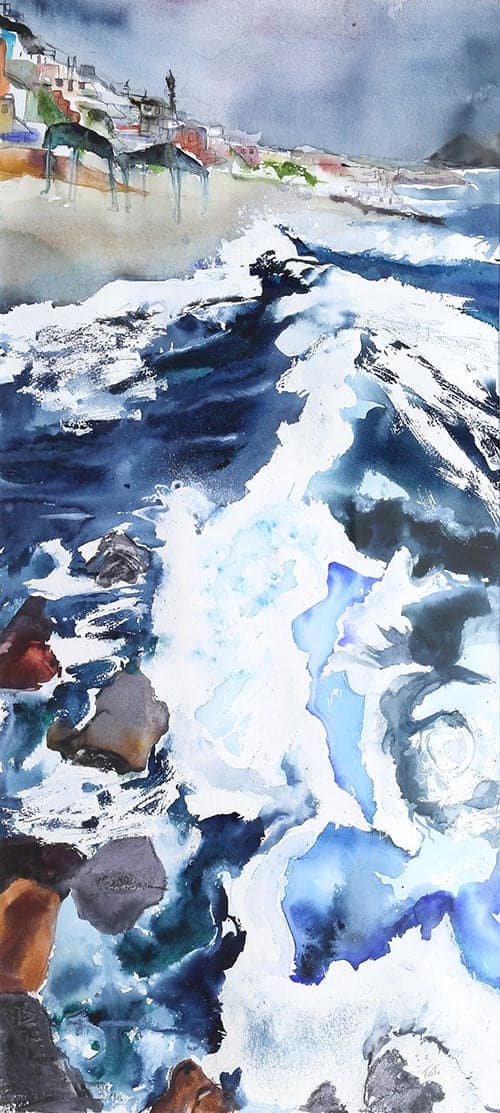
The Long Wave Home by Maria Valle-Riestra (click for larger image)
The first time we interviewed this artist, it was for an award for a figure painting — not the sea and surf that’s her signature subject matter. So when juror Elizabeth Peak selected The Long Wave Home for the Potomac Valley Watercolorists’ Award this month, we took the opportunity to ask Maria Valle-Riestra about the marriage of water and watercolor:
Where is the scene in The Long Wave Home?
Maria Valle-Riestra: The scene is from a seaside beach town called Pulpos, approximately 25 miles south of Lima City, Perú, on the Pacific coast. I was born in Lima and have lived a good part of my life in this city. Pulpos is a beach where I have spent innumerable days and nights with my husband and friends (who have homes in Pulpos) for the last 25 years during the southern hemisphere summer.
What keeps you coming back to surf and waves as subject matter?
The ocean continues to enrapture me and has not lost its power over me. I continue to paint it with renewed desire each time. I have spent many hours of my life in awe and in pure contemplation of the ocean, mostly the big wave, rough ocean of the coast near Lima. It is beautiful and scary at the same time.
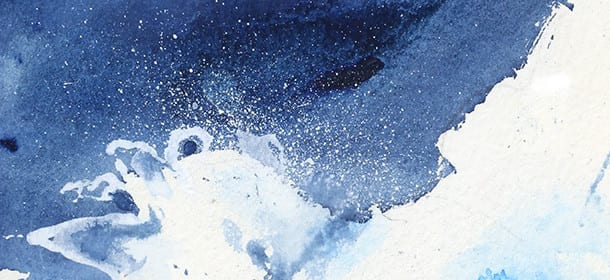
The Long Wave Home (detail) by Maria Valle-Riestra.
Each time I begin a painting of it in my home/studio in Arlington it is a little bit like free travel to this place I love. Surf, waves and the zone of clash between land and water are favored in my waterscapes because these are places of action, dramatic encounters between both.
How did you arrive at the very vertical composition for this painting?
The vertical composition was a premeditated distortion. I stretched the y axis or vertical axis approximately by a scale factor of three.
From the vantage point I was standing to get an image for this painting (an outcrop of rocks at one end of the beach) I could see the wave coming onto the beach sideways. The incoming wave was breaking at the level where I was standing on the rocks, so instead of seeing the white surf of the breaking wave away and horizontal to my eyes — as I would see it it if I had been standing on the sand in the middle of the beach — I saw it as a long, white, vertical mass going away from me into the distance. I decided I would exaggerate this natural perspective even more and see what would happen when doing this vertical scale augmentation. The result is seen in this painting, The Long Wave Home.
The Long Wave Home (detail) by Maria Valle-Riestra
What was your biggest challenge with this painting?
My biggest challenge was to stay firm on my decision of vertically distorting all aspects by the same factor, not only the breaking wave but the shape of the rocks, little houses at the top, etc. I would be tempted sometimes to draw and paint in a more realistic way and had to challenge myself not to.
What’s not yet a big challenge, but might become one soon, was my venturing out on my bare feet onto the irregular, sometimes slippery and unstable rocks that jut out to the sea.
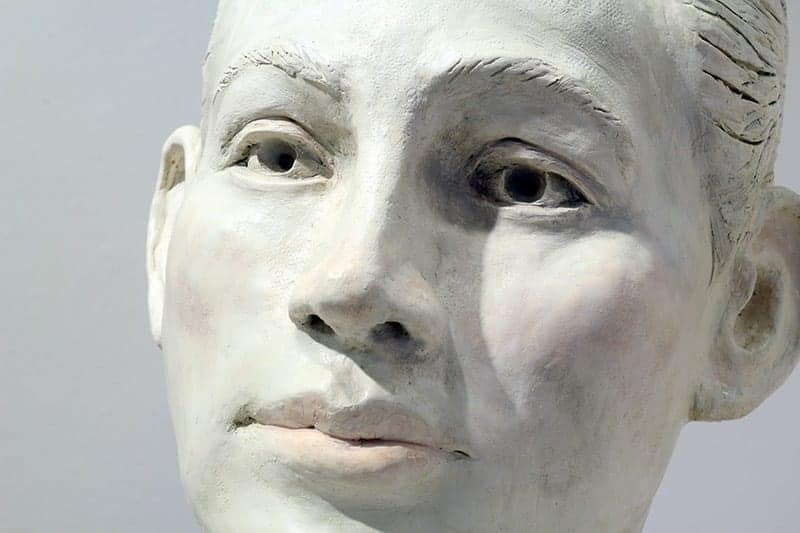
Persephone by Hal Adkins (click for a larger image)
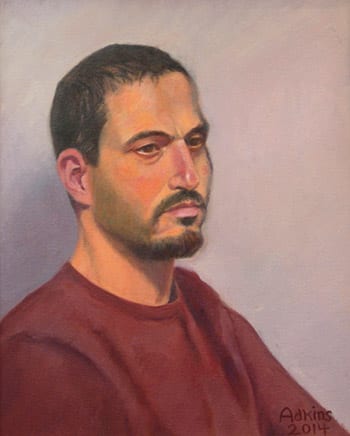
“This is such a satisfying portrait, and difficult because it seems so familiar. I was drawn to its simplicity — without sacrificing attention to detail — and nice use of subtle color. The title makes a difference, adding a layer of narrative and pointing to the interior life of the character. Yet its outward but distant look interacts with the viewer in the present.” — Jessica Beels, juror for “Taking Shape”
Sculptor and painter Hal Adkins won the Monkith Saaid Award this month with his best-in-show sculpture, Persephone. We asked him about his artistic background, for some behind-the-scenes details, and his playlist recommendations for the creative process:
What was your goal with Persephone?
Hal Adkins: My goal whenever I’m doing a portrait, whether sculpting or painting, is first of all to get a good likeness, then to get some aspect of the subject’s personality, and finally to convey a sense of narrative or mystery, if you will — the feeling that there’s a story we’re not being told, but that we can sense a small part of. There are those who will say that getting a likeness is not critical, but I’ve always felt that to convey the sense of presence of another human being, it is important that the artwork look credibly like the model.
Of course, taking liberties with the likeness for expressive or emotional reasons is a time-honored practice, going back to at least Goya, and probably before that. However, before you distort a likeness for such reasons, you should first be able to get the likeness down accurately. My goal in creating art is very close to that of Renoir, who believed that art should be beautiful because there is already enough unpleasantness in the world.
Anthropos by Hal Adkins, from the 2015 All-Media Exhibit
Why terra cotta?
Water-based clay is a wonderfully malleable and forgiving medium which allows great expressivity. Sculpting with clay can give you the sense that you are almost creating a person as you shape it and build it up. Sculpting in clay has helped me understand how apt the biblical story of Adam being created from clay is.
“Why shouldn’t art be pretty? There are enough unpleasant things in the world.”
― Pierre-Auguste Renoir
Were you a sculptor or painter first?
I began painting when I was a student at Tulane University, spring semester of 1975, now some 40 years ago, when I took intro oil painting from my sister’s boyfriend, a graduate student and great painter named Dale Murray. I only started sculpting last year when I took a workshop with Paul Lucchesi on the advice of Danni Dawson, who said it would help my painting, and it just sort of clicked. I have since taken classes with Thanasi Papapostolou, who is a wonderful sculptor and teacher and has helped me progress.
I think the experience of painting portraits and figures for many years, and especially my concentration on life drawing for five years at the Art League of Houston under the instruction of another great artist and mentor, Janet Hassinger, has enhanced my ability to adapt fairly easily to the medium of sculpture. Sculpting in a way is like doing life drawing in that you need to know anatomy and be able to situate bodily features correctly in relation to each other, but it is drawing in three dimensions with an infinite number of contours to define.
Apostle, oil, by Hal Adkins (from the January 2015 All-Media Exhibit)
What draws you to the different media you use?
I think I am drawn to clay and oil paint because they are both traditional technologies that have not changed in 500 years, in the case of oil painting, or 5,000 years, in the case of clay sculpture. They both allow a direct connection to the masters of the past and at least a small appreciation of the struggles they endured in creating the works that are still admired today. Oil paint and clay are both forgiving mediums that allow you to correct and adjust as you go along. Additionally, sculpting in clay satisfies a primal urge we all seem to have for playing with mud!
What’s your creative process like, from an idea to a finished piece?
In sculpting, when working from a live model, the first step is to decide whether to render a full figure, some portion thereof, or a portrait head or bust. This is where inspiration and intuition take over as you formulate your idea. Another alternative is to do a bas-relief, which involves a nice combination of drawing and sculpting and permits you to create an environment and a little story around the figure. Once you settle on your idea and concept, it becomes a matter of roughing in the piece with masses of clay, constantly adjusting proportions and relationships, and then refining the details and surface. It is a very physical, kinetic process. The figure emerges from the clay and, when it’s going well, begins to take on a life of its own. Modeling the piece is only half the process, followed by drying, firing, repairing if necessary, working up the patina, and mounting on a suitable base.
Persephone (detail) by Hal Adkins
How did you achieve the finish and coloration?
The patina on Persephone was achieved by applying numerous transparent layers of pigment over the piece after it was fired. I began with a light green acrylic wash followed by transparent white and then rubbed different hues of oil paint into certain areas. I applied a faint amount of quinacridone rose to the lips, nose, cheeks, eyelids, and ears to give a touch of warmth to the piece.
Do you listen to music while you work? What’s your favorite thing to listen to?
I always listen to music when sculpting or painting. I particularly like Lyle Lovett and other Texas alt-country singer-songwriters such as Townes Van Zandt, Willie Nelson, Robert Earl Keen, and Steve Earle. I also listen to James Taylor a lot and just about any 1970s group, the music of my college years. A particular favorite I play often is Nana Mouskouri, a longtime star in Europe who I discovered when I was 21 and have enjoyed ever since. I was born in the Mississippi Delta and grew up in Memphis, Tennessee, and have a natural fondness for Delta blues singers such as Muddy Waters and Buddy Guy. Classical guitar music is also very good to work to. Around St. Patrick’s Day, I immerse myself in music of Celtic groups such as Solas and The Waterboys.
How long have you been an artist — or when did you first know you wanted to do what you do?
I always enjoyed drawing when I was young and excelled in art history courses in college, but I had no formal training in art until I took painting my senior year at Tulane. The third painting I did in that class, a portrait of my roommate, was accepted into the annual art school juried show that year, which some art majors did not make it into. Painting became the most exciting and satisfying thing I had ever undertaken, and I began thinking of myself as an artist.
I continued to paint after college and had some commissions, including one for the ABC Television daytime drama “All My Children.” Meanwhile, I did the practical thing and went to law school, becoming a lawyer and practicing for a number of years. While there was satisfaction to be found in drafting effective documents and pleadings and in solving problems for clients, nothing in law ever gave me the feeling of accomplishment and the enjoyment that I get from making art. I am now devoting most of my time to developing my sculpting and painting skills with the goal of becoming a professional portrait painter and sculptor. (Commissions are welcomed!)
Deadline: September 14. The competition is open to all artists 18 years of age or older creating drawings. Theme: “Drawing” – Whether the work is in black and white or color, created as classical or experimental, this call is all about drawing. More about this call for artists →
Bethesda studio space
Deadline: September 15. Studio B is located in downtown Bethesda adjacent to the Bethesda Metro. Studio space is available beginning October 2015. Studio information:
Studio is 215 sq. feet
Rent is $405 per month, inclusive of all utilities
Artists are required to be in the space during retail hours of Wed. – Sat., 12–6pm and during the monthly Bethesda Art Walk
Artist has 24/7 access to Studio B and their personal studio space
Artist may sell artwork and there is no commission taken on artist sales
For more information about the studio space, click here.
Painting residency
Deadline: September 28. Calling all artists working in paint! The Golden Foundation has just released the 2015 application for residency sessions in 2016. More about the residency →
Washington Award
Deadline: October 15. Since its inception in 2001, the Washington Award has remained open to talented artists working in any medium. Each winner will be awarded the cash prize of $5,000. More about the Washington Award →
Northern Virginia Fine Arts Festival
Deadline: December 6. The Northern Virginia Fine Arts Festival is produced by the Greater Reston Arts Center (GRACE) and is a competitive, juried, outdoor event that showcases the best contemporary fine art and craft from around the country. Two hundred artists will be selected on the basis of quality, originality, and craftsmanship by a panel of jurors, who are experts in their fields, and by members of GRACE’s professional staff. More about the festival →
RRUUC
Deadline: rolling. River Road Unitarian Universalist Congregation encourages local artists to exhibit their work in its Fellowship Hall in Bethesda, MD. Artists do not have to be congregation members. There is no fee to exhibit or to apply for an exhibit, but RRUUC receives 20% of the final total of all sales. Applications to exhibit are accepted on a rolling schedule. We are now scheduling 2017. Steps in the application procedure are explained here.
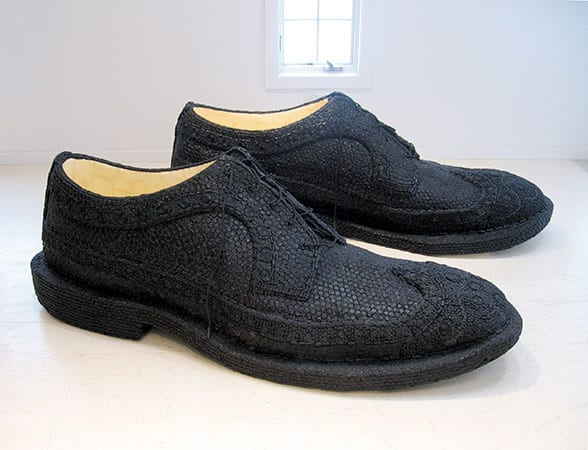
Licorice Shoes; licorice, silicone, and Styrofoam; by Andy Yoder. 2.5′ × 2.5′ × 7′ each.
With the right approach, anything can be an art material.
Among the new classes coming to The Art League this Fall, there’s one that puts that idea to the test with some wide-open explorations in sculpture. New instructor Andy Yoder (andyyoder.com) is teaching Sculpture and the Concept of Why in the Fall, Winter, Spring, and Summer this school year. Here’s what students have in store:
Who should take this class?
Andy Yoder: This class is wide open! I’m hoping to enlist everyone from beginners or non-artists to professionals with lots of experience.
I’ve only ever worked in traditional (realistic, non-conceptual) art. Is this class for me? Will I be in over my head?
This class is for everybody, and nobody will be in over their head. “Conceptual” has a chilly, elitist sound to it, but for me it just means that there’s ideas behind the work. My assignments are designed to be simple and open-ended, allowing for fun, unexpected results. The challenge will be letting go of pre-conceived ideas and habits, so a lack of experience may be an asset!
Early One Morning and detail, 300,000 matchsticks, by Andy Yoder. 43″ diameter.
What does the title of the class mean?
I didn’t choose it, but I look at it as a reminder of the balancing act it takes to make art: getting a piece of work started, then allowing it to take its own course, and hopefully coming up with something new. Asking “why?” keeps us from acting on autopilot, and it’s as useful in the business world as the studio. Then there are times when it can get in the way of working instinctively, in a cloud of creativity, where all the best results are lurking.
What will a typical Sunday be like in this class?
I want the studio to be a place where people work in a focused way, while keeping it relaxed enough for participants to move around and bounce ideas or questions off each other. There’s no hierarchy, just people making things. I might take time to introduce a project, show images of other artists’ work to stir the pot, or have a group discussion, but mainly it will be about trying new approaches and seeing what comes out of it.
Home, School, and Office by Andy Yoder
What kinds of materials will students use?
As wide a variety as possible. For many of the projects there are no limits to the choice of materials, including food. You never know what might trigger a memory or idea, leading you in a new direction. Other times we may restrict the materials to point out how even the simplest means can lead to dramatically different results, while still managing to reflect the personalites of the people who made them.
How would you describe your own art and practice?
Basically I try to avoid following routines, much as I described above. I love letting random materials lead to new ideas, or coming up with an idea and figuring out how to express it. With commissions, I use the particulars of the site or sponsor in the same way. Recent projects have involved wooden matches, artificial flowers and riveted copper. I’ve also been putting a lot of time into a series of drawings and paintings. As you can tell, I like variety, and the assignments for this course will reflect that.
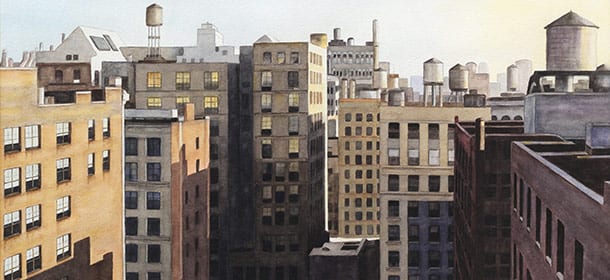
Windows, watercolor, by Michele Rea. (click for full size)
What’s the best way to capture the feeling of being in New York City? On the sidewalk, looking through a camera lens, like so many famous street photographers? Or is it above the fray, looking down on a seemingly quiet city?
Artist Michele Rea uses both the camera and the paintbrush as tools: capturing her compositions through the viewfinder, and then laying down watercolor to recreate layers of grime and texture. After Windows was chosen as the Best in Show piece for this year’s ’Scapes exhibit, we asked the artist about how watercolor and the city work together.
Where is Windows? What made you want to paint it? Windows is in New York City. I took the photo from a hotel window in Union Square. I love New York and try to paint as many subjects as I can from there. I also find subjects from the urban landscape of cities across the United States.
How did you first get started with this kind of urban, industrial subject matter? How has your approach to it changed over time?
I first started painting industrial subjects when I visited my son, living in Chicago.
For eight years, I only painted subjects I found there. By doing this I felt a connection to my son. It started with bridges and the elevated subway tracks and gradually led to old buildings. The darkened windows always drew me in. What was going on inside? I love the mystery of what took place in the past and who might have lived or worked there.
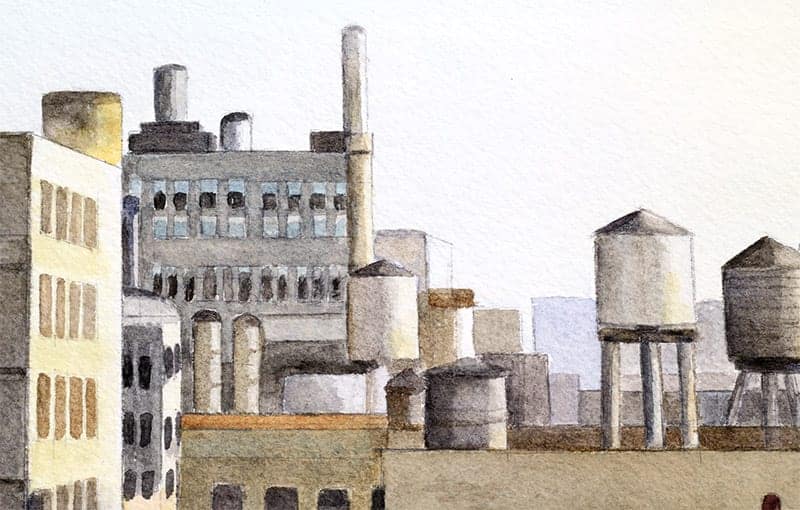
Windows by Michele Rea (detail)
Where and how do you find new subjects and compositions?
I create my compositions through my camera lens. By scanning the landscape this way I discover many patterns, shapes and angles. Where the angles converge at a point, an abstract composition is formed. Sometimes I zoom in on a subject and realize it isn’t what I thought. Some of my paintings are close-ups of objects showing their rust, peeling paint, and decay. I am a master painter of rust and textures. Interestingly, my painting Windows doesn’t really have either.
Every Which Way by Michele Rea, from her 2010 solo exhibit at The Art League, “Vantage Point.”
What makes watercolor the right choice for these paintings?
I am meticulous with the perspective of my architectural subjects and spend many hours perfecting the drawings. I choose to work in watercolor because I can capture the mood of a subject by using strong colors in many layers, as well as different textures and fine details. I always want to entice the viewer to come closer, inviting them to imagine what mystery lies hidden beyond the frame.
What’s your favorite thing about being a painter?
My favorite thing about being a painter is expressing my love of a subject for all to see! I am very emotional about my paintings. Each one has my whole heart in it!
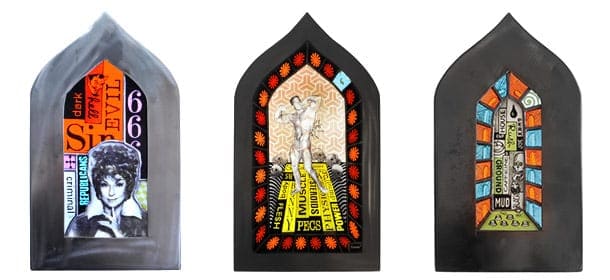
For October’s group exhibit, “Superstition & Belief,” our juror is the New York-based stained glass artist Joseph Cavalieri. He wrote this guest post for artists to read ahead of the exhibit.
The deadline to enter this exhibit is Friday, September 4!Enter here.
Juror Joseph Cavalieri at work.
With a title like “Superstition & Belief,” this exhibition has the possibility of being mistaken for a house of worship or even a haunted house — it could go either direction. I am hoping to get plenty of entries from beginners to seasoned artist, and expect to be surprised.
When selecting entries for any exhibition, first on my list is the concept behind the work. Before I look at the title and any description, I seek intriguing art, that is distinct and fresh. I particularly feel work that shows emotion, and creates a strong mood, will result in a powerful group show. I also study the fabrication of the work, and compare it to other similar work. Quality of workmanship and production value is important.
As I view the entries I first make a working list of my top selections, and see how they complement each other. Often I draw out the exhibition space and see the best arrangement, choosing what piece should open the show, and which should close it. I decide how best to arrange the art to create a storyline to entertain, surprise and possibly educate the viewer.
About entering exhibits: Submissions, delivery, promoting and attending the exhibition all take plenty of energy and time away from the artists’ production schedule. Before entering an exhibition, one should research the gallery to see the location, photos of the gallery space, past shows, hours the gallery is open to the public and how much work normally sells. In my experience, every show you get your work into is worth the exposure and connections it brings. I have two rules for artists: you must attend the opening, and you must meet at least three strangers during that opening.
Artist have many challenges in life. When I teach I have a very popular worksheet to help students focus. It includes questions on their favorite work in the past, and a “Five Year Plan.” I ask the students to discuss a fantasy job five years from now. It helps direct the path of their careers. Some students only want to make work as gifts to friends, some want to have a great work studio, while others want a solo show in an important gallery or museum in five years. If you are reaching for a solo show in the future, you have to take the proper steps, starting with group shows like this one at The Art League.
Calvin & Hobbes on artist statements. Cartoon by Bill Watterson, July 15, 1995
“Hey, that was a good artist statement!”
It’s a sentiment you don’t hear very often, and yet it’s what we found ourselves saying after reading the statements below. Artist statements don’t have to be a source of fear (for the writer) and boredom (for the reader)! See a few examples of strong artist statements below, and below that, a discussion of what makes them good.
Andy Yoder, sculptor: “Many people take great comfort in the bathroom towels being the same color as the soap, toilet paper, and tiles. It means there is a connection between them, and an environment of order. Home is a place not only of comfort, but of control. This sense of order, in whatever form it takes, acts as a shield against the unpredictability and lurking chaos of the outside world.
My work is an examination of the different forms this shield takes, and the thinking that lies behind it. I use domestic objects as the common denominators of our personal environment. Altering them is a way of questioning the attitudes, fears and unwritten rules which have formed that environment and our behavior within it.”
Nancy McIntyre, silk screen artist: “I like it when a place has been around long enough that there is a kind of tension between the way it was originally designed to look and the way it looks now, as well as a tension between the way it looks to whoever is caring for it and the way it looks to me. Trouble is, the kinds of places I find most appealing keep getting closed or torn down.
What do I want to say with my art?
Celebrate the human, the marks people make on the world. Treasure the local, the small-scale, the eccentric, the ordinary: whatever is made out of caring. Respect what people have built for themselves. Find the beauty in some battered old porch or cluttered, human-scale storefront, while it still stands.”
Dawn Benedetto, jeweler: “Poppi is my fun and clever alter ego. It’s a line of jewelry that doesn’t take life too seriously. The glass and sterling rings are my invention and are unique in that they stretch to fit most everyone. Poppi adds a splash of color to jeans or an extra spark to ignite a little black dress; heck, it’ll even brighten up a trip to the grocery store.
If nothing else, it’s a statement. Poppi laughs. Poppi flirts. Poppi screams. Poppi says it all without you saying a thing.”
Diana Chamberlain, ceramicist: “I work in porcelain for its suppleness, delicacy and strength. Porcelain’s willingness to be transformed, both in form and texture, makes it a perfect medium for exploring the iconic meaning of dress and the concept of shelter.”
Margaret Cerutti, painter: “Capturing the light is everything! As a plein air painter, it is always the light that I remember most about any location. It is my inspiration.
Its elusive quality can transform a figure or a landscape in just a matter of seconds. I strive to convey that sense of place by capturing its fleeting magic.”
Alison Sigethy, glass artist: “Getting outside is good for the soul. Through my artwork, I try to bring the outside in. While I make no attempt to portray actual plants or animals, I do want my creations to look like they could have lived or grown somewhere. Living with beautiful objects that pay tribute to the natural world reminds us to slow down and helps us reconnect with nature.”
Charlene Fuhrman-Schulz, sumi-é artist: “My subject matter is nature, whether it is a traditional landscape or a bird and flower painting. I use traditional materials, ink and brush on rice paper, to capture movement and life — making the brush dance and the ink sing. Everything is captured in the spontaneous dance and movement of the brush as it meets the rice paper. There is no going back and correcting when painting with ink and rice paper.”
Looking past the obvious, close observation and engagement of the subject is my process. The challenge is to see beyond the distraction of the conspicuous to capture its unique self. Some of my subjects are quite beautiful, others less so. My goal is to inspire those who see my work to look more carefully at the world around them, to discover beauty in unusual places.”
So what makes these artist statements work?
What these artist statements do
keep it short
grab the reader’s interest with the first sentence
introduce the author’s personality and enthusiasm
give a hint about the why of the artwork
use the first person (I, me, mine — this is not a strict rule, but it does seem to help the author write a more straightforward, readable statement)
What these artist statements don’t do
summarize the resume found elsewhere on the website
give a physical description of artwork photographed elsewhere on the website
sound generic
use “art speak”
Some questions to think about when writing your statement
What keeps you coming back to the studio, day after day?
What’s the best way someone has responded to your artwork (comment in a guest book, at an exhibit, etc.)
What questions are you asked most frequently about your work?
What’s your artist story? (as opposed to your biography and CV)
Who is your art for?
More resources
Telling your story, and your artwork’s story, increases its value. Here are some other blog posts you might be interested in:
Pathway to Heiau, acrylic on canvas, by Karen Kozojet Ching. (click for larger image)
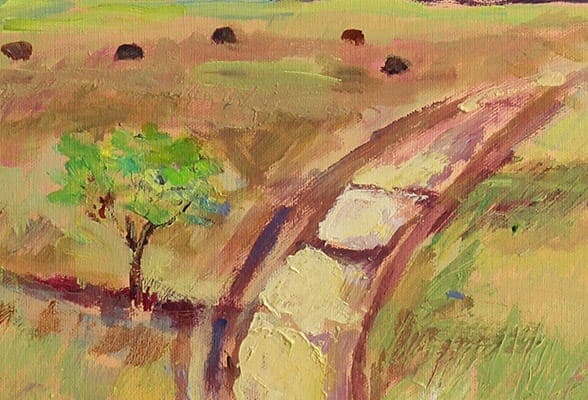
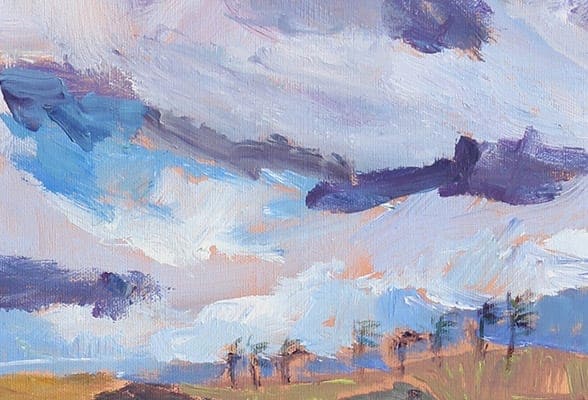
Distant cows grazing on windswept grass, all under a huge expanse of sky: this American landscape sounds like the Midwest, but the palm trees atop the hill point to a different origin. We asked the artist, Karen Kozojet Ching, to tell us a little about this painting, the winner of the Chameli & Amiya Bose Award in ’Scapes.
Where is Pathway to Heiau?
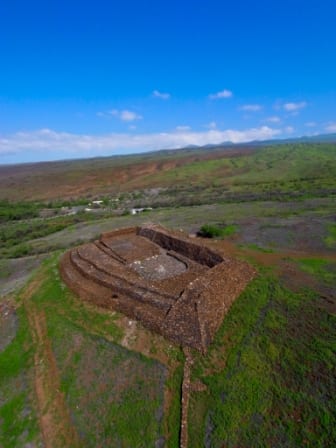
Karen Kozojet Ching: It is located on the Big Island of Hawai’i. A heiau is a Hawaiian temple made of piled lava rock.
What made you want to paint this spot?
The terrain captivated my attention. The sky was breathtaking. I was also surprised to see cattle in Hawaii.
Pu’ukoholā Heiau National Historic Site on the island of Hawai’i. (photo courtesy National Park Service)
Paths have always intrigued me. They are a metaphor for our own life journey. There is a beginning, end, and so many experiences and choices along the way.
What was your goal with this painting?
I wanted to express the visceral connection to the landscape. It was bright and arid. The grasses and palms swayed beneath the island breeze.
Is this piece part of a series?
My husband is Hawaiian. We vacationed on the Big Island with my husband’s extended family. His parents delighted in sharing their culture with their grandchildren. We went on many island excursions. I created a body of work as a tribute to my ‘ohana’s Hawaiian heritage. ‘Ohana means family.
The series also included paintings of richly textured petroglyphs and seascapes. Petroglyphs are lava rock carvings etched into stone centuries ago by Native Hawaiians.
Pathway to Heiau (detail) by Karen Kozojet Ching
How is it different from other landscapes you’ve painted?
Each painting is a unique exercise in creative thinking. This painting is a bit more raw or incomplete than most of my work. I wanted the expressionistic strokes to expose the cadmium underpainting to reflect warmth of the afternoon.
Why are you a painter?
I need to create.
Pathway to Heiau (detail) by Karen Kozojet Ching
Painting is a reflection of my observations and experiences. I want to share with the viewer the awe that captivated my attention when I first saw the subject. I am continually learning new techniques and experimenting with innovative materials to better articulate my vision.
What’s a perfect day in the studio?
The perfect day has no time constraints.
Painting to me is a transcendent experience. I enter into a meditative process that is driven by intuition. I place the energy of the moment onto the canvas. I alternate between studio and plein-air to keep my senses keen.