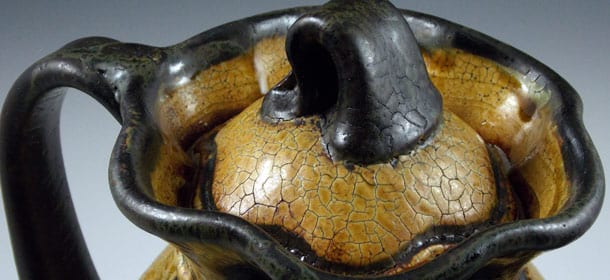
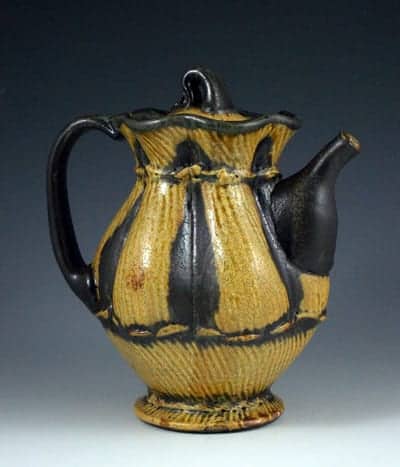
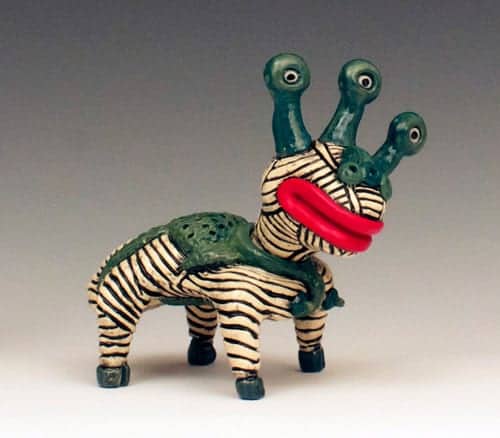
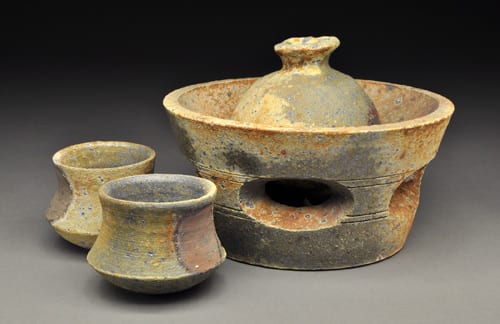
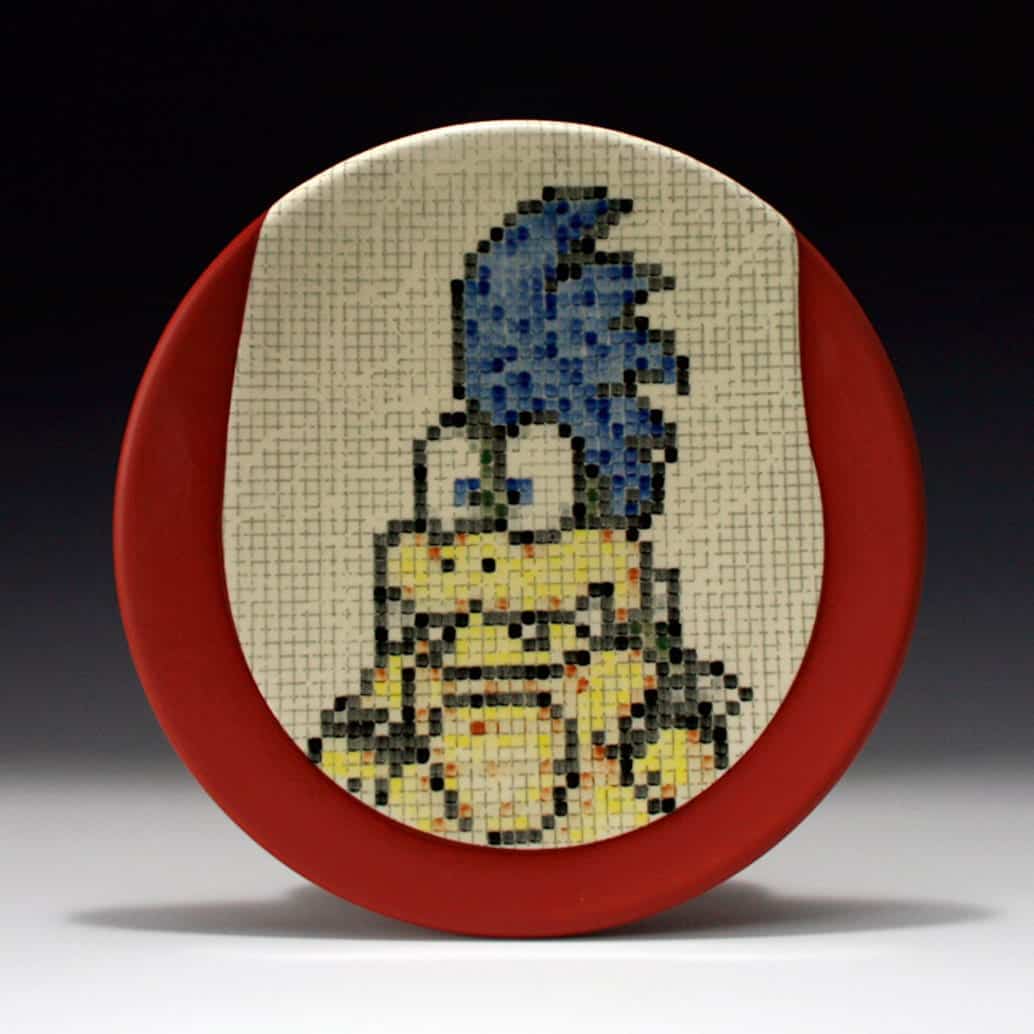
Soda-Fired Creamer by Carolanne Currier (Huntington, PA), Warm Yellow Plate by David Flohr (Falls Church, VA), and Black Tea Cup by Tony Wise (Lubbock, TX).
Functional and beautiful handmade ceramic wares perfect for your next brunch or dinner party are making their way into The Art League Gallery from all corners of the US and Canada this June. Tony Clennell juried this exhibit of ceramic art that belongs on your dinner table. Plates, pitchers, cups of all kinds, and more will be showcased during “Tabletop,” opening on June 4.
For images of all the accepted artwork and an exhibit program with price list, click here. Meet the juror and join us for the “Tabletop” reception next Sunday, June 8, 4:00–6:00 pm. Clennell will announce the award winning artists.
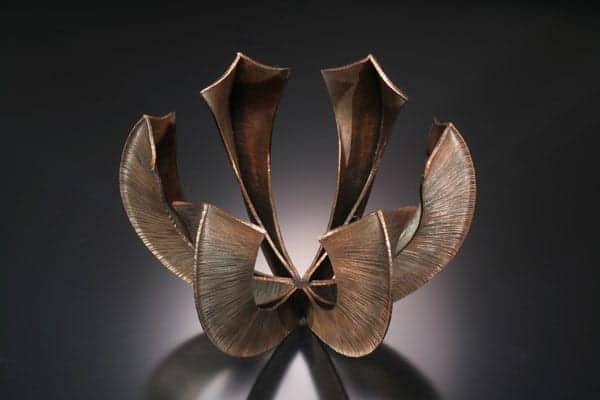
Japanese Shino Sake Set by Hironobu Nishitateno, Loves Park, IL.Cover image: Scraggleware Teapot by Eric Botbyl, Humboldt, TN.‘Madeline’ Salt and Pepper Shaker by Molly Uravitch, Minneapolis, MN.Machine Adaptation Reliquary, Mezcal Cantaro And Cups by Trevor Dunn, Jacksonville Beach, FL.Portrait of Larry Koopa by Shane McNutt, Toronto, Ontario.
The 2013–14 Space of Her Own class graduated last night in a ceremony at the Torpedo Factory featuring student artwork from this year and speeches by mentors and mentees.
Throughout the school year, the fifth-grade girls in SOHO met weekly for lessons on subjects in life skills and the arts, with projects including film photography and jewelry making.
“We are all failures — at least the best of us are.”
— J.M. Barrie
Neo-Expressionism @ The Art League
Receiving: June 2 and 3. Artwork drop-off for “Neo-Expressionism” is next week! More about the exhibit →
American Landscapes
Deadline: June 19. The Maryland Federation of Art invites all artists residing in the United States, Puerto Rico, Canada and Mexico to enter American Landscapes: Art of the Americas, a juried fine art exhibition for work depicting the Americas — North America, Hawaii, Central America, South America and the Caribbean. Any 2-D and 3-D work following exhibition guidelines will be considered by the juror. Selected works will be exhibited at MFA Circle Gallery. More about the exhibit →
Finland residency
Deadline: July 18. Applications are open for the Arteles Creative Residency Program 2015 in Hämeenkyrö, Finland. Artists and creative professionals can apply. More about the residency →
Maryland Artists
Deadline: July 24. Mid Atlantic Arts Foundation provides administrative support and organizes application review for the Maryland State Arts Council Individual Artist Awards. Categories for the awards include Visual Arts: Crafts and Visual Arts: Photography. More about the awards →
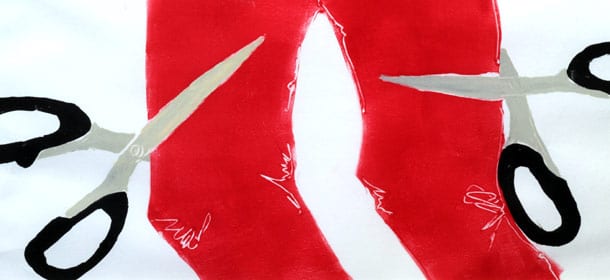
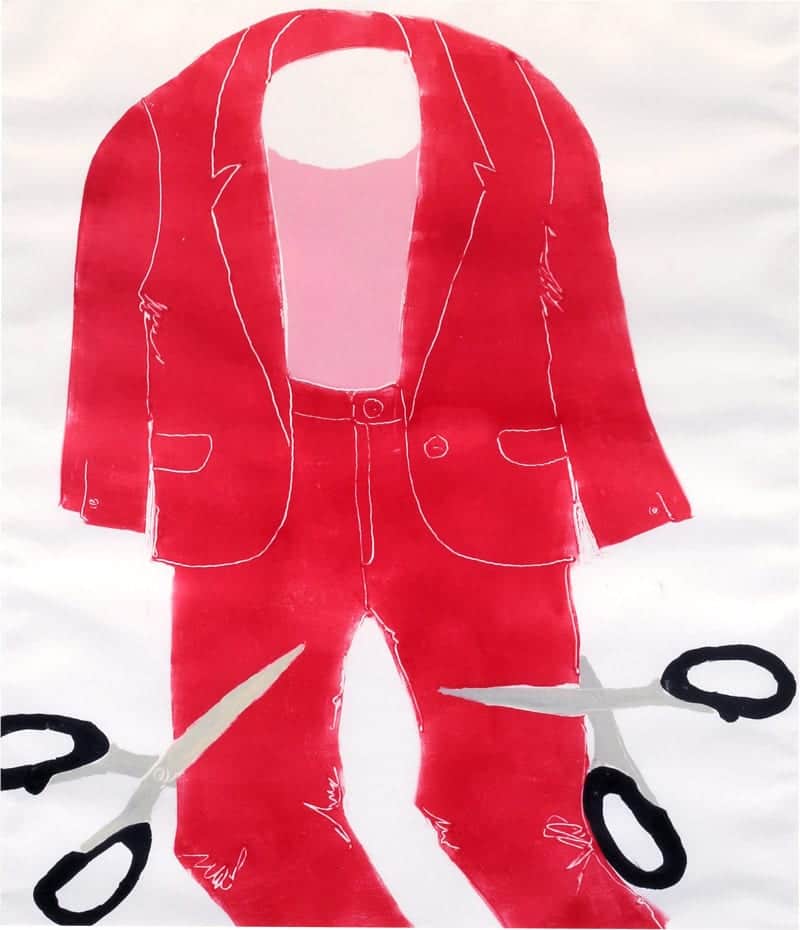
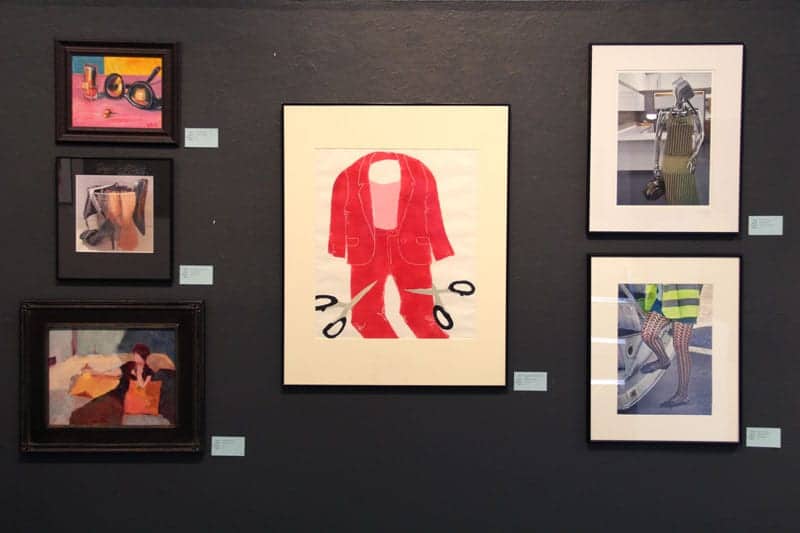
Women Can’t Wear Pants to Work, monotype by Rose O’Donnell (click for a larger version).
This month, during our “The Feminist Movement in Art” exhibit, some Art League staffers are reflecting on important works of feminist art that have influenced and made a mark on their lives. Gallery Director and printmaker Rose O’Donnell wrote about the story behind her honorable mention monotype. Click here to read the other article in this series.
I feel very fortunate to have had a piece accepted into this month’s “Feminist Movement in Art” exhibit. Not only that, I received an Honorable Mention from our juror, Amanda Jirón-Murphy, from the Hamiltonian Gallery in DC.
My monotype of a red pants suit with two pairs of scissors preparing to cut off the pant legs has inspired a lot of people to ask about the story behind this piece and to share some of their own experiences. The monotype is titled Women Can’t Wear Pants to Work, and it is based on my own experience in 1972.
Here is my story and some of the stories I have collected about being a working woman in the 1970s. It shows that women have come a long way in the workforce. But it also shows that we have a long way to go to achieve true equality.
I graduated from University of California, Berkeley in the heady days of the Vietnam War protests. The feminist movement was just gaining strength. Gloria Steinem had just begun to gain prominence as a leader in the women’s rights movement with her article in 1969, “After Black Power, Women’s Liberation.” In 1971, the National Women’s Political Caucus was founded and shortly after that the Equal Rights Amendment was introduced, fought in Congress, but did not pass. I was aware of all these things but more concerned with just getting a job.
I found work as an accountant at the local Montgomery Ward department store. My daily task was to total up all the receipts from each department on a giant 10-key adding machine. Our office was a “pool” style workplace. We all sat at long tables and didn’t really have desks of our own. It was a boring, soul-sucking job, but I was trying to save up money to attend graduate school.
One day I wore a red pants suit my mother had given me for Christmas. It was the nicest piece of clothing I owned at the time and I was proud of the way the double-knit bell-bottoms fit (I was skinnier then). At work that day, my boss told me that the store manager wanted to meet with me. I thought at the time that maybe I was up for a promotion.
I walked into his office. He was sitting behind his desk, and the human resources guy was sitting on the corner of the desk, “Mad Men” style. The manager said, “Nice pants suit.” I thanked him, very pleased with myself.
He then said, “You can’t wear pants to work.” I just stood there, slightly stunned, looking back and forth at him and the HR manager, both in pants. He then explained, “Women can’t wear pants to work.” The HR manager then chimed in, “Plus, we’d like to see those pretty legs of yours.”
I was horrified. In those days, you didn’t speak up. You just “took it,” according to my mother. I went home and cried but I never wore that pants suit again.
More artwork from “The Feminist Movement in Art”
When I started sharing this story, I began hearing of other women who encountered similar discrimination in the workplace. One artist told me that the women in her Austin, Texas office got together and marched around the cubicles demanding the right to wear pant suits to work. Another woman told me that she interviewed for a job as a legal secretary and was asked to sign an agreement that she wouldn’t get pregnant. Another person told me that she was scheduled to attend a business conference with her boss. He came to her and said that women weren’t allowed to travel.
The women’s movement and the feminist art movement helped to bring about a lot of changes in our world. I wear pants almost every day now. And, even though women have advanced from being paid 60 percent of what a man in the same job made in 1970, today we only make 73 percent of what a man would make. We still use the phrase “who wears the pants in that family” as a derogatory term about women who are the decision makers in their families.
These stories and my own enrage me even today. Why did we put up with that? Why did I put up with that? It is our job as humans to bring about even greater change so that, as Steinem put it, we create “… a society in which there will be no roles other than those chosen or those earned.”
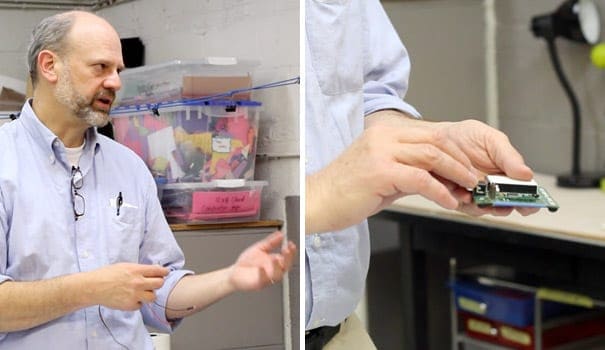
Instructor John Kauffman demonstrates microcontrollers at Artfête 2013.
Motion, Light, And Sound:
Dynamic Sculptures And Installations
June 14–15, 2014 / $180 Registration page
What is a microcontroller?
It’s another tool in the artist’s kit. A way to add lights, sound, and movement and make artwork interactive and dynamic. And it’s the subject of an upcoming workshop at The Art League.
This new-media workshop was offered for the first time last August, when we shared a Q&A with the instructor, John Kauffman. Here it is again:
What will students do in this workshop?
John Kauffman: Students will work with a microcontroller — a very small, cheap, self-contained computer. The students will also have some standard electronics components like those seen on any electronics circuit.
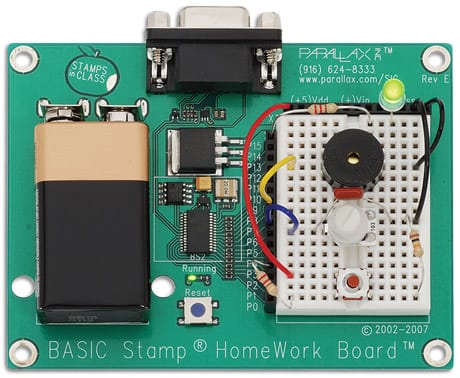
The microcontroller in the BASIC Stamp Activity Kit used in the workshop.
Then there are some little devices that sense the environment (light, switches) and more that control the environment (motors, lights, speakers). These pieces can be inserted in different combinations so there is no need to solder or use other special tools. All of the bits are re-usable for projects after the class.
Animating art consists of three parts: sensing the environment (light levels, the viewer twisting a dial), outputs (in this workshop: motor, lights, and sound), and in between, the microcontroller itself — listening to the inputs, deciding what to do, and controlling the outputs.
You can think of this as another tool in the artist’s kit. A potter uses a kiln, a painter the different types of paint, and a photographer a camera. Mastery of each kind of equipment enables the artist to go from the idea to the finished product. The microcontroller is another tool to implement the artists’ concept into a finished piece of art.
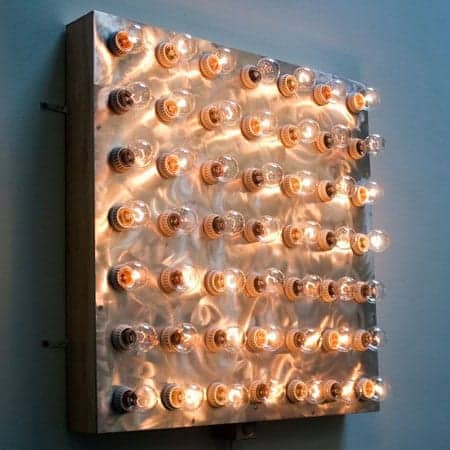
Changing Lights by Simon A.J. Winder. Winder’s description of the piece: “The viewer is chaotically and warmly illuminated.” Image used with permission.
Who is this for? Do students need any experience?
Several types of people can enjoy this course — people who have a piece in mind and need the knowledge to implement it, people who want to learn what’s possible, and life-long learners without a specific purpose at the present, who enjoy the challenge of new ideas. This is a completely fresh arena for most artists.
This course is very carefully designed to start at zero and only spend time on technical details as needed for the goals. For example, everything you need to know about electricity is summed up in three sentences. Only a few dozen technical terms are used and these are carefully explained. If you understand half the functions of a digital camera, then you will have no problems with this course. It is very useful to be capable of assembling small pieces using screwdrivers, pliers, etc. I have always admired the deftness of a painter or drawer to produce dozens of effects from the same brush or chalk — these kinds of people will have no problem. A magnifying glass or jeweler’s loupe is useful if you have trouble focusing close; I use one all the time.
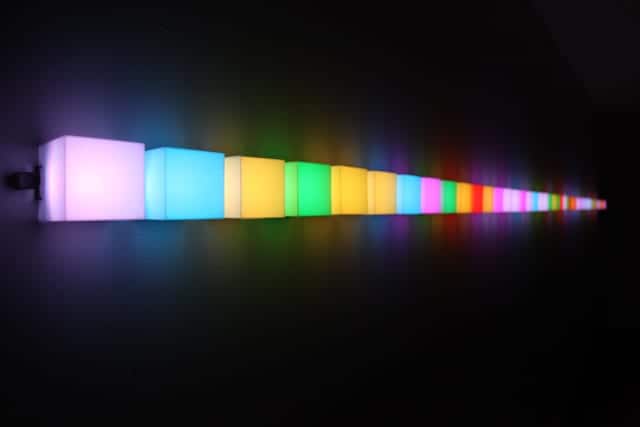
rgbca #2 by Philip Galanter was made with a microcontroller (like the ones used in this workshop) and LEDs. Watch a video of the installation in action on Galanter’s website. Image used with permission.
What’s your background?
I’m a techie, not an artist. But I love observing and learning about art. The Metropolitan Museum of Art had Tuesday evening docent tours and I barely missed one in the 18 months I lived in Manhattan.
I’ve been working with the microcontroller tool for ten years and teaching technology in general an additional ten. I view myself like an expert in digital cameras or lithographic presses. I can teach the techniques, trouble shoot problems and explain the capabilities and limits. But it may be very hard for the technician to produce a great print.
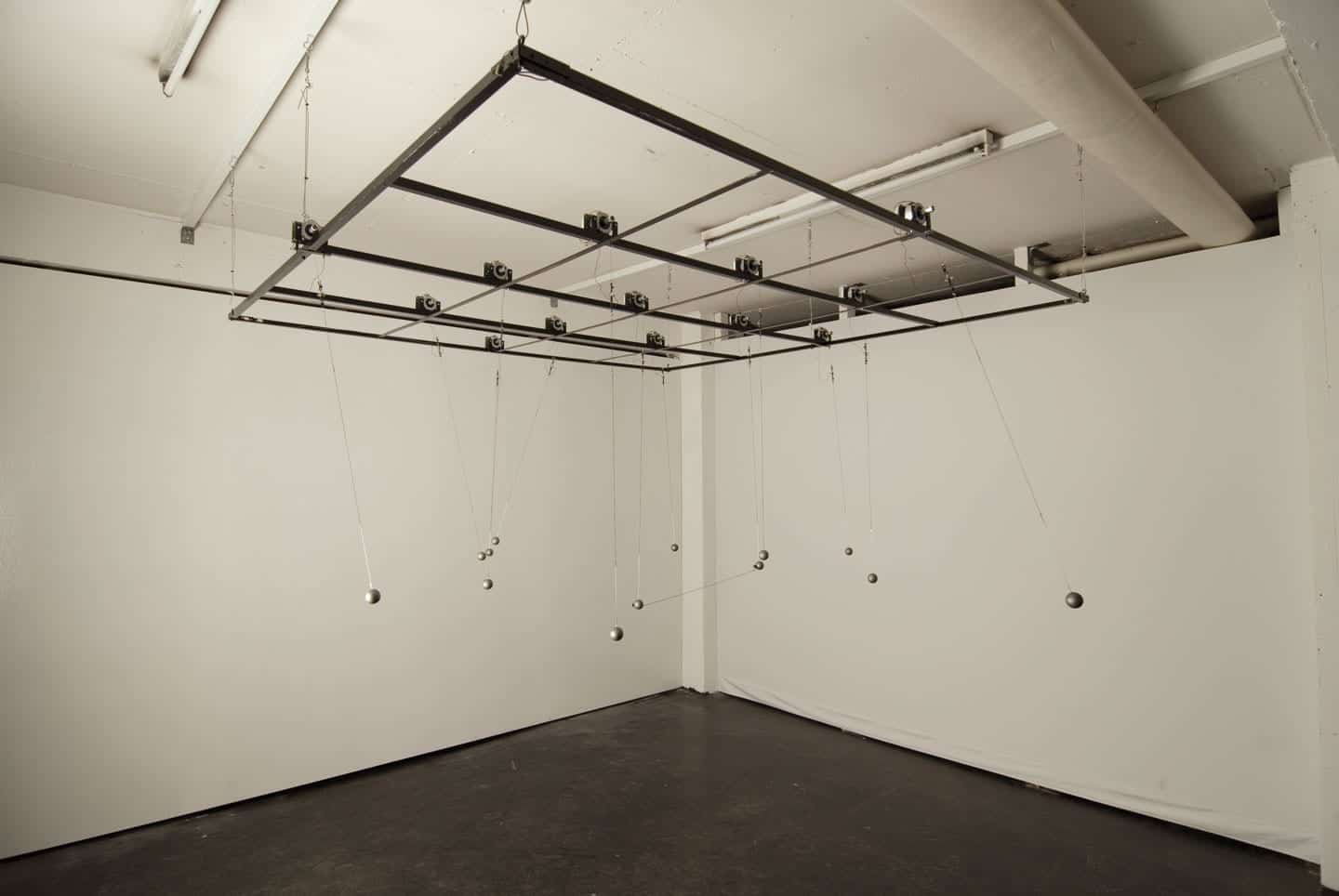
Connect, a “feedback-driven sculpture” by Andreas Muxel, uses microcontrollers to control 13 steel balls. Image used with permission.
What will students take home after 2 days?
Students will go home with knowledge and experience. They will have completed about a dozen projects, although each one is deconstructed to re-use the parts in the next. These projects will be demonstrations of techniques, not actual artistic pieces. I think just as important is that participants will understand what can and cannot be done with this tool. Artists will not end with a finished piece in this short course, but keep your eyes open for follow-up courses where we develop a given technique into a finished piece.
“Failure is the condiment that gives success its flavor.” ― Truman Capote
DC Art Bank last chance!
Deadline: May 23. The DC Commission on the Arts & Humanities is seeking to purchase two- and three-dimensional works of art. To expand the District’s collection further into new media forms of contemporary art, we strongly encourage video artists and other technological innovators to apply. Artists are also encouraged to submit works in series. This call is open to all artists who reside or maintain studio space in the Washington, DC metropolitan area; including surrounding areas in Maryland and Virginia. Read the full call to artists →
(e)merge
Deadline: May 30. The (e)merge art fair will take place October 2–5, 2014 at the Capitol Skyline Hotel. (e)merge will feature international galleries and nonprofit spaces along with independent artists. Work in all media (including painting, sculpture, works on paper, and photography) will be carefully considered, projects involving experimental works in non-traditional formats are especially encouraged. The application fee is $55. More about the art fair →
Readymade@100
Deadline: June 15. This Fall, the American University Museum at Katzen Arts Center will present “Readymade@100,” an exhibit celebrating the 100th anniversary of Marcel Duchamp’s readymade concept. The exhibition is curated by Maryland artist, art theorist, and Corcoran College of Art and Design professor Mark Cameron Boyd and includes an “open call,” juried exhibit opportunity seeking submissions of “new” readymades from artists that significantly expand upon Duchamp’s idea. More about the exhibit →
Call for Proposals: Kentucky
Deadline: July 1. Interstruct, at the Lexington Art League, is a multi-site exhibition taking place in a number of spaces in Lexington, Kentucky. Artists are asked to submit proposals for projects that respond directly to a place. In the proposal, artists can indicate a specific location in or near Lexington, or can describe the type of space appropriate for the work (old bourbon distillery, historic home, public parking garage, cemetery, domestic/urban exterior, etc.). Read the full call to artists →
Re-runs: the announcements below have appeared here previously, but there’s still time to enter!
Touchstone Gallery
Deadline: May 27. Touchstone Gallery is planning a return engagement of the MiniSolos@Touchstone guest artist exhibit during the month of August. It is a once-a-year opportunity for area artists to have a “mini-solo” show in our contemporary gallery. There is no entry fee, but a $250 hanging fee for accepted artists. More about the exhibit →
Crafty Bastards 2014
Deadline: June 6. Crafty Bastards Arts & Crafts Fair — an exhibition and sale of handmade alternative arts and crafts from independent artists — will be held Saturday, September 27 and Sunday, September 28, 2014 from 10 am – 5 pm. There is a jurying process for vendors and a $20 application fee. More about the fair →
Washington ArtWorks
Deadlines: See below. Washington ArtWorks in Rockville, Maryland has three open calls for artists:
Claire Carroll, Woman Shoots Man (click for full size)
Photographer Claire Carroll is on a roll in the Gallery, with two different jurors recognizing her pictures with Best in Show awards in two months. Last month we featured a Q&A about her extra-colorful Lifesaver in “Pop Art.” Today’s Q&A is about Woman Shoots Man, which won the Amelia T. Clemente award in our exhibit open through June 2, “The Feminist Movement in Art.”
Juror Amanda Jirón-Murphy said Woman Shoots Man recalled Jeff Wall’s 1979 photograph, Picture for Women, with the roles of male artist and female subject switched — the same reversal of roles that caught Carroll’s eye after taking the image.
What was your goal with this photograph? How do you think it fits into the tradition of feminism in art?
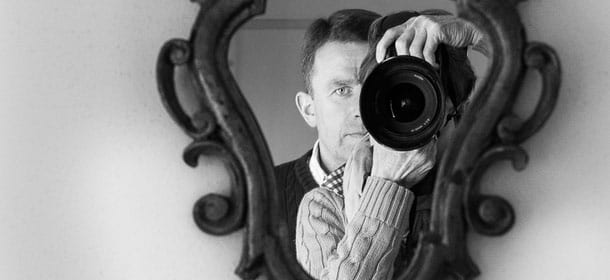
Claire Carroll: I was actually shooting myself in the mirror — which is something I have done on other occasions if the mirror, or the larger reflected area, is interesting — when my husband walked into the frame and peered at me in the mirror. I saw the shot immediately and positioned him so that he was only partially visible and staring directly into the camera/at me. It took a few shots to get it right as he is a reluctant model!
What struck me about the image with respect to feminism is that so often in art, men are the artists and women are the models. Not always, obviously, and much less so now, but traditionally it was that way. In my image the role is reversed. The title, Woman Shoots Man, was also carefully chosen to suggest woman’s power over man. There are so many stories in the news at the moment about men overpowering and suppressing women that I wanted to show an instance of woman being in control of man.
Are there any feminist artists you looked to for inspiration for this photograph, or in general?
To be honest, I didn’t create this image to fit the exhibit and I was so lucky to have taken it so recently and for it to have fitted the theme so well. So in that respect I wasn’t looking for a feminist influence for the image. There are some incredible female photographers and in portrait photography Julia Margaret Cameron is inspirational. Her work is so evocative and timeless.
Julia Margaret Cameron: Beatrice, 1866, Albumen silver print. The J. Paul Getty Museum, Los Angeles. (click for full size)
How was this different from your other portrait work?
As I mentioned I have taken a few selfies in mirrors but no other self portraits. I do shoot portraits of other people but they are natural rather than staged. I think I will be exploring a different approach to portraits in the future.
Born in Alexandria, drawing since age two, and now on his way to teach in Shanghai, Dan Thompson is leading a workshop next month focused on portraiture — specifically, painting the human head in oil.
Dan Thompson, Jason
Thompson said his goal for the workshop is to articulate a series of questions and problems in portrait painting, then address them each in turn. For example, he’ll give pointers on painting the neck — an under-appreciated and misunderstood part of portrait work, he said.
Anatomy will be an important part of the workshop — not the determining factor in a successful portrait, but a useful building block. Students of portraiture should know the interior structures first, then move beyond them, Thompson said. In the same way, workshop students will complete grisaille studies laying out an approach to light and dark before they add color.
To answer the question of what makes a successful portrait, Thompson pointed to the three criteria laid out by John H. Vanderpoel: action, construction, and character. The last, which refers to the subject’s personality, is what creates a sense of “vitality” in a portrait, Thompson said.
Dan Thompson, Blaine
Thompson has taught at The Art League for years, but his first visit here was as a student. After starting in art as a two-year-old, then dabbling in music, he returned to art as a teenager. He graduated from the Corcoran, then took classes at other institutions (including The Art League) before being accepted to the New York Academy of Art, where he graduated valedictorian. (His full biography can be found on his faculty page.)
Before his June workshop at The Art League, Thompson will be traveling to the University of Shanghai to teach and advise residency winners from the New York Academy of Art. As exciting as that is, he said he’s still looking forward to teaching the “motivated community” of students here in Alexandria when he returns.
Evening in Paris, colored pencil on frosted Mylar, by Suzanne Vigil. Winner of the Marker Award in the May All-Media Exhibit. (click for full size)
The last time we featured painter and colored pencil artist Suzanne Vigil on this blog, she was fresh off a solo exhibit in the Gallery and an award for the April 2013 “Flora & Fauna” exhibit. In that interview, she told us about a narrative, character-based series called “Labels.”
This time around, Vigil has a new award — the Marker Award for Best in Show in the May All-Media Exhibit — and a new direction in her colored pencil work:
Is this part of the “Labels” series? What are you working on now?
Suzanne Vigil: Evening in Paris is the beginning of a new series I’m developing with colored pencil.
I continue to use frosted mylar and work both sides of the film. I arrived at this new limited color concept as I was organizing my many boxes of pencils. I noticed there was a enormous variety of grays. Warm grays, cold grays and French grays. As a colored pencil artist, I use multiple layers of colors to achieve tones and wondered if I could convert that concept to gray. Rather than use a lighter hand to do highlights as you would with graphite, I selected a specific gray (20%, 40%, 60%) to arrive at that tone. What a surprise! I maintained the same hand pressure but got the lights and darks I was looking for.
Detail from Evening in Paris
I separated my grays into warm for skin tones and cold for clothing and background. This pushed the effect even further and gave a greater sense of animate versus inanimate. As I studied the drawing, I recalled the bottle of Evening in Paris perfume my mother kept on her 1950s skirted dressing table. The bottle was deep blue. All those memories are faded now which prompted me toward the other component of this drawing, the slightly tinted areas on the face and the bottle. Just a “suggestion” of color.
I think of this, and the others which will follow, as a black and white drawings. The color, which is applied primarily to the backside of the mylar, is a subtle reminder to the viewer of a time past.
A real failure does not need an excuse. It is an end in itself. — Gertrude Stein
Virginia artists last chance!
Deadline: May 16. Virginia residents 18 and over are invited to submit to a juried art show presented by the Bay School Community Arts Center in Mathews, Virginia. Over $3,000 in prizes are available. More about the exhibit →
Touchstone Gallery
Deadline: May 27. Touchstone Gallery is planning a return engagement of the MiniSolos@Touchstone guest artist exhibit during the month of August. It is a once-a-year opportunity for area artists to have a “mini-solo” show in our contemporary gallery. There is no entry fee, but a $250 hanging fee for accepted artists. More about the exhibit →
Crafty Bastards 2014
Deadline: June 6. Crafty Bastards Arts & Crafts Fair — an exhibition and sale of handmade alternative arts and crafts from independent artists — will be held Saturday, September 27 and Sunday, September 28, 2014 from 10 am – 5 pm. There is a jurying process for vendors and a $20 application fee. More about the fair →
Washington ArtWorks
Deadlines: See below. Washington ArtWorks in Rockville, Maryland has three open calls for artists:
“Off the Wall” (deadline: July 1, or when space runs out) Artwork priced at $500 or less
Re-runs: the announcements below have appeared here previously, but there’s still time to enter!
Paint! Manassas
Registration: through May 20. Competition phase: May 2–June 6. Exhibit: June 7–30. Your art must depict sights found in Historic Old Town Manassas. Art must be created between 5/2 and 6/6 with an approved date stamp. More about the event →
DC Art Bank
Deadline: May 23. The DC Commission on the Arts & Humanities is seeking to purchase two- and three-dimensional works of art. To expand the District’s collection further into new media forms of contemporary art, we strongly encourage video artists and other technological innovators to apply. Artists are also encouraged to submit works in series. This call is open to all artists who reside or maintain studio space in the Washington, DC metropolitan area; including surrounding areas in Maryland and Virginia. Read the full call to artists →
Ward 5 Artists
Deadline: May 30. Artists living or working in Ward 5 are invited to submit work for Artists Off-Rhode at Off-Rhode Gallery. No entry fee. More about the exhibit →
Washington Printmakers Gallery
Deadline: May 31. WPG is now accepting entries for the 2014 National Small Works exhibition. Submitted works must be original hand-pulled or digital inkjet prints, completed within the past two years, with an image no larger than 170 square inches and a frame no wider than 18 inches. Photographs will not be considered. More about the exhibit →
Digital Magic
Deadline: June 1. Digital photography, digital painting, 3D modeling, 3D printing, web based artwork, digital installation, video, phonography, mobile device display, and mixed media works are all potential objects for exhibition. Read the full call to artists →
Del Ray Artisans
Receiving: June 1–2. “SUITES” at Del Ray Artisans is open to all area artists. The theme is SUITES: Scandalous, Uproarious, Intriguing Titillating Entanglements & Seductions.Read the call for entry (PDF) →
Artist in Residence at Artisphere
Deadline: June 4. Artisphere is offering a free 500 square foot studio space for one artist each for a five month time period in Fall 2014 and Spring 2015. More on the residence →
Strange Bedfellows
Deadline: June 6. Strange Bedfellows is organized by Washington Project for the Arts and will be located at VisArts at Rockville. This exhibit will explore intimacy in its various incarnations, approaching the topic from a variety of angles. More about the exhibit →
Photo Review contest
Deadline: June 30. Jennifer Blessing, Senior Curator of Photography at the Guggenheim Museum in New York City, will be the juror for the 2014 Photo Review Photography Competition. More about the contest →
This month, during our “The Feminist Movement in Art” exhibit, some Art League staffers are reflecting on important works of feminist art that have influenced and made a mark on their lives. Communications Director Erica Fortwengler writes about her encounter with a sculpture on Capitol Hill that left a lasting impression. Click here to read the other article in this series.
In the summer of 2000 after my freshman year at William and Mary, I excitedly began an internship on Capitol Hill for a Democratic Congressman from Pennsylvania. It was President Bill Clinton’s last year in office, months before the painful Bush/Gore election. Hillary Clinton was running for the open U.S. Senate seat in New York, and rumors were swirling about her future political ambitions beyond Capitol Hill. Terrorism and 9/11 were not yet part of our daily vernacular, and we lowly interns could wander just about anywhere around the Capitol grounds with a flash of the badge.
Summer is the peak of the tourist season in DC, and constituents from the home district would roll into town eager for a private VIP tour of the Capitol building. Luckily, this task fell into the intern column. It was my favorite part of the job.
In preparation for our roll as tour guide, we had to learn about all of the art in the Capitol. My very favorite piece was, and still is, “The Portrait Monument.” Not only do I love that the sculpted tribute to three of our most important women suffragists is (now) proudly displayed in the Rotunda, I adore that when carved in 1920, the artist had the foresight to realize that her “monument” to women’s rights was not complete.
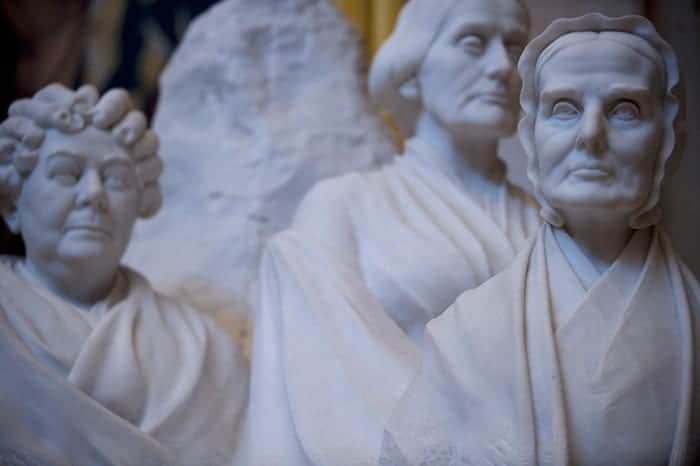
Close-up of the Portrait Monument to Lucretia Mott, Elizabeth Cady Stanton, and Susan B. Anthony, by Adelaide Johnson (1920) (Courtesy Architect of the Capitol)
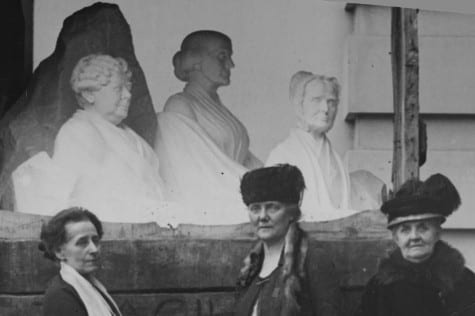
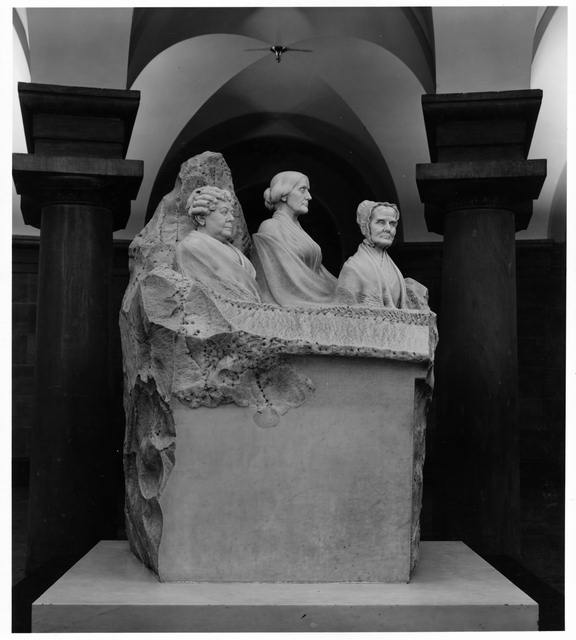
Sculpted out of Carrara marble by Adelaide Johnson, this monument features three busts of the seminal leaders of the woman’s suffrage movement: Elizabeth Cady Stanton, Susan B. Anthony, and Lucretia Mott. The National Women’s Party presented the monument to the U.S. Capitol in February 1921, but it wasn’t without much controversy.
The statue at the unveiling. Adelaide Johnson is on the left, with Dora Lewis and Jane Addams (Photo courtesy The Library of Congress)
Then President of the National Women’s Party (NWP), Alice Paul, had to order the sculpture to be dragged down the street by mules from the NWP headquarters to the Capitol. Eventually, Congress begrudgingly accepted the gift. Before the unveiling, Congress ordered the original inscription on the sculpture to be whitewashed, removing lines such as “Men, their rights and nothing more. Women, their rights and nothing less.” After one day in the Rotunda, the sculpture was moved to the basement where it stayed for 76 years. In 1996, after a campaign to raise $75,000 to bring the statue to the Rotunda, the sculpture was finally brought up from the basement for public view.
It’s impossible not to notice that behind the carefully sculpted busts of the three women is a lump of unfinished marble; and this is where rumors begin to swirl about the monument’s intended message.
Some say that to Johnson, the unfinished monument referred to the unfinished work in the quest for women’s rights. Others say that the ambiguous shape represents all of the unknown women who have fought, and will fight, for women’s equality. Johnson saw herself as a “feminist, not merely a suffragist,” and that having the right to vote was an important step along the road, but certainly not the final destination. She knew there was still a tremendous amount of work ahead.
The Monument on display in the Crypt (Courtesy Library of Congress)
Urban legend has it that Johnson intended for the unfinished chunk of marble to be reserved for the first female president. At least that’s what I was told when I began my Capitol tours. Interestingly, in 2000 when I would share this tidbit with my tour groups (and again when I returned to intern in the summer of 2001), most everyone would chime in and say that they thought Hillary Clinton would be the one to claim the spot. Mind you, Hillary Clinton had yet to be elected to the U.S. Senate.
I haven’t been back to the Capitol building since I gave my last tour in August 2001, but I think about that sculpture often. I wonder if the legend is true, and if so, who will claim the fourth spot and when. Now that we’re at the precipice of the 2016 election season with the rumors rampant of a Hillary run, I can’t help but hope that “The Portrait Monument” will soon be completed with our first Madam President.
Have you signed up yet for Martha Wilson’s free talk, May 22 at The Art League? Are you wondering who Martha Wilson is, and what her work is all about? We recently ran across this 2012 interview on the Art21 blog by Emily Colucci, and wanted to share it with you:
Even though it’s always based in performance art, your work has gone through a few different evolutions over the years. How would you describe the progression of your artwork?
Martha Wilson: The work that I started doing from 1971–1974 was photo-text work. I had the concept and then, I would either take the photo myself or have someone else take it for me to find out how the experiment was going. Someone had to take a photo for me so Richard, who was the boyfriend who looked like Marcel Duchamp, who dumped me, did so.
Then Richard dumped my ass and I moved to New York. I decided if I’m going to put my personality together I’m going to do it in New York. I found the feminist movement and discovered the most marvelous, welcoming environment to land in. I started an all-girl band, Disband, which was made up of members who couldn’t play instruments. At that time in the 1970s, everyone was in three bands in the no wave scene. Then, Disband disbanded.
I was doing these live performances as the First Ladies, starting with Nancy Reagan. For decades, my studio consisted of a suitcase where I would carry my heels, my hose, my suit, my wig, my pearls. I still have that suitcase.
Then, Mitchell Algus discovered me in 2008 and asked if I could look back at my work from the 1970’s. So I pulled everything out from under the bed. And my friend said, “Now that you have a dealer you have to ask him for another show.” I didn’t really have any new work, then I thought I could revisit the information in the photo-text works from the perspective of a woman north of 60 years of age.
Read the full Q&A here, which also touches on Franklin Furnace — the artist-run space Wilson founded and directs, and which she’ll be discussing at The Art League. You can see more of Martha Wilson’s work on her website, marthawilson.com, and don’t forget to RSVP!
If you weren’t able to attend last week’s lecture on Neo-Expressionism, you’re in luck! The talk by Gallery Director Rose O’Donnell is reproduced below, for all our members wondering about the theme of next month’s exhibit (or anyone else who’s curious).
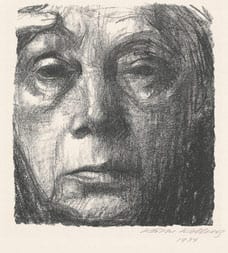
1. Origins: German Expressionism
Kathe Kollwitz
Movement from the 1920s
Started in Germany
Artists such as Max Ernst, Edward Munch and Kathe Kollwitz (right)
Subjects featured personal, emotional visions and highly charged political statements
2. What came before
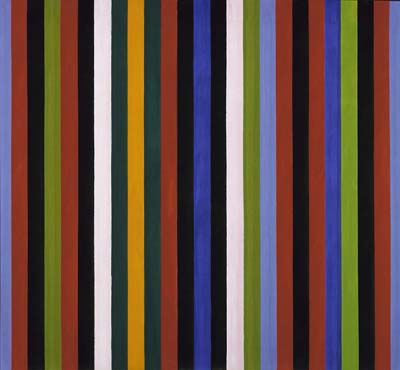
Gene Davis, Art League instructor
Abstract Expressionism: Art movement of the 1950s characterized by spontaneous gestures and abstraction
Colorfield: Works focused on large blocks of color, minimal and abstract
Pop Art: Movement of the 1960s and 70s that included images from popular culture, advertising and news
3. When, How, & Why
Neo-Expressionism was a style that emerged in the early 1980s in Italy, Germany and the United States
George Baselitz, a German artist, led a revival of German Expressionism, a movement of the early 20th century
Artists wanted to break from the strict abstraction and formalism of Conceptual and Minimalist (Colorfield) Art with its lack of emotion
Characterized by combining traditional subjects with political and emotionally charged subjects
Painters returned to myth and history for their subjects
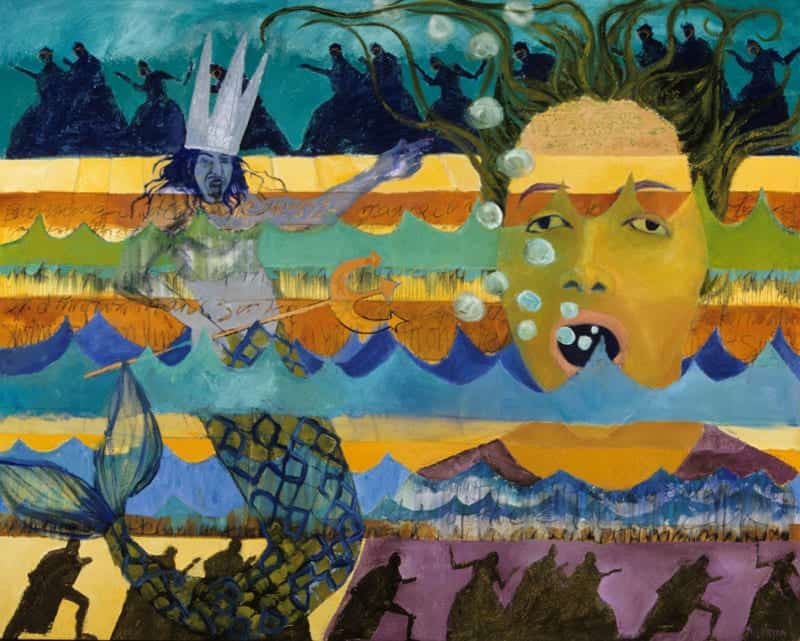
Poseidon and Me (detail) by Art League instructor Beverly Ryan
4. The Critics
“Supporters of Neo-Expressionism, and the larger return to painting in the 1980s, argued that Conceptual Art, Minimalism, and Pop had neglected art’s ability to activate the imagination, to invent myth, and to give vent to human emotion. However, some critics charged Neo-Expressionism with pandering to right wing politics and the tastes of the art market.” (TheArtStory.com)
“Artists now are involved instead with reclaiming that which has been rejected or popularized, and redefining the separateness of art. … Painters — and only a few years earlier painting was widely rumored to be dead — switched from acrylics to time-honored oils.” (Kim Levin, author of Beyond Modernism and juror for the June exhibit)
5. Characteristics of Neo-Expressionism
Appropriation of popular imagery
Return to the human figure
Return to traditional materials
Subliminal associations and fragments
Bringing art back to nature and into the familiar world
Opening reception & meet the artists: Tonight! May 8, 6:30–8:00 pm
Tonight’s the opening reception for three exciting new exhibits here at The Art League:
In “Playground,” painter Courtney S. Hengerer has created abstract paintings with freedom, spontaneity, and light touches of color that fit the exhibit’s name.
“The Feminist Movement in Art” asked our members to draw inspiration from the feminist artists of the 1970s, with reflections on women’s lives and experiences in the present day. Amanda Jiron-Murphy, gallery director at the Hamiltonian, juried this exhibit. You can find it on the blue walls of the Gallery, identified by the blue tags.
And in the May All-Media Exhibit, you’ll find a mix of artwork in all media, as selected by juror Mira Hecht, a DC artist and painting teacher at the Corcoran.
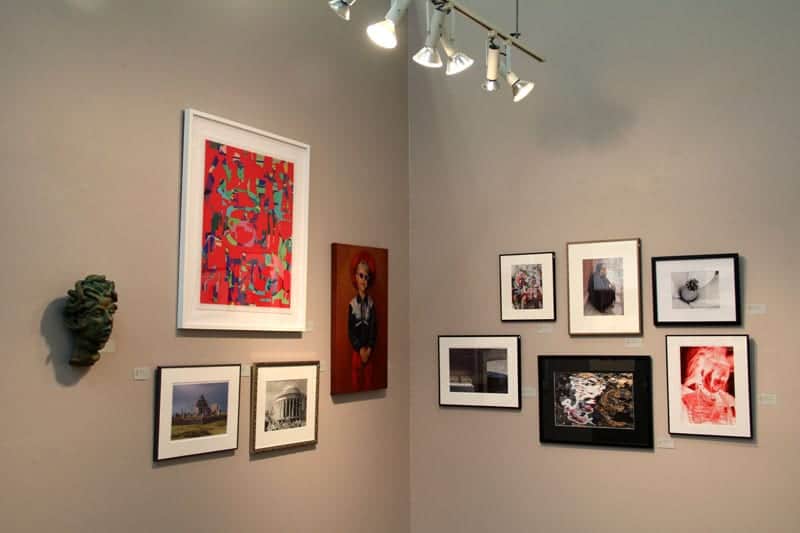
Tonight’s your chance to see these new exhibits and meet the artists behind them! The opening reception runs from 6:30 to 8:00 pm, and as always, it’s free and open to the public. Here’s a sneak peek at the Gallery for May:
Courtney S. Hengerer’s “Playground”From “Playground”The May All-Media Exhibit“The Feminist Movement in Art”“The Feminist Movement in Art” (foreground: Mother Time by Elena Tchernomazova)“The Feminist Movement in Art” (H by Ann Zahn and Rejoice by Josh Band)
“Try again. Fail again. Fail better.” — Samuel Beckett
Hill Center Galleries regional exhibition
Deadline: May 10. Open to DC, Maryland, Virginia, and Delaware artists. Original hanging work created in any medium within the past 3 years will be considered. Juried by Philip Kennicott of the Washington Post. More about the exhibit →
The Lobby Project
Deadline: May 11. The Lobby Project, organized by Washington Project for the Arts, has a 28′ l x 8′ h white wall with lighting in the lobby of a glassed office building. Selected artists will receive a $500 honorarium. The call is open to all artists regardless of media used or geographic location. Artists do not need to be WPA members and there is no submission fee. Read the full call to artists →
Paint! Manassas
Registration: through May 20. Competition phase: May 2–June 6. Exhibit: June 7–30. Your art must depict sights found in Historic Old Town Manassas. Art must be created between 5/2 and 6/6 with an approved date stamp. More about the event →
DC Art Bank
Deadline: May 23. The DC Commission on the Arts & Humanities is seeking to purchase two- and three-dimensional works of art. To expand the District’s collection further into new media forms of contemporary art, we strongly encourage video artists and other technological innovators to apply. Artists are also encouraged to submit works in series. This call is open to all artists who reside or maintain studio space in the Washington, DC metropolitan area; including surrounding areas in Maryland and Virginia. Read the full call to artists →
Re-runs: the announcements below have appeared here previously, but there’s still time to enter!
Underpass Competition
Deadline: May 9. The NoMa Parks Foundation seeks an artist, artist team, designer or architect to create designs for four railroad underpasses in the NoMa neighborhood of Washington, DC. More about the competition →
Figurative art
Deadline: May 12. “Flesh & Bone” at Hillyer Art Space is a juried exhibition that examines contemporary figurative art. Juror: Judy Byron. More about the exhibit →
Hillyer also has an open call for proposals for the 2015/16 exhibition season, with a deadline of September 28. More info here →
Cooperstown national juried exhibit
Deadline: May 15. The annual National Juried Art Exhibition is open to artists working in all mediums residing in the United States. The show runs in the July/August time slot and coincides with the peak of Cooperstown’s summer tourist season allowing for prime public exposure. Juror: Sondra Freckelton. More info and entry here →
Ward 5 Artists
Deadline: May 30. Artists living or working in Ward 5 are invited to submit work for Artists Off-Rhode at Off-Rhode Gallery. No entry fee. More about the exhibit →
Washington Printmakers Gallery
Deadline: May 31. WPG is now accepting entries for the 2014 National Small Works exhibition. Submitted works must be original hand-pulled or digital inkjet prints, completed within the past two years, with an image no larger than 170 square inches and a frame no wider than 18 inches. Photographs will not be considered. More about the exhibit →
Digital Magic
Deadline: June 1. Digital photography, digital painting, 3D modeling, 3D printing, web based artwork, digital installation, video, phonography, mobile device display, and mixed media works are all potential objects for exhibition. Read the full call to artists →
Del Ray Artisans
Receiving: June 1–2. “SUITES” at Del Ray Artisans is open to all area artists. The theme is SUITES: Scandalous, Uproarious, Intriguing Titillating Entanglements & Seductions.Read the call for entry (PDF) →
Artist in Residence at Artisphere
Deadline: June 4. Artisphere is offering a free 500 square foot studio space for one artist each for a five month time period in Fall 2014 and Spring 2015. More on the residence →
Strange Bedfellows
Deadline: June 6. Strange Bedfellows is organized by Washington Project for the Arts and will be located at VisArts at Rockville. This exhibit will explore intimacy in its various incarnations, approaching the topic from a variety of angles. More about the exhibit →
Photo Review contest
Deadline: June 30. Jennifer Blessing, Senior Curator of Photography at the Guggenheim Museum in New York City, will be the juror for the 2014 Photo Review Photography Competition. More about the contest →
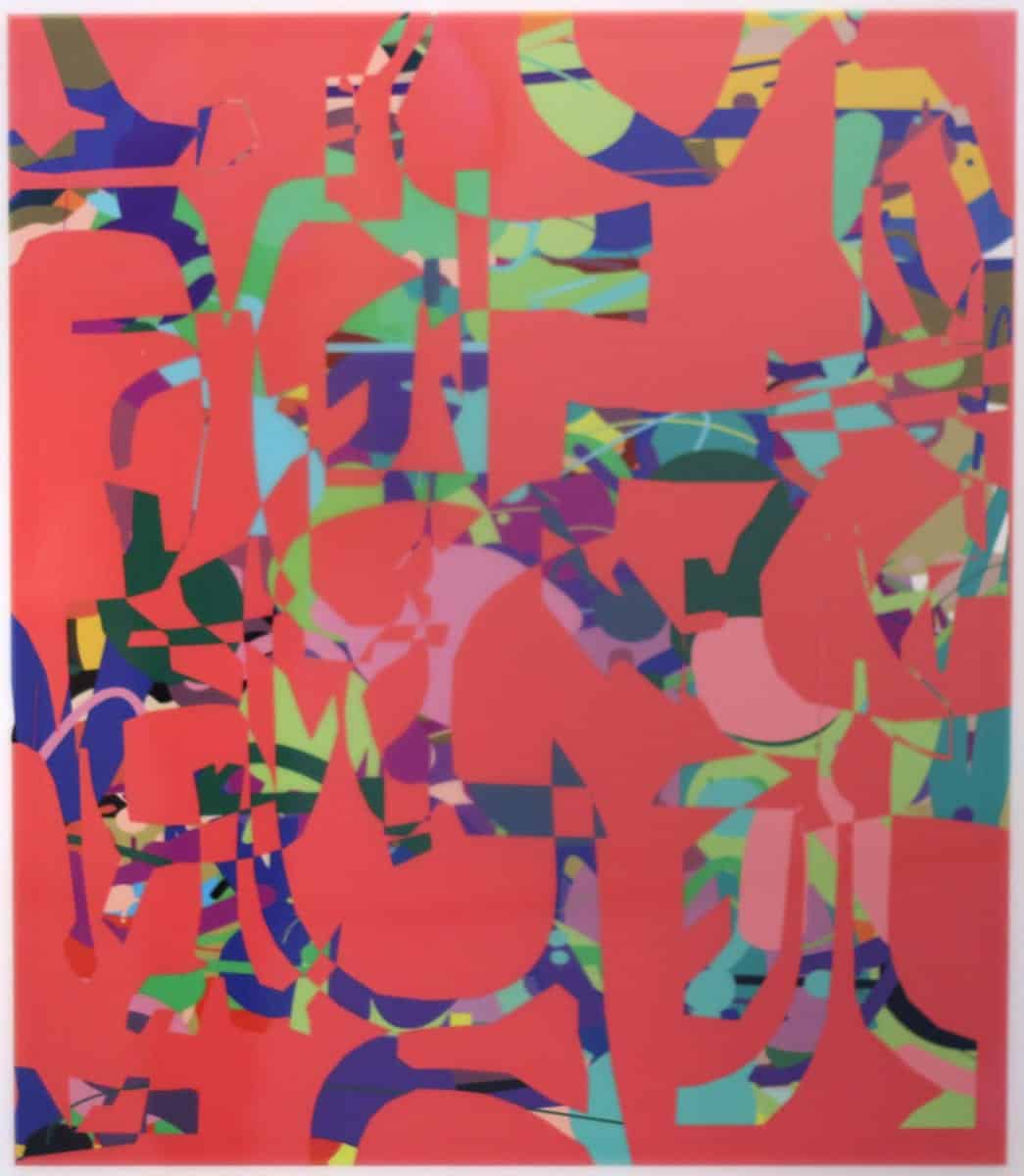
Arlie Hammons won the Marshall Award for best-in-show with his print, Klafangled #4, in the April “Pop Art” exhibit (open through May 5). We asked him when he knew he wanted to be an artist.
“I never wanted to be an artist,” he said. “I was dragged into it.”
Many Art League artists are people who have come to art later in life — as a career change, after retirement, or just picking it back up after a while. Hammons’ reason is different: he experienced a traumatic brain injury.
Before his injury, Hammons worked in IT. After his injury, he was first introduced to art by Marcia Dullum, an Art League and Torpedo Factory artist.
They met at a picnic in 2006, and when Hammons learned Dullum was an artist, he expressed an interest in finding out what he could do artistically — specifically, with graphic design, Dullum said.
They became art friends. He enrolled in a graphic design course at The Art League. Before he had a studio, he and Dullum would paint together in his garage.
Since then, he’s studied art with teachers including Marsha Staiger at The Art League and Mira Hecht at the Corcoran, and moved from graphic design into abstract art, while incorporating his background in computers.
“The way I see Arlie today … he’s kind of come back, full circle, to this place that he can use his expertise,” Dullum said. “When I see that piece down there (in The Art League Gallery), I see the full circle.”
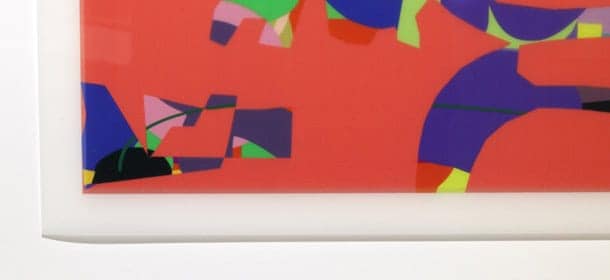
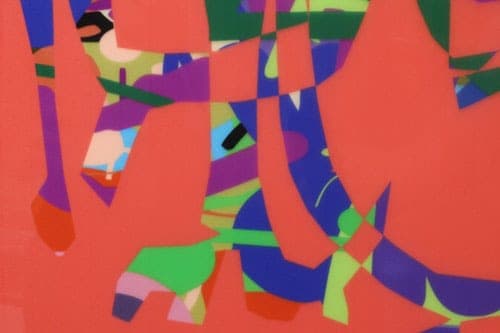
Detail from Klafangled #4
This piece, and the series it’s part of, has its origins about three years ago, when Hammons wrote a computer program to generate random images. Those images form the basis for paintings, or in this case, mylar prints. Hammons describes it in his artist statement:
“My paintings grow from within the confines of a computer screen. A programmatic computer image — random and non-repeatable — is created by a computer program that I write and at times modify. This image is masked out using free-hand drawing with a mouse and graphics software. The resulting image is hand-traced to create a vector image. These drawings are drastically enlarged and either digitally printed directly onto mylar using UV-cured ink, or hand-painted on canvas using synthetic polymers.”
Zippydi Do Dah #3 from the September All-Media Exhibit.
The main factor in deciding between a painting and a print is “how much time I have,” Hammons said. When he paints a piece, he’ll change a color if he doesn’t like it. With a print, he uses the colors as they come.
Hammons’ main motivation comes from a desire to experiment and make new things. The computer program came about because “I wanted to see shapes and things I hadn’t seen before,” Hammons said.
To print his images, Hammons wanted Mylar and the waxy look it creates, he said. Printing on Mylar presents its own challenges, which he worked out by talking to a printer.
After creating four series from his computer program, Hammons’ experimental energy and interest in randomness are currently leading him in a new direction: he wants to use a taffy pulling machine to make art. At the moment, he’s not sharing what that will look like, other than to say it will be more 3-D than 2-D. Like his computer, a taffy pulling machine would inject an element of chaos into Hammons’ artwork.
Dullum said she’s grateful that the juror recognized this body of work, and touched that Hammons credits her with starting him on the path to being an artist.
“But he did the work of learning to be an artist,” she said — work that includes large parts of rejection and showing up. Dullum said she hopes Hammons continues down the path he’s on.
“In art, you never find yourself. It’s a continual journey.”
Avis Fleming, Art League instructor and multitalented artist, has a new show opening today at Printmakers, Inc., with a reception this Sunday. Go see it! Here are the details:
“Printed, Painted, Potted,” a one-artist show of new etchings, lithographs, monotypes, paintings and ceramics by Virginia artist Avis Fleming, opens May 1 through June 30 at Printmakers Inc., in Alexandria’s Torpedo Factory Art Center. Opening reception is Sunday, May 4, 2–4 pm, in Printmakers, Studio 325 (third floor) of the Torpedo Factory Art Center.
Fleming’s work, in recent shows in Virginia, New Orleans and Maine, was also included in the 2013 New York City retrospective show “Banned in Washington,” color school painters of Washington, curated by Mark Dagley of New York. Her ceramic piece, “Louisiana Canton,” done in conjunction with potter/husband Paul Hodge, won honorable mention in the 2013 national ceramics show “Tabletop,” at The Art League, juried by Linda Christenson of Minnesota. Fleming has taught figure and sketchbook drawing and other classes and workshops at the Art League School for more than 25 years.
Fleming’s work in this show includes prints, paintings and ceramics of Maine, Ireland, Louisiana and rural Loudoun County Virginia, where she has a studio and where she and her husband have a small farm in the historic Quaker village of Unison.
The Printmakers exhibit will be open daily 11 – 6, May 1 to June 30. For more information about the show and Fleming’s work, see www.avisflemingart.com.
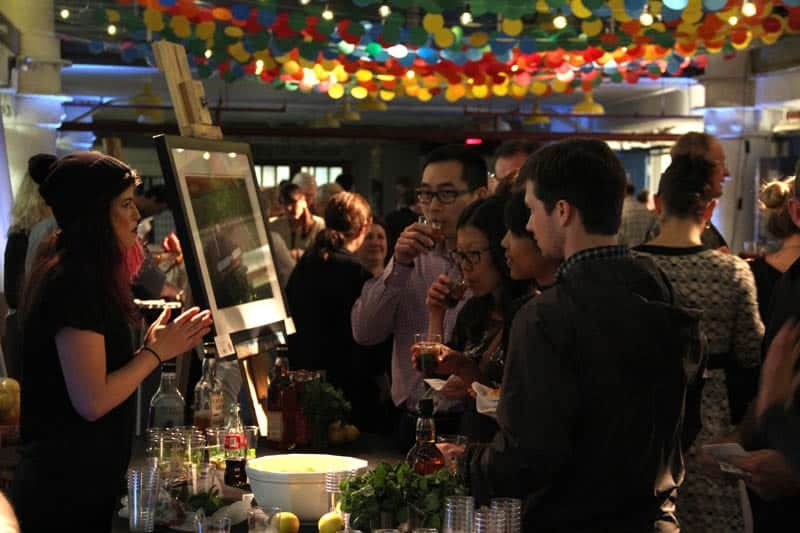
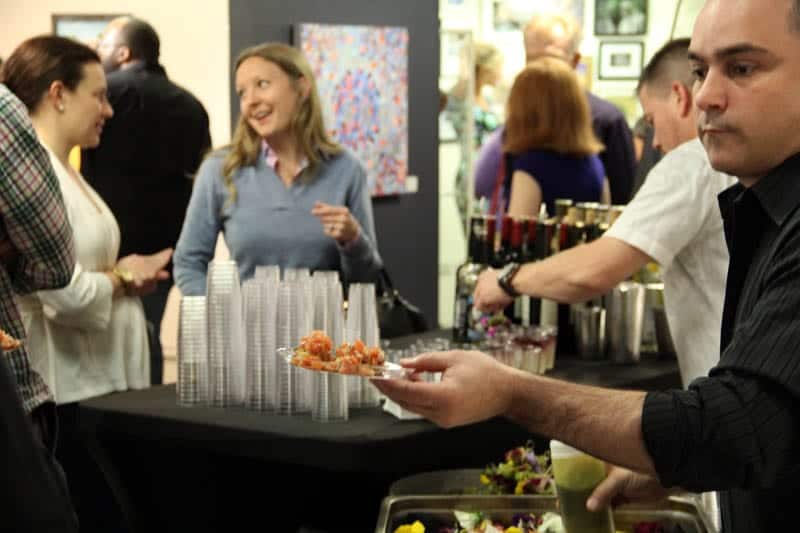
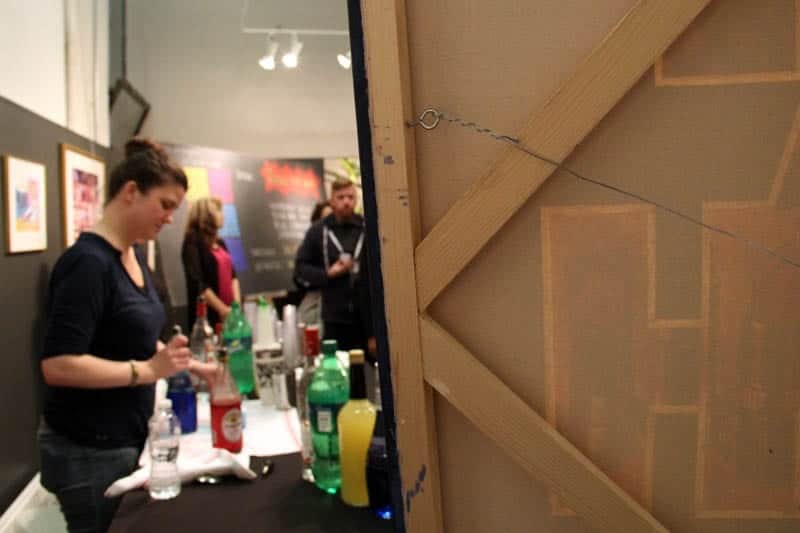
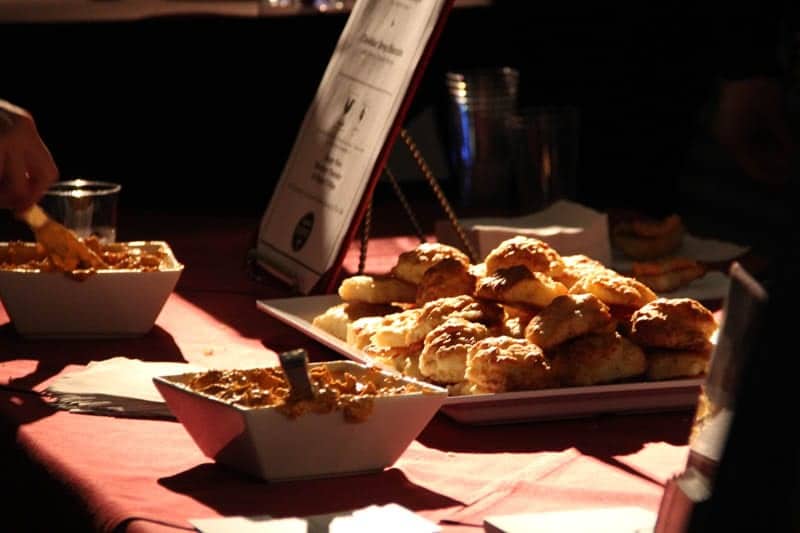
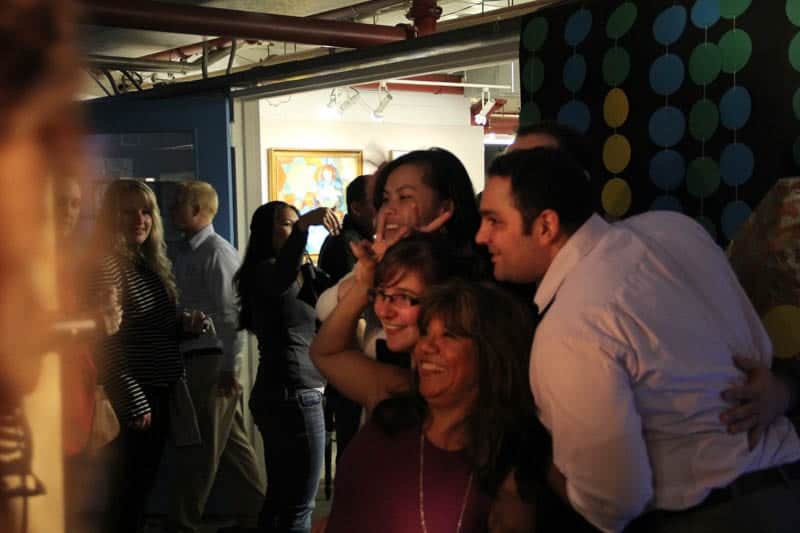
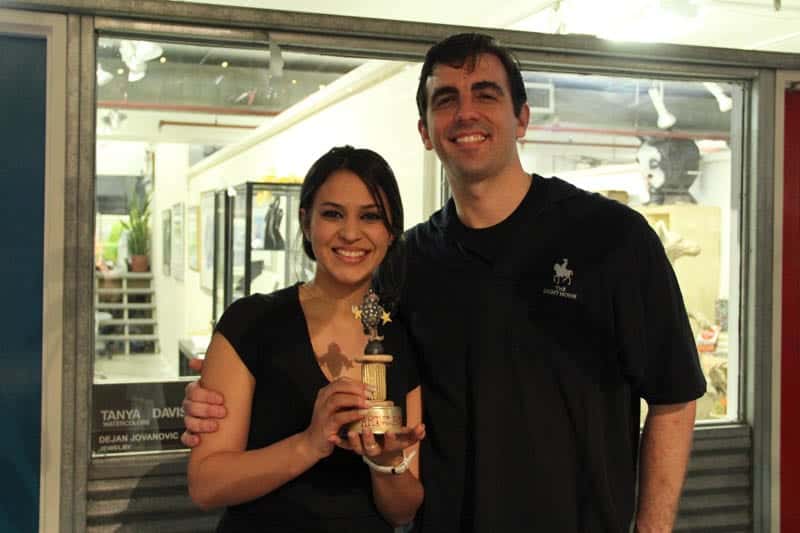
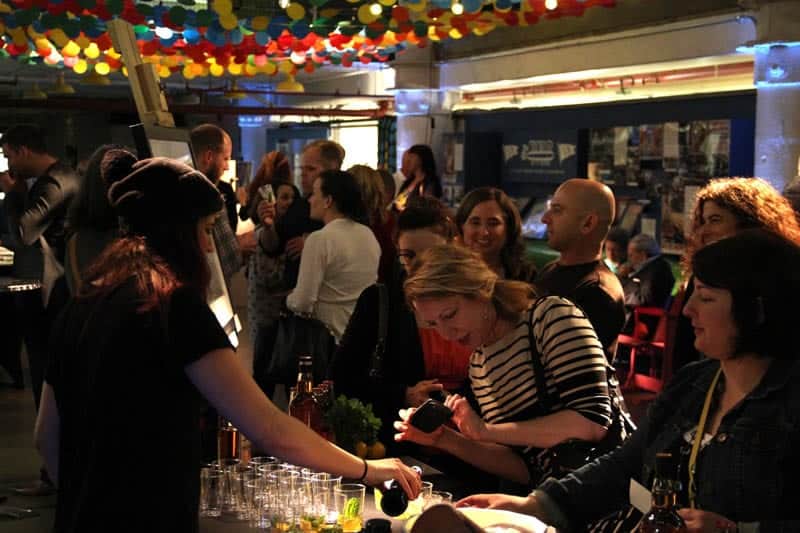
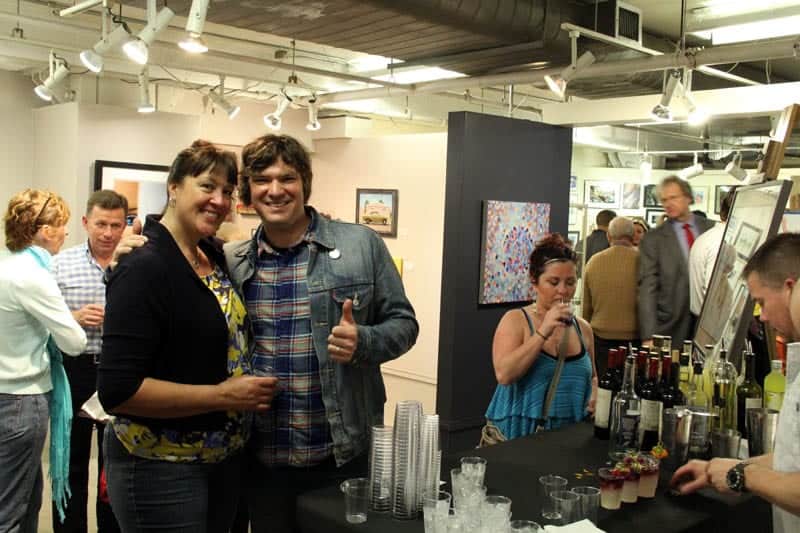
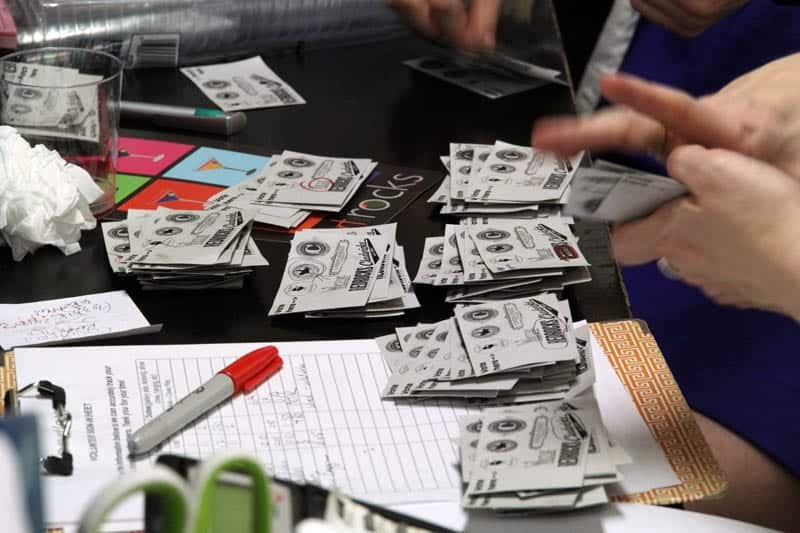
Almost 300 people turned out to try the Pop Art-inspired spread. Bastille, Chadwick’s, Columbia Firehouse, the Light Horse Restaurant, RedRocks Neapolitan Bistro, Union Street Public House, and Virtue Feed & Grain all participated, and two went home with trophies.
John from The Light Horse Restaurant took home the judge’s prize, awarded by Chad and Emily from Catoctin Creek Distillery, WeLoveDC‘s Jenn Larsen, and PandaHeadBlog‘s Morgan Hungerford-West. The Light Horse’s Mellow Yellow, inspired by a still life photograph of a yellow pepper, riffed on a Bloody Mary with Watershed Gin and a garnish jam-packed with olives, house-cured pickles, goat cheese-stuffed peppadew pepper, and house-cured bacon.
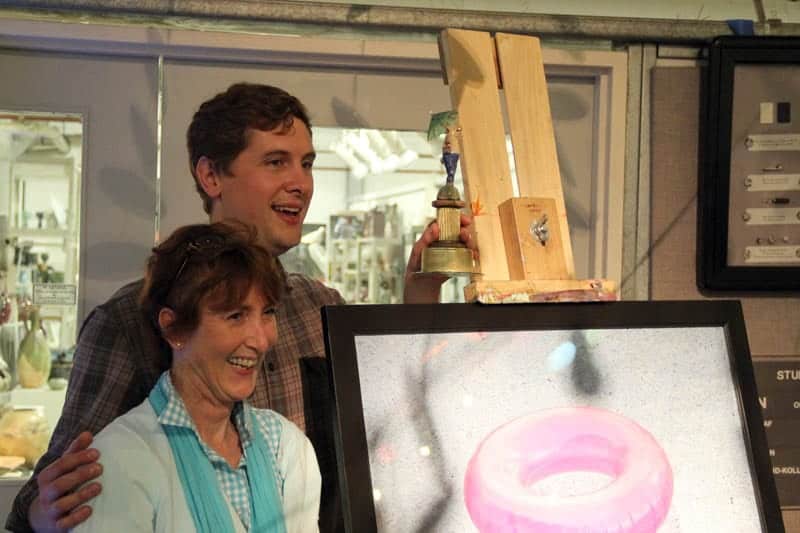
The people’s choice award was close — within three votes — but the winner once again was Trae at Chadwick’s, this time with the Cannonball. Inspired by this photo of an inner tube drifting in a swimming pool, the Cannonball featured kiwi, blanc de blanc, rum, triple sec, blue curacao, and mint, finished off with a frozen watermelon ball.
The winners! Above, the Light Horse Restaurant, and below, Trae from Chadwicks with “The Life Saver” photographer Claire Carroll. Torpedo Factory artist Lisa Schumaier made the trophies.
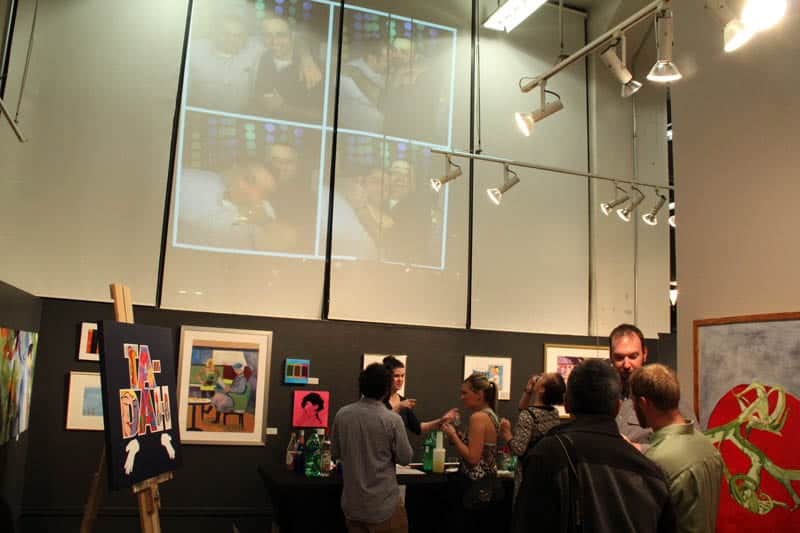
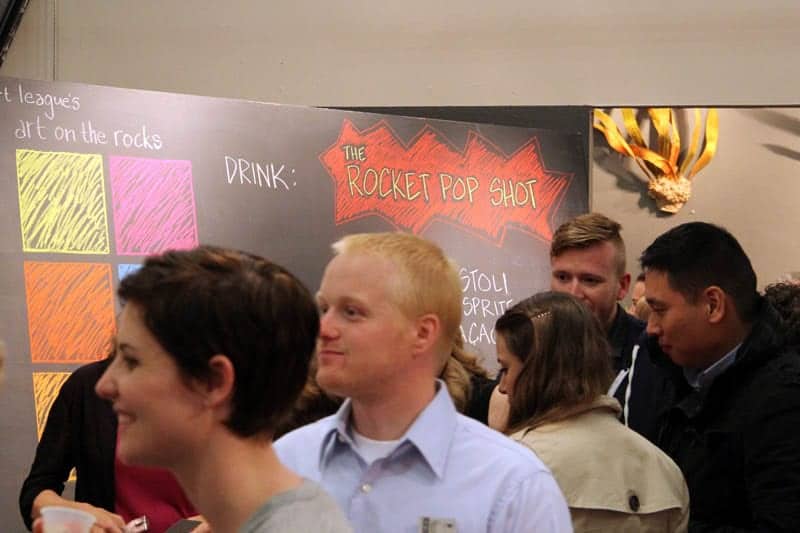
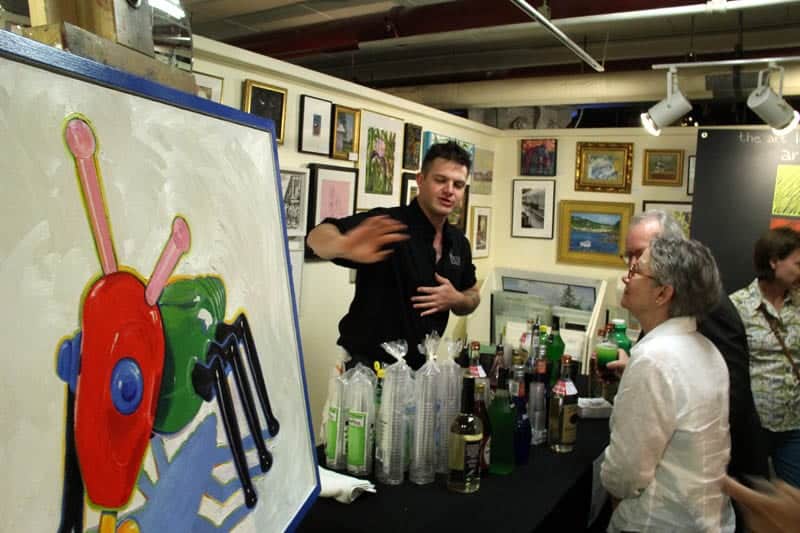
Photo booth and Instagram pictures were projected on the Gallery windows.Eventgoers watch Brodie from Union Street Public House making the red, white, and blue Rocket Pop Shot.Mike from Virtue Feed & Grain and The Cootie.
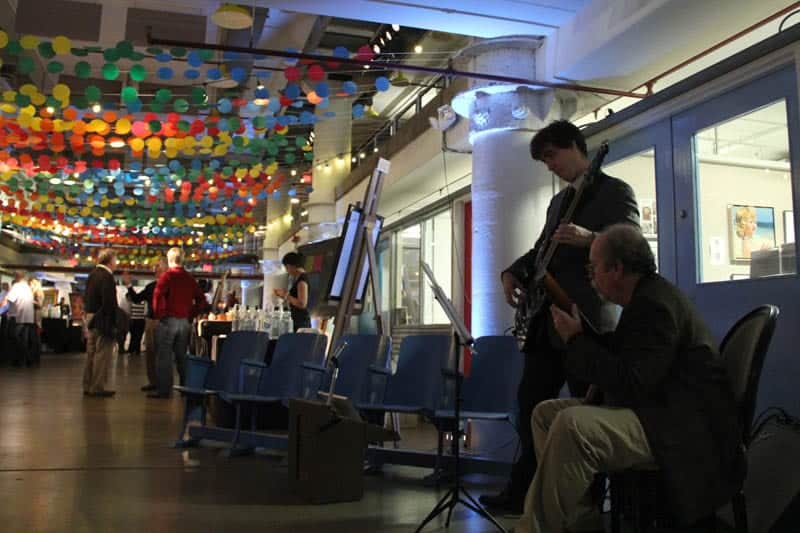
The Gassmann Duo returned to provide the evening’s jazz soundtrack.









 In the summer of 2000 after my freshman year at William and Mary, I excitedly began an internship on Capitol Hill for a Democratic Congressman from Pennsylvania. It was President Bill Clinton’s last year in office, months before the painful Bush/Gore election. Hillary Clinton was running for the open U.S. Senate seat in New York, and rumors were swirling about her future political ambitions beyond Capitol Hill. Terrorism and 9/11 were not yet part of our daily vernacular, and we lowly interns could wander just about anywhere around the Capitol grounds with a flash of the badge.