Artist Opportunities #334

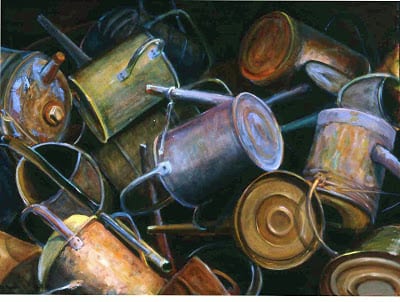
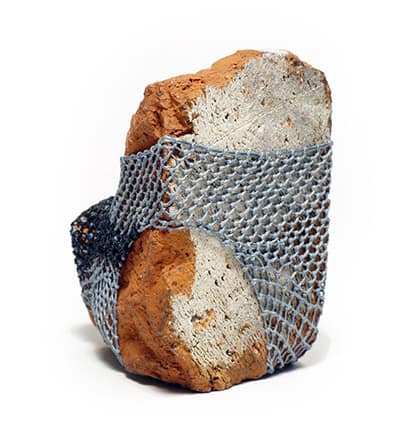
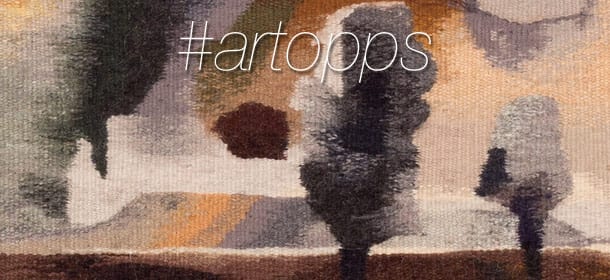
Anticipation by Art League tapestry instructor Tea Okropiridze

On Tuesdays, we gather a variety of artist opportunities around the DC area and beyond. Find one below and enter today — good luck! Click here for recent opportunities posts, and submit your opportunity listing here.

Paint Great Falls

Deadline: Open until spaces are filled. Artists are invited to register online to participate in the second annual Paint Great Falls: Plein Air Competition in Great Falls, VA.

Painting

Deadline: September 1. The Maryland Federation of Art invited all artists residing in the United States, Puerto Rico, Canada and Mexico to enter its 5th annual all-painting competition, Strokes of Genius. Juror: Joey P. Mánlapaz.

Portrait competition

Deadline: September 6. Artists 18 years or older residing in Maryland, Virginia, the District of Columbia, West Virginia, and Delaware are invited to enter the 8th Annual Expressions Portrait Competition. No photography, computer art, or reproductions. Judge: Jordan Xu.

Op-Ed at The Art League

Deadline: September 12. Online entry only. For Op-Ed, Art League members are invited to express their views about current cultural, political, or personal events – whatever you feel passionately about. Artists are encouraged to create statement pieces that will evoke a response. Juror: David Bellard, photographer.

Migration

Deadline: September 13. #Migration61, at all six Busboys and Poets locations in the DC area, is open to all media except freestanding sculpture. Artwork does NOT have to be created in the aesthetic style of Jacob Lawrence. The topic or content of the work, though, must reflect the theme of migration/emigration/immigration.

Young at Art

Artwork drop-off: October 4. Young at Art at Durant Arts Center is open to all DC-area residents ages 55 and older. All media are accepted and cash prizes will be awarded.


Re-runs: These announcements have been posted here before, but it’s not too late to enter!

Exhibit proposals

Deadline: August 31. The Arts Club of Washington (DC) continues its support for the visual arts with the Call for Entries for the 2017–2018 gallery season. Exhibitions are scheduled monthly from September 2017 through May 2018.

Fall art show

Deadline: September 1. The 45th Annual Fall Foliage Art Show (Waynesboro, VA) is seeking fine artists and artisans for the annual two day outdoor juried fine art exhibition.

Digital Fabrication Residency

Deadline: September 1. Digital Fabrication Residency program residents learn and gain hands-on experience with laser cutting, CNC routing, FDM 3D printing, digital embroidery, 2D plotting and 3D scanning. Applications for the 3 Day Onsite Residency Program in Easton, MD must include a project proposal that outlines what the resident plans to work on while onsite.

Maryland artists

Deadline: September 2. Artists, 18 years or older, residing in Maryland or within a 100-mile radius of Ellicott City, Maryland are invited to apply for Art Maryland 2016, a biennial juried exhibit.

Small photo works

Deadline: September 4. Hillyer Art Space (Washington, DC) celebrates Fotoweek DC with FORMAT, a small works show featuring photo-based art. All work must be under 10″ in any one directions (inclusive of frame). This exhibition will be juried by DC-based photographer and curator, Laila Abdul-Hadi Jadallah.

Exhibit proposals

Deadline: September 4. The Carver Center Gallery (Towson, MD) is now accepting exhibition proposals for the 2016-2017 school year. We are looking for a wide variety of solo or group exhibitions representing work from MFA graduates, emerging, and mid-career artists.

F.E.A.S.T.

Deadline: September 6. F.E.A.S.T. at VisArts 2016 (Funding Emerging Art with Sustainable Tactics) is a bridge between artists and the community.  F.E.A.S.T. is a public meal designed to use community-driven financial support to democratically fund projects that use art and creative thinking to impact the community. F.E.A.S.T. at VisArts 2016 will take place on September 25th on the Rooftop at VisArts in Rockville, Maryland, 11:30 to 3:00 PM.

The nude figure

Deadline: September 9. The Nude Figure at Wayne Art Center in Wayne, PA is juried by Paul DuSold and Scott Noel. Open to all artists working in painting, drawing and sculpture.

DC-area artists

Deadline: September 15. The Franz and Virginia Bader Fund was established in 2001 in accordance with the will of the late Virginia Bader to provide grants to visual artists who have reached the age of 40, reside within 150 miles of Washington, D.C., and whose ability to concentrate on their art would be enhanced by receiving a grant.

Virginia residencies

Deadline: September 15. Applications are now open for residencies at the Virginia Center for the Creative Arts.

Public sculpture

Deadline: September 23. The Riverdale Park (MD) Public Art Initiative is announcing a Call for Artists. The initiative seeks five sculptures of various styles and sizes to display for a one year-long placement, at pre-determined, publicly-accessible sites within the Town of Riverdale Park. The stipend is $2,000 per selected work.

Art League solo exhibits

Deadline: September 23. Entry is now open for 2018 solo artist exhibits at The Art League. Entry is open to all Art League exhibiting artist members.

Paintings

Deadline: September 28. “Root to Bloom: Places Artists Call Home” at Principle Gallery (Alexandria, VA) will feature paintings representative of where the featured artists call “home.” Works must be paintings no more than 40 inches along the longest edge (measured unframed).

Contemporary craft

Deadline: September 30. The Greater Denton Arts Council announces the opening of its 2017 Call for Entries for the 30th Annual Materials: Hard + Soft Contemporary Craft Exhibition. This exhibition celebrates the evolving field of contemporary craft and the innovation of artists who push the boundaries of their chosen media.

Maryland residency

Deadline: September 30. VisArts invites applications and proposals from local, national, and international artists for a four month residency at VisArts at Rockville, MD.

Small works

Deadline: September 30. The Council for the Arts (Chambersburg, PA) presents “Miniature Art 2016.” 2-D artwork must have an image size no greater than 4″ by 6″, and sculpture should not exceed 5″ in any direction. No crafts, jewelry, photography, laser prints or computer-generated artwork.

Photography about homelessness

Deadline: October 1. For Picture This, organized by Flashlight Baltimore, entries can depict the homeless experience from around the country, however the Baltimore region is preferred. Entries must be original photography.

Bas-relief

Deadline: October 3. The Dexter Jones Award, an unrestricted prize of $5,000, is presented annually to a sculptor for an outstanding work of sculpture in bas-relief. Each competitor must be a United States sculptor between the ages of 18 and 39.

Fotoweek 2016

Deadline: October 7. There are three categories, and a chance to win cash prizes & have your photographs featured in the FotoWeekCentral gallery at the National Geographic Museum during this fall’s FotoWeekDC festival.

Figure & figurative

Deadline: October 11. Gallery Underground announces “Figuratively Speaking,” a national juried art competition. All-media artists, sculptors, and photographers are invited to create visual works that interpret the theme “Figuratively Speaking” in two different ways: by depicting human forms, faces and features in representational or abstract works (portraiture, sculpture and all subject matter including people); or works which depict a broader interpretation of the theme, such as figurative language and figures of speech.

Awards for career development

Deadline: October 15. The 2016 S&R Foundation Washington Award application is now open! Every year the S&R Foundation awards four $5,000 prizes to emerging artists working in a broad range of disciplines including painting, photography, sculpture, music, dance, dramatic arts, film, digital, and interdisciplinary arts.
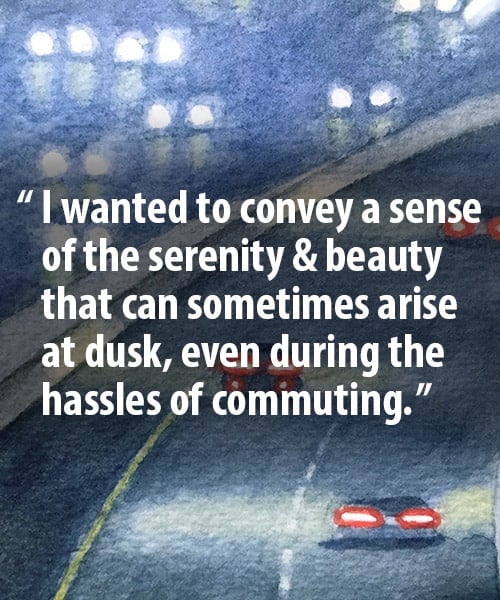
Florence Setzer and the Beauty of the Commute

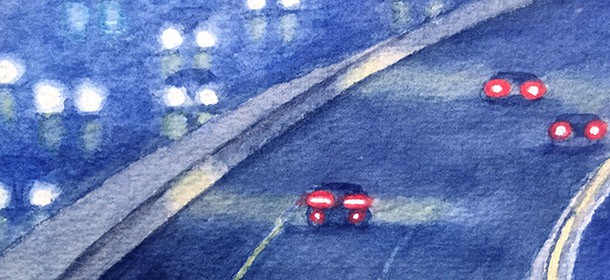
Homeward Bound, watercolor, by Florence Setzer. Winner of the Potomac Valley Watercolorists Award.

It’s a familiar scene: red lights on the right, white lights on the left. A gentle curve, following the sun home at the end of a long day.

What’s unfamiliar is the sense of calm. An unexpected subject for a watercolor painting, rush hour finds peace in a cool palette — and a quiet moment plucked from a stressful routine. Homeward Bound by Florence Setzer won the Potomac Valley Watercolorists Award, and we asked the artist to tell us about its origins, and her process as a watercolor artist.

What was your goal with Homeward Bound?
Florence Setzer: Heading home after work brings an element of relief and anticipation. I wanted to convey a sense of the serenity and beauty that can sometimes arise at dusk, even during the hassles of commuting.

What road is depicted? What made you want to paint it?
The road is the beltway, seen from a pedestrian bridge I frequently cross. The painting was a response to a challenge by Gwen Bragg to do a painting on the subject “return.” What came to mind was returning home from work, and this image of rush hour traffic suggested itself.

Cape Town by Florence Setzer, part of her "Distant Cities" series.
Cape Town by Florence Setzer, part of her “Distant Cities” series.

Why do you work in watercolor? What does it offer that other media don’t?
I first fell in love with watercolor just because I liked the way it looks. The subtle gradations that naturally occur in wet-in-wet watercolor can create striking effects that are hard to achieve in other media. These effects work particularly well in landscape features like sky and water.

The white paper and transparent paints can provide a wonderful sense of light. The convenience of a medium that requires little preparation or cleanup, and thus lends itself to spontaneity, was a bonus. Watercolor is also extremely portable for plein air work.

Florence Setzer - Homeward Bound (detail)

What is your creative process like, from finding an idea to declaring a piece finished?
I’m not particularly introspective about my painting. I paint more or less realistically, and I think what I try to do is to capture and convey the beauty of the world around me.

I like to begin with some striking visual image that I’ve experienced. My paintings are predominantly landscapes. When I paint indoors, I work from photographs. I crop them and do value studies until I come up with a satisfying composition and a format that suits the subject. Then I sketch the image on the paper.

I usually use fairly traditional watercolor techniques, with a succession of transparent washes. When the painting is close to being finished, I set it on an easel by my breakfast table and contemplate it over breakfast and lunch. Sometimes I spend a long time deciding whether a painting is finished or not. Then I photograph and frame my paintings. While those aren’t particularly creative activities, they seem to me to be a part of the job of producing the finished work of art.

Across the Golden Gate by Florence Setzer

What are you working on now?
Lately I’ve been thinking of series of plein air paintings of a single place under different conditions. I just returned form Maine, where I did plein air paintings of the shore at high and low tide. Also, I’ve done a couple of paintings of cities seen from a distance, which I’m thinking of turning into a series.

“Landschap” is on view through Sunday, September 4.

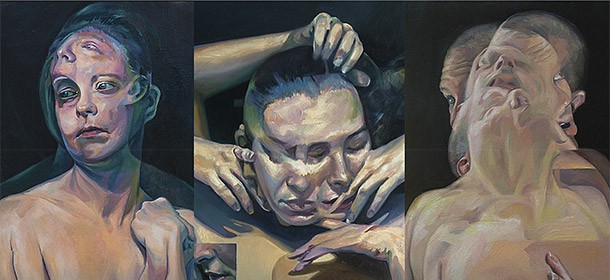
See Scott Hutchison’s “Synchronicity”

Reversed Her Hemispheres, oil on linen, by Scott Hutchison. Inspired by the Emily Dickinson poem.
Reversed Her Hemispheres, oil on linen, by Scott Hutchison. Inspired by an Emily Dickinson poem.

Art League instructor Scott Hutchison has a new exhibit at Hillyer Art Space next month, titled “Synchronicity”:

“a series of paintings that start with the use of a combination of photography, digital collage, animation and projections to create multifaceted figures that appear to move and animate, each painting consisting of four or five different poses.”

The opening reception is September 2 at 6:00 pm, and the exhibit continues through October 1. You don’t want to miss this one!

Scott teaches drawing and painting classes at The Art League. Take a look at his schedule of classes here:

Scott Hutchison at Hillyer Art Space

  • 9 Hillyer Court NW, Washington, DC
  • Monday 12:00–5:00 pm, Tuesday–Friday 12:00–6:00 pm, Saturday 12:00–5:00 pm, Sunday 11:00 am–5:00 pm

Meet Kathlyn Avila’s Zelda

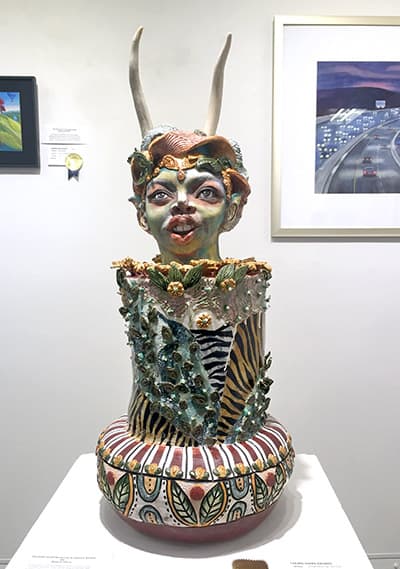
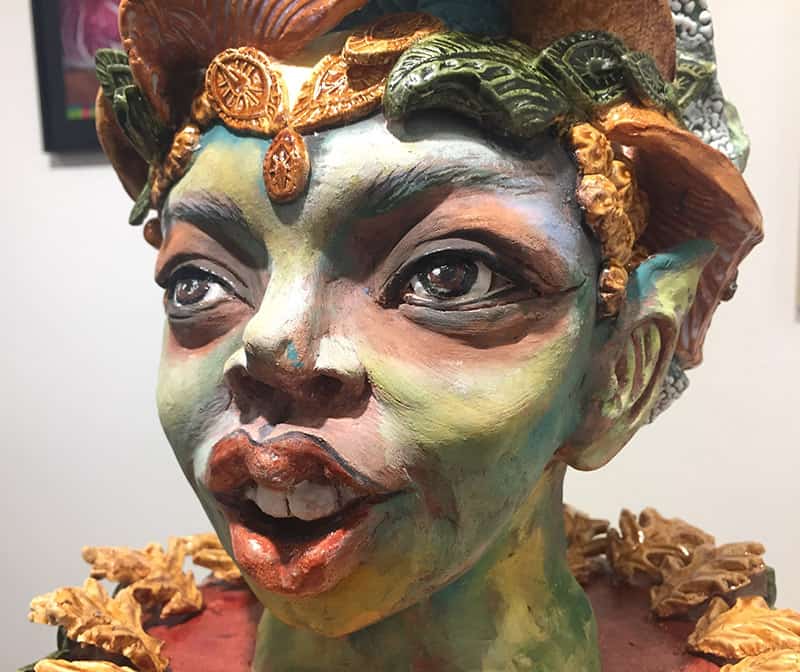
Legends of Zelda by Kathlyn Avila, winner of the Monkith Saaid Memorial Sculpture Award for Best in Show.

Artist Kathlyn Avila needs no introduction: you’ve read about her influences and process and about her characters and figures in past posts.

Her latest creation, however, could use one. With goat horns and a friendly smile, Legends of Zelda won the Monkith Saaid Memorial Sculpture Award in this month’s sculpture-only exhibit, “Taking Shape.” We asked the artist to get us acquainted.

Love Kathlyn’s sculptures? Check out her two classes starting in September.

Who is Zelda?
Kathlyn Avila: Zelda is my interpretation of an African fairy. I chose the name Zelda because one of its origins means “blessed” or “happy.” Most African fairies are known for their benevolence. There are many stories of these fairies that have helped families, children, and hunters. The legend of these fairies are that they provide magic and give spiritual knowledge to people.

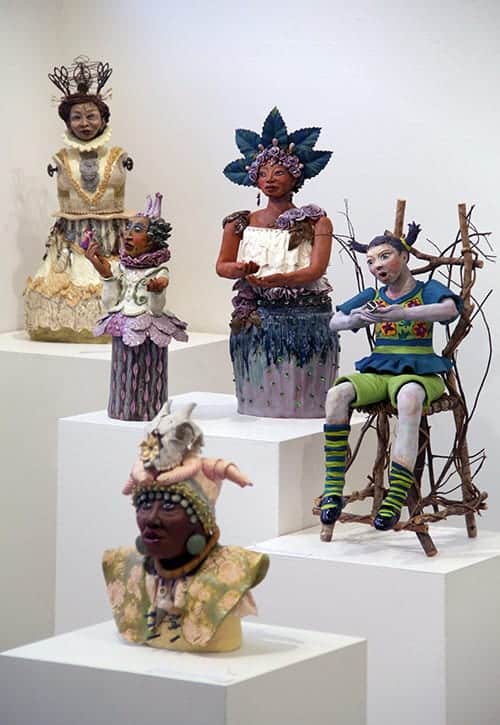
Sculptures by Kathlyn Avila from her December 2015 exhibit, "No Ordinary Woman."
Sculptures by Kathlyn Avila from her December 2015 exhibit, “No Ordinary Woman.”

What was your goal?
My goal in sculpting this figure was to creatively translate the magical and mystical essence of the mythological beings known as African fairies into a ceramic form. The forests and jungles of West Africa are said to be inhabited by a multitude of fairies and gnomes, most of which are known for their benevolence. The surface of my sculpture is adorned with animal patterns, leaves, and textiles design prints that are indicative of West Africa.

Legends of Zelda (detail) by Kathlyn Avila

What was the inspiration for the horns?
The horns on “Zelda” are goat horns which have numerous symbolic meanings. My use of the horns represent power and strength.

The horns were also used as a drinking vessel in antiquity and has a dual meaning symbolically that is both masculine and feminine. This dual symbolism, therefore, is representative of the yin/yang energy. “Zelda” embraces all with equal caring and balance.

“Taking Shape” is on view through Sunday, September 4.

Artist Opportunities #333

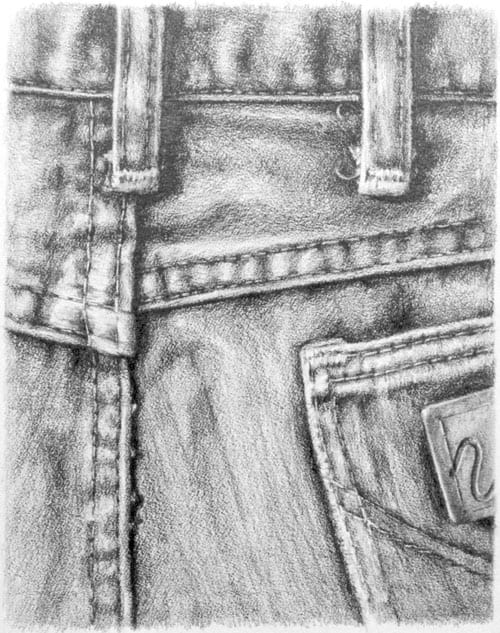
This week's banner image is a graphite drawing by Art League instructor Lisa Semerad.
This week’s banner image is a graphite drawing by Art League instructor Lisa Semerad.

Artist Opportunities is back this week after a two-week vacation.

On Tuesdays, we gather a variety of artist opportunities around the DC area and beyond. Find one below and enter today — good luck! Click here for recent opportunities posts, and submit your opportunity listing here.

Maryland artists

Deadline: September 2. Artists, 18 years or older, residing in Maryland or within a 100-mile radius of Ellicott City, Maryland are invited to apply for Art Maryland 2016, a biennial juried exhibit.

Small photo works

Deadline: September 4. Hillyer Art Space (Washington, DC) celebrates Fotoweek DC with FORMAT, a small works show featuring photo-based art. All work must be under 10″ in any one directions (inclusive of frame). This exhibition will be juried by DC-based photographer and curator, Laila Abdul-Hadi Jadallah.

Nude figure

Deadline: September 9. “The Nude Figure” at Wayne Art Center (Wayne, PA) will present a survey of contemporary responses to the nude to illuminate resonances between traditions of imagining the figure and the artist’s personal experience.

DC-area artists

Deadline: September 15. The Franz and Virginia Bader Fund was established in 2001 in accordance with the will of the late Virginia Bader to provide grants to visual artists who have reached the age of 40, reside within 150 miles of Washington, D.C., and whose ability to concentrate on their art would be enhanced by receiving a grant.

Virginia residencies

Deadline: September 15. Applications are now open for residencies at the Virginia Center for the Creative Arts.

Fotoweek 2016

Deadline: October 7. There are three categories, and a chance to win cash prizes & have your photographs featured in the FotoWeekCentral gallery at the National Geographic Museum during this fall’s FotoWeekDC festival.

Awards for career development

Deadline: October 15. The 2016 S&R Foundation Washington Award application is now open! Every year the S&R Foundation awards four $5,000 prizes to emerging artists working in a broad range of disciplines including painting, photography, sculpture, music, dance, dramatic arts, film, digital, and interdisciplinary arts.


Re-runs: These announcements have been posted here before, but it’s not too late to enter!

Exhibit proposals

Deadline: August 31. The Arts Club of Washington (DC) continues its support for the visual arts with the Call for Entries for the 2017–2018 gallery season. Exhibitions are scheduled monthly from September 2017 through May 2018.

Fall art show

Deadline: September 1. The 45th Annual Fall Foliage Art Show (Waynesboro, VA) is seeking fine artists and artisans for the annual two day outdoor juried fine art exhibition.

Digital Fabrication Residency

Deadline: September 1. Digital Fabrication Residency program residents learn and gain hands-on experience with laser cutting, CNC routing, FDM 3D printing, digital embroidery, 2D plotting and 3D scanning. Applications for the 3 Day Onsite Residency Program in Easton, MD must include a project proposal that outlines what the resident plans to work on while onsite.

Exhibit proposals

Deadline: September 4. The Carver Center Gallery (Towson, MD) is now accepting exhibition proposals for the 2016-2017 school year. We are looking for a wide variety of solo or group exhibitions representing work from MFA graduates, emerging, and mid-career artists.
F.E.A.S.T.

Deadline: September 6. F.E.A.S.T. at VisArts 2016 (Funding Emerging Art with Sustainable Tactics) is a bridge between artists and the community.  F.E.A.S.T. is a public meal designed to use community-driven financial support to democratically fund projects that use art and creative thinking to impact the community. F.E.A.S.T. at VisArts 2016 will take place on September 25th on the Rooftop at VisArts in Rockville, Maryland, 11:30 to 3:00 PM.

The nude figure

Deadline: September 9. The Nude Figure at Wayne Art Center in Wayne, PA is juried by Paul DuSold and Scott Noel. Open to all artists working in painting, drawing and sculpture.

Public sculpture

Deadline: September 23. The Riverdale Park (MD) Public Art Initiative is announcing a Call for Artists. The initiative seeks five sculptures of various styles and sizes to display for a one year-long placement, at pre-determined, publicly-accessible sites within the Town of Riverdale Park. The stipend is $2,000 per selected work.
Art League solo exhibits

Deadline: September 23. Entry is now open for 2018 solo artist exhibits at The Art League. Entry is open to all Art League exhibiting artist members.

Paintings

Deadline: September 28. “Root to Bloom: Places Artists Call Home” at Principle Gallery (Alexandria, VA) will feature paintings representative of where the featured artists call “home.” Works must be paintings no more than 40 inches along the longest edge (measured unframed).

Contemporary craft

Deadline: September 30. The Greater Denton Arts Council announces the opening of its 2017 Call for Entries for the 30th Annual Materials: Hard + Soft Contemporary Craft Exhibition. This exhibition celebrates the evolving field of contemporary craft and the innovation of artists who push the boundaries of their chosen media.

Maryland residency

Deadline: September 30. VisArts invites applications and proposals from local, national, and international artists for a four month residency at VisArts at Rockville, MD.

Small works

Deadline: September 30. The Council for the Arts (Chambersburg, PA) presents “Miniature Art 2016.” 2-D artwork must have an image size no greater than 4″ by 6″, and sculpture should not exceed 5″ in any direction. No crafts, jewelry, photography, laser prints or computer-generated artwork.

Photography about homelessness

Deadline: October 1. For Picture This, organized by Flashlight Baltimore, entries can depict the homeless experience from around the country, however the Baltimore region is preferred. Entries must be original photography.

Bas-relief

Deadline: October 3. The Dexter Jones Award, an unrestricted prize of $5,000, is presented annually to a sculptor for an outstanding work of sculpture in bas-relief. Each competitor must be a United States sculptor between the ages of 18 and 39.

Figure & figurative

Deadline: October 11. Gallery Underground announces “Figuratively Speaking,” a national juried art competition. All-media artists, sculptors, and photographers are invited to create visual works that interpret the theme “Figuratively Speaking” in two different ways: by depicting human forms, faces and features in representational or abstract works (portraiture, sculpture and all subject matter including people); or works which depict a broader interpretation of the theme, such as figurative language and figures of speech.

Banff residency

Deadline: ongoing. Artists with a professional standing in their field and emerging artists of promising talent are encouraged to apply for Independent Residencies at the Leighton Artists’ Colony in Banff, Alberta.

Open Call

Deadline: Ongoing. Washington ArtWorks (Rockville, MD) is holding an Open Call for the Walls. Artists pay a fee to hang work for two-month periods in these unjuried exhibits.

Repost: Websites for Artists

Guide to Artist Websites

The Art League Blog is on vacation this week, so we’re reposting some of our most popular resources on sharing your art online! Please enjoy this post from the vault, originally published June 23, 2016.

“If you’re an artist and you don’t have a website yet — or if you want to change the one you have now — it’s never too late to get started!”

That’s why we started our original artist website post, and three years later, it’s more true than ever. If you’re ready to take the plunge, you’ve come to the right place! This guide will walk you through:

  • Why you need an artist website
  • Creating your website:
    1. Defining your goals for your site
    2. How to choose your web service
    3. How to choose a domain name
    4. What you should put on your website
  • Other resources you can use
The website of Jeff Huntington uses Other People’s Pixels.

Why does my art need a website?

A website is another way for people to find out about you and your artwork. They could be strangers who find you by googling “sculptors in DC,” or people who already know you and want to learn more.

Think about it this way: where do you go when you’re making a purchase or doing research? Online. So will your potential customers (and email subscribers, and fans, and so on).

The website of Andy Yoder is built in WordPress using the Vertex theme.

Step 1: Define your goal

Your goal for your website will determine what features you need. Common goals include:

  • I want to sell artwork through my website
  • I want my website to serve as a portfolio for interested galleries, customers, and fans
  • I want people to find and contact me
  • I want to keep my fans and customers updated with my latest news

If you want to sell work through your website, make sure the service you choose (below) has an option for an online store — and make sure it’s easy to use! If you want to make a portfolio site, make sure the service you choose can handle beautiful image galleries. If you want to keep customers updated, you will probably want a built-in blog and email newsletter.

If any of these are must-haves for you, make sure they’re a possibility on the platform you choose.

The website of Suzanne Vigil uses Smugmug.

Step 2: Choose your web service

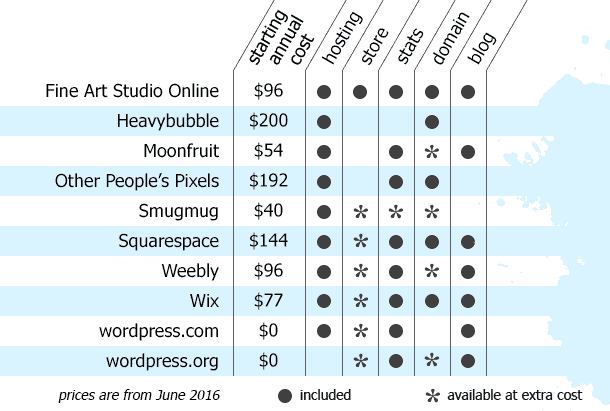
We made a chart comparing some of the most popular options out there. Some are geared specifically toward artists, but most of them have portfolio templates for your design, and they’re all suitable for use by artists. See below for an explanation of the terms used and links to the websites:

Artist website services comparison

How to read this chart

  • Hosting: This is how your website is delivered to visitors. You’ll pay around $10 a month if you get hosting on your own (for example if you use WordPress.org), but it’s included in all the other services above.
  • Store: Is there a built-in way for people to purchase through your website? Typically, you’ll pay extra for this feature.
  • Stats: Can you get information on how many people are visiting your site and how they’re getting there?
  • Domain: A domain name, like theartleague.org, is an important factor. Do you get your very own domain? Or do you have to share one, like theartleague.squarespace.com? (This is sometimes offered as a free option, but it’s worth it to pay for your very own domain.) See below for tips on choosing your domain name.
  • Blog: Is there a built-in blogging platform?

Links to the services above

Fine Art Studio Online | Heavybubble | Moonfruit | Other People’s Pixels | Smugmug | Squarespace | Weebly | Wix | WordPress.com | WordPress.org

Do your research

Before committing, see if there’s a free trial. You should also look for examples of live artist websites using the service you’d like to use. Keep your goal (step 1) in mind as you tick off the following checklist:

  • Can you use the back end? The back-end is the part of the website that’s visible only to you, where you go to make changes to your website.
  • Is there customer service? When your website goes down or disappears, will there be someone to answer the phone?
  • Is it mobile friendly? Most of your visitors will be viewing on their phone (possibly at the very moment they’re standing in front of your artwork). Make sure everything works properly and is easy to use.
  • What designs are available? Notice that this is last on the list. It’s typically the easiest thing to change, and it’s most important to consider the function and content before appearance. That said, you’ll want to pick a service that matches your abilities. There’s a trade-off: easier services with drag-and-drop builders will tend to look more bland, but a highly customized site will take more work and know-how.
The website of Melissa Staiger uses Squarespace.

Step 3: Choose your domain name

As explained above, the domain name is where people will find you online. It typically ends in .com. Follow this formula if you can:

your first name + your last name + .com

For example, fridakahlo.com. That should be your first choice, but if that’s taken, try one of these variations: fridakahloart.com, fridakahloartist.com, fridakahlostudio.com, or fridakahlo.com.

Note that people are more likely to visit a website that ends in .com than .net or something else.

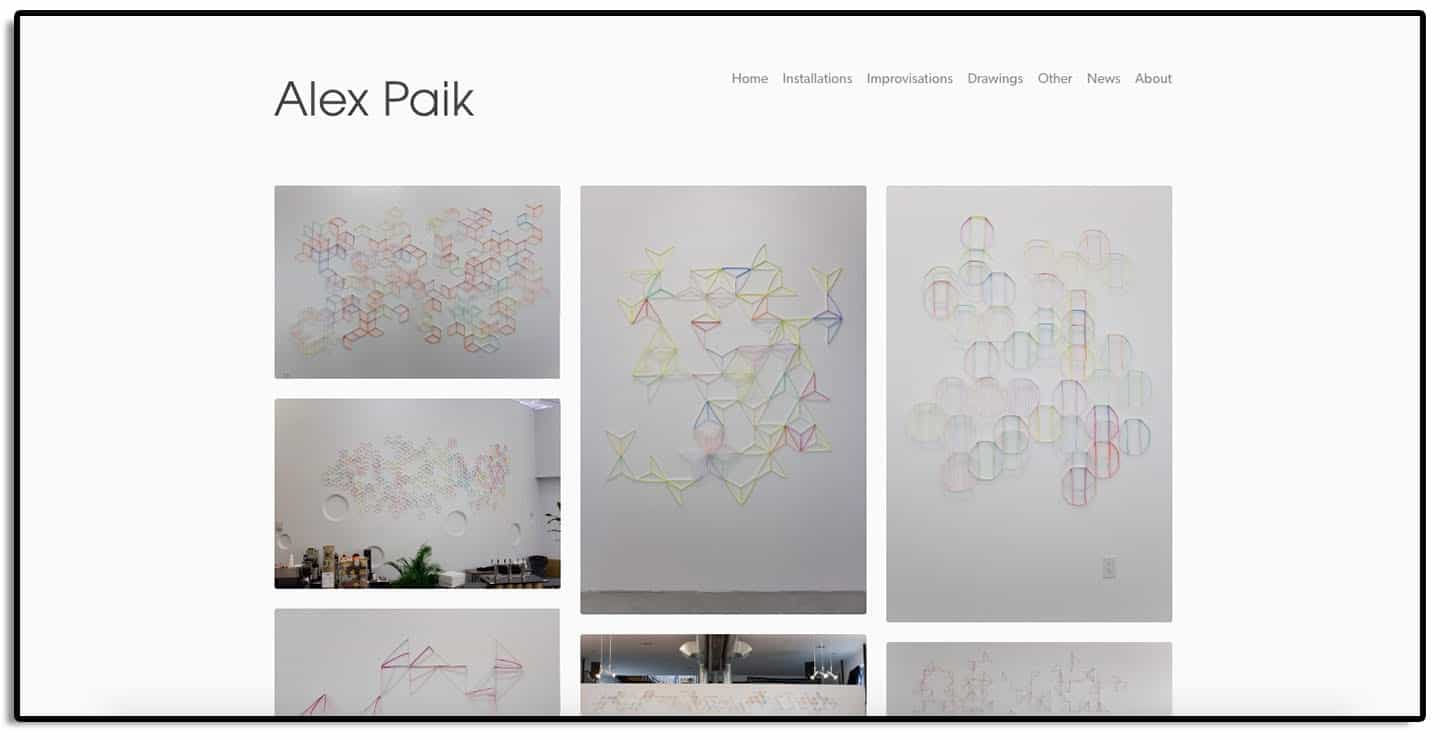
Alex Paik built his website using Tumblr.

Step 4: Build your website

Now comes the fun part. Again, what you put on your website depends on your goal. At a bare minimum, you will want the following two things:

  • images of your artwork
  • your contact information

You’ll probably expand on this to include things like your artist bio or statement, different image galleries, or a store or blog, depending on your needs.

It’s important to start small and keep your website up to date. Any obviously out-of-date information is going to lead to visitors leaving your website. As you get comfortable with building and updating your website, you can start to build more.

Online gallery Buy Some Damn Art is built using Shopify.

Conclusion

A functional, up-to-date website is a must for any artist working today. While it takes some time to set up and maintain — time that you’d rather spend in the studio — it pays dividends in creating a visible, professional presence for your art.

Hopefully, this guide gave you a head start on the process. If you have any questions, let us know in the comments!

Other resources

Here are some other articles you might find helpful:

Repost: Artwork Photography Guide

How to Photograph Your Artwork

The Art League Blog is on vacation this week, so we’re reposting some of our most popular resources on sharing your art online! Please enjoy this post from the vault, originally published August 13, 2015.

Much like framing your artwork, photographing it is one of those things that can feel like a chore: necessary for entering exhibits and selling work, but not easy to do. One option is to pay a professional (see the bottom of this post for recommendations). Another is to try it yourself.

If you’ve attempted photographing your artwork in the past, you’ve probably noticed a number of issues: uneven lighting, incorrect colors, and glares and shadows. This method reduces those problems while using nothing you don’t already have (assuming you have access to a camera and a computer).

Step one: Get a cloudy day

Wait until it’s overcast outside. Why? The cloud cover will act as a giant diffuser — like those umbrellas photographers use — so that the light seems to come from everywhere. That means your subject will be evenly lit. Set your piece up in a safe place, not too windy, where the light can get to it from every angle.

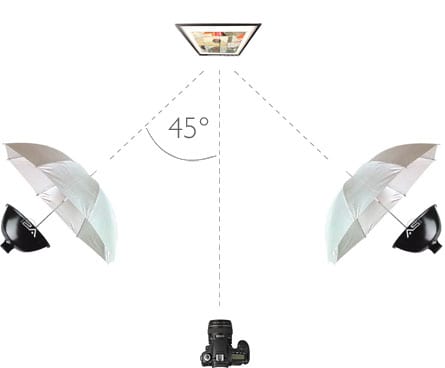
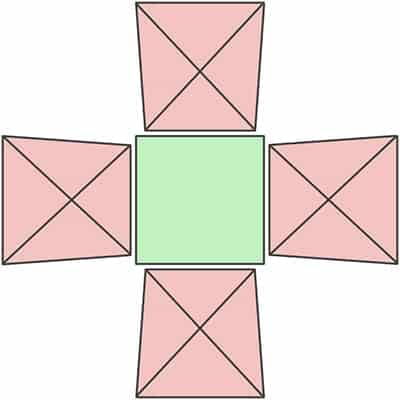
Not a cloudy day and you’re on a deadline? Time to rearrange the furniture. Get two lights of the same power and color (that is, the same light bulb) and arrange them like this:

Lighting diagram

If you can, use a translucent plastic bag as a cheap diffuser: hang it over the light so it’s softer and less direct. Please be careful and don’t do this with hot lights!

By the way: make it easy on yourself and photograph your work before it’s framed. That way, the glass or Plexiglas over top won’t cause reflections.

Tips for 3-D work: The main concern here is to have a background free of distractions — preferably, plain white or black, or a gradient between the two. (Even if you shoot outside, you don’t want the viewer to notice your surroundings.) To show off the texture, it may be beneficial to have the light source stronger on one side than the other, to create some (slight) shadows. The juror for “Taking Shape” offered more tips in her juror’s dialogue.

Step 2: Change your camera settings

Your light is ready to go. Now to get your camera set up the way you want it.

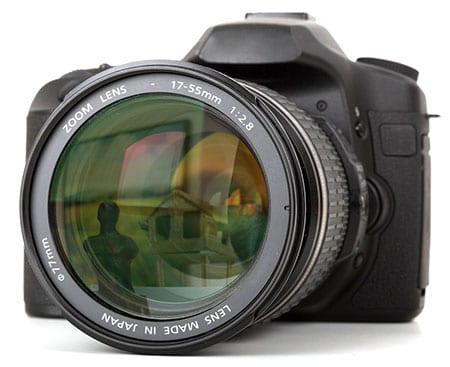
(Note: while your smartphone is great for quick in-progress shots to post to Facebook, it’s not suitable as a camera for submission-quality photos. Use or borrow a digital camera with better resolution and more control over the settings.)

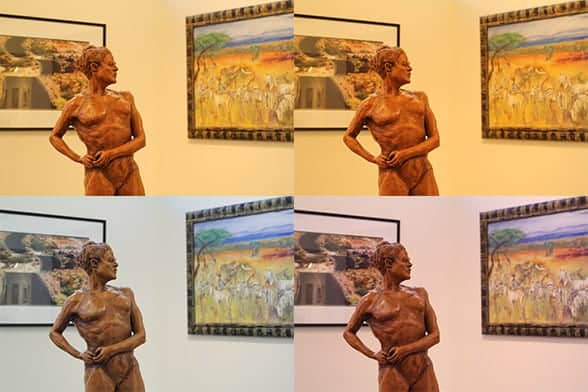
White balance is how the camera determines what color “white” is, which artists know depends on the temperature of the ambient light: incandescent, fluorescent, sunshine, etc. This is where you might have run into problems with inaccurate colors in your past photo attempts.

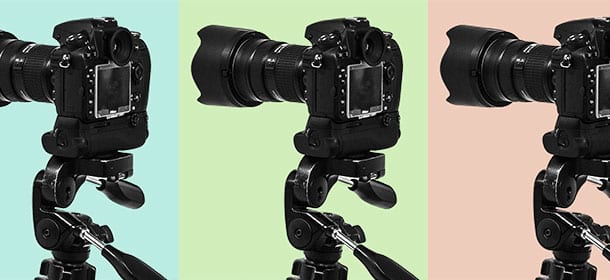
Four unedited photos with the white balance set to (clockwise from top left) daylight, cloudy, fluorescent, and tungsten. In this case, tungsten is closest to making the white walls white.

Find your white balance setting and set it to “cloudy,” which might also be represented by a cloud icon. If you can’t find it, and your camera manual doesn’t mention white balance, try shooting your art against a white background (like foamcore), and hopefully your camera’s auto setting will correctly adjust. But if you do have control over white balance, avoid using auto-mode while shooting artwork.

If you’ve gone the indoor route instead of a cloudy day, set the white balance to match the kind of light you are using. Correctly setting the white balance will get your colors pretty close to spot-on, but if not, you can adjust the temperature and tint in the free photo editor of your choice.

Finally, make sure your flash is turned off.

Step 3: Take your shot

Do you have a tripod? This is the time to use it. Otherwise, stand or sit still, hold your elbows against your body, and take and release a deep breath before taking the picture. You can also try propping the camera on something solid. Take several pictures in case some are out of focus or blurry.

Position the camera so it’s facing the artwork head-on: the lens should line up with the center of the subject, and not tilted one way or another. In other words, the plane of the artwork should be parallel to the back of your camera — or you’ll get a trapezoid instead of a rectangle.

Don't take the photo from an angle, or you'll get "keystoning."
Don’t take the photo from an angle, or you’ll get “keystoning.”

Finally, get a little closer. The artwork should fill the image, horizontally or vertically, to maximize the resolution of the final photo. Don’t waste those pixels!

Step 4: Edit

If you don’t have a photo editor on your computer, you can always download one for free (see below for links). And if you saved the box your camera came in, there may be a disc in there with photo-editing software.

First, correct the color if necessary. You might find this option under “color correction,” “color balance,” “temperature,” or “tint.” The goal here is to get your whites white and your blacks black. You may also want to manually adjust the contrast. Using “auto” color or contrast is probably not going to work for photos of artwork.

Second, crop the image so your artwork fills the image (2-D artwork) or it has some room to breathe, without anything distracting in the background (3-D artwork).

Finally, resize if necessary. The Art League has a minimum image size for online jurying (1920 pixels for the longest side), but no maximum size, so you should be all set. Save it with a new file name so you don’t lose the original file. Now you’re ready to submit!

Other resources

Blog posts & tutorials

Photographers for hire

Free image editing software

Repost: Starting an Artist Blog

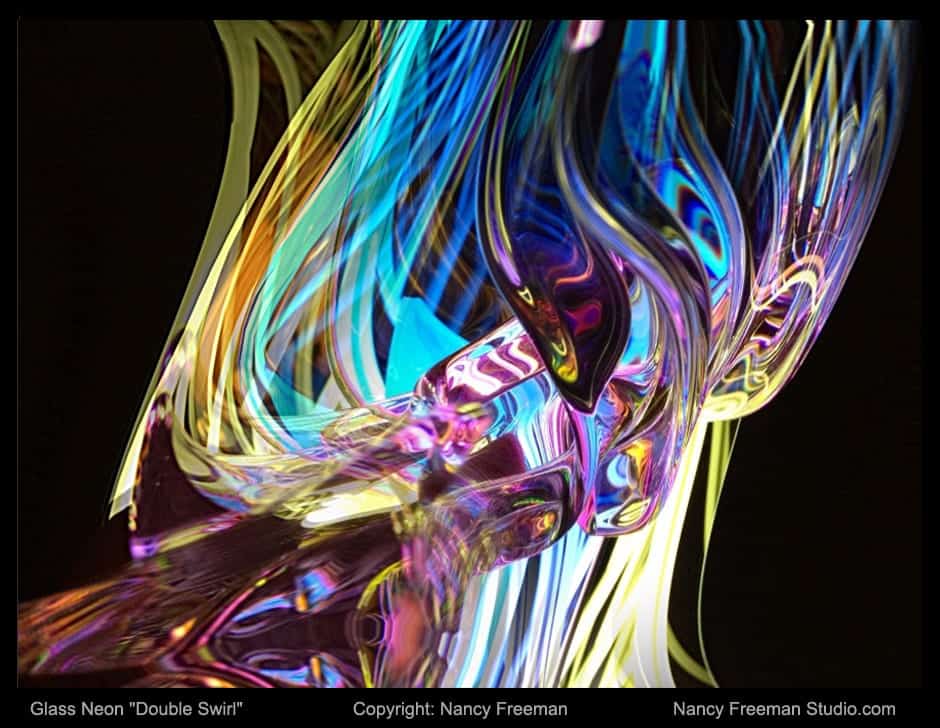
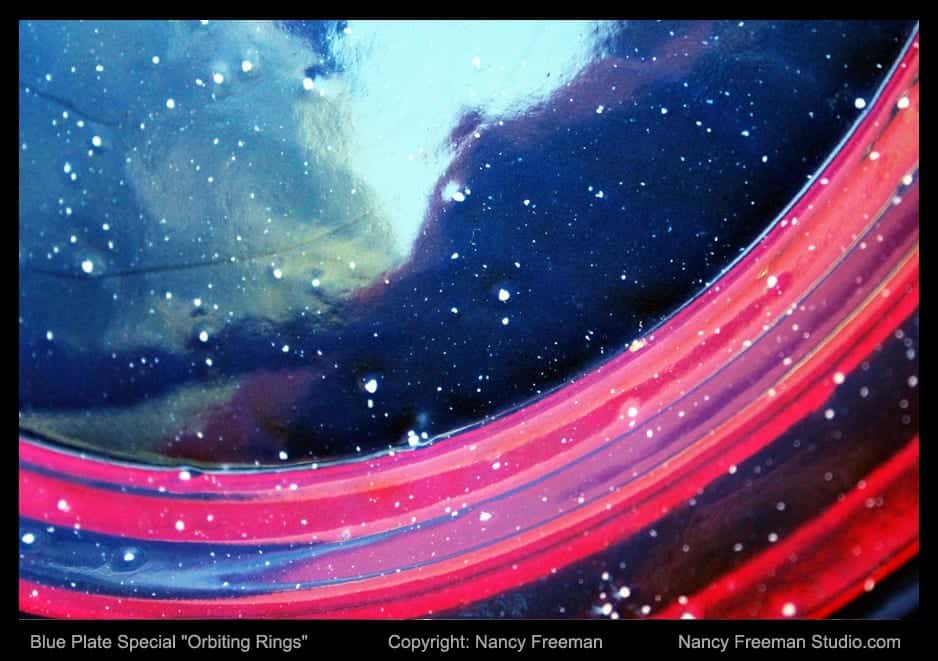
Artwork by Nancy Freeman.

The Art League Blog is on vacation this week, so we’re reposting some of our most popular resources on sharing your art online! Please enjoy this post from the vault, originally published September 20, 2012.

Artists: do you blog? Have you considered starting one? If you have spare time, blogging can be a great way to keep in touch with the people who follow your work, and a place for new people to find you.

Why blog? There are lots of reasons, but here are a few:

  • Share the why and how behind your artwork.
  • Show works in progress, and connect with your fans and buyers. They can keep up to date on your new work and shows by signing up for your RSS feed or an e-mail newsletter of your blog posts.
  • Ask your readers questions, and get comments on your posts.
  • Improve your search engine rankings and make it easier for people to find you online.

That said, blogging isn’t for everyone. You should blog only if you have the time and energy, and something to say.

If you already have a website, your platform might include a blogging function so you don’t need to maintain a separate site. If you don’t have a website, try WordPress (which is what this blog runs on) — it’s free, and you can use it for both your blog and the rest of your website. (Other popular options are listed below.)

Tips and perspectives from artists

We asked some Art League artists who blog for their perspective on everything. Read to the end for some resources that can help you with starting a blog and ideas for what to write about.

“Reston Founder Robert (Bob) Simon: Face #100” by Jill Banks. This was the final painting in Jill’s 100 Faces in 100 Days project, which was chronicled on her blog. You can read about this final piece here.

Jill Banks never read blogs before starting on the suggestion of another artist, but she says she finds it easy and interesting to write about life as an artist. Artists, collectors, and people who are just interested in art read her blog. She says people get attached to paintings when they are just images of works in progress, then they are thrilled to see them in person: “it already feels like it’s a part of them.”

Jill’s “100 Faces in 100 Days” project, in which she painted 100 volunteer models from January 1 to April 10 last year, was announced on her blog and featured every day there while it was going on. That’s probably when her blog was most popular, she says, with people checking in to see the latest post and see photos of the portraits. (Jill includes an image with every post, which is considered blogging best practice.)

“It really built a following,” Jill said of the 100 Faces chronicle. Articles like these, which allow readers to follow an ongoing project and to connect with the stories behind artwork, are perfect for blogs.

“And Not a Drop to Drink” by Cindy Packard Richmond, from this post on her blog.

Like Jill, Cindy Packard Richmond uses Blogger, Google’s blogging platform, for her blog. But she says she doesn’t like it, citing concerns over difficulty in readers leaving comments and about image copyright. (We’ll feature tips about how to protect your art online in a future post.)

Cindy writes that she tries to blog at least twice a month, though she blogged more frequently during her solo exhibit at The Art League Gallery last year. She says her posts are more about her life than art, specifically. “My blog is not a true artist blog,” she writes. “Artist block comes up now and again, but I am more likely to grouse about tenants of our summer house or my son’s dog.  I try to be droll.”

Nancy Freeman says that while her blog is only one part of her site, it’s by far the most active part. She tries to update it at least twice a week. Using Weebly, the system her site is built on, has been straightforward; she says that it’s producing the content that’s been time-consuming, in particular, photographing and editing images of her artwork.

“My site is a lot like a garden;” Nancy writes, “it’s more of a process than a product and is always a work in progress. And as with a garden, the rewards are in direct proportion to the time and effort you put into it.” You can read more of Nancy’s thoughts about her new website on her blog.

For other examples of artist blogs, Google some of your favorite artists or check out the links to Art League blogs in the right sidebar.

Thinking of trying blogging out? Here are some resources to help you get started:

If you have any thoughts or questions, let us know in the comments!

Repost: Email Newsletters for Artists in Three Steps

The Art League Blog is on vacation this week, so we’re reposting some of our most popular resources on sharing your art online! Please enjoy this post from the vault, originally published July 9, 2014.

We’ve written extensively about using social media and blogs to promote your art, but we haven’t really touched on the most powerful part of an artist’s online toolkit: email.

Many artists have a contact list of emails they’ve collected from different exhibits and events (and hopefully, their website).

Don’t let that list collect dust! Once somebody’s expressed interest, you want to keep that relationship alive by staying in touch. That’s an email newsletter.

So how to start? Whether you have an old email list to work with, or you need to start collecting names from scratch, it won’t take long:

1. Pick a service and start collecting

Email service providers

There are numerous email service providers (ESPs) to choose from. Two of the most popular are Constant Contact and MailChimp, the latter of which The Art League uses. MailChimp is even free if your list has fewer than 2,000 subscribers! If you used a website builder or similar for your site, check to see if there’s a built in option there.

There are many, many other options, both paid and free. Search around! Any good service will offer options to export and import lists, so you won’t be stuck.

Why use a service? Sending through a service, instead of through your personal email account, has several advantages: it’s easier to manage your list, you can see whether people are opening your emails, and it’s less likely to be marked as spam, especially as your list starts to grow.

Add the signup form. Whatever service you go with, the next step is to add names. You probably have three main sources:

  • people who sign a guestbook at an exhibit or art fair,
  • people who have purchased artwork from you in the past, and
  • people who sign up on your website.

To capture the last group, follow your email service provider’s instructions to add a signup form to your site. Keep it quick, easy-to-use, and hard-to-miss, and watch those emails come in!

You can add other addresses manually — for example, people who wrote their address in a guestbook — but make sure you only add people who have given their permission. Otherwise, your emails may start getting marked as spam.

2. Design an email

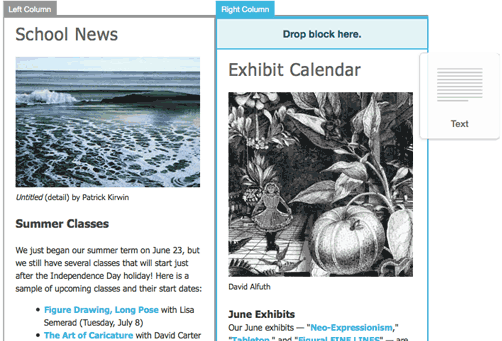
MailChimp's email builder.
MailChimp’s email builder.

This is the fun part! As a guiding principle, think of all the promotional emails you get every day. Which ones do you actually open, and which ones go straight into the trash?

There are three things every good email needs:

  • Subject line: This is the most important part. Why should I open your email? Let me know with a short, clear subject line, or it’s likely to remain unopened.
  • Image: You’re a visual artist, after all, so make sure to include at least one image. The less the recipient needs to read, the better. If you have a web-friendly version of your exhibit card (or workshop flyer, etc.), that will work beautifully.
  • Something to do: This is called a “call to action.” Somewhere in the course of your email — maybe even more than once — you need to let me know what you want me to do. Otherwise, I’m likely to read your email and move on, and then you’ve lost my attention. So instead of just announcing the date of the reception, include a clear message: “Come to my reception tonight! I’d love to see you there!” Other potential calls to action: “Sign up,” “Come see,” “Watch my latest video,” etc.

Some common reasons you might send an email:

  • a new exhibit you’re in
  • an opening reception or event you’ll be at
  • a new offer for buyers
  • something new for sale: bowls you’ve just fired, photos you’ve just printed, etc.
  • other news: what would your fans want to hear about?

Let people know what to expect when they sign up for the first time. If you have different people interested in different things, organize your list into different segments and email the most relevant groups. (Your email service will have a tutorial on managing your lists.)

3. Hit send

Hit Send

How often will you send emails? That will largely be determined by what kind of emails you send. If you send announcements about receptions, exhibits, and other events, that will be dictated by when you have those events. If you want to send out a newsletter, make sure you’re committed to keeping it up. (If you have a blog, you can achieve this by automatically sending emails with each new post or on a regular basis – just search for “RSS to email.” This blog’s newsletter sends out weekly to everyone who signs up here.)

Find a happy medium between sending out too frequently, in which case your useful emails may start to look more and more like spam, or too infrequently, which might cause people to forget why and when they signed up in the first place. MailChimp’s co-founder recommends sending at least quarterly in his blog post with tips for artists.

Any questions or other ideas? What artist newsletters are you subscribed to, and which ones are your favorites? Let us know in the comments!

Repost: What To Post As an Artist on Social Media

Sun and cloud
Illustration by Casey Webb

The Art League Blog is on vacation this week, so we’re reposting some of our most popular resources on sharing your art online! Please enjoy this post from the vault, originally published July 2, 2014.

This guest post comes to us from Casey Webb of Jung Katz, a blog for artists and creatives, where this was first published. Casey is an artist whose primary passions are business and creating art that’s personal to her. Together with Joey Souza, also of Jung Katz, she has a social media following of over 2,000.

Social media can be a very useful tool for growing a strong community of followers — if you tend to your networks regularly and in the right way.

However, it can be a bit overwhelming to try and post daily if you have no idea what to post or what not to post. These tips work great for any social media network, including Facebook, Twitter, Instagram, Google+, and Tumblr.

What to post:

  1. Artwork
: Finished pieces, works in progress, and sketches. People follow you because they want to see your art. Give them a behind the scenes peak that they can’t see from just glancing at your website or portfolio. Maybe even take some pictures of your work space.
  2. Project Updates: 
Are you starting a new series or collection? Artists need to self-promote a bit. If they’re interested in your work, they’ll most likely be interested in other projects by you as well.
  3. What inspires you
: Set aside some time to give a shout out to a fellow artist. This is a wonderful networking tool, just make sure you have permission to share their artwork beforehand. More than likely they will be extremely flattered and maybe even return the favor.
  4. Upcoming Events: 
Tell them about gallery shows or craft fairs you’ll be at, and that you hope to see them there.
  5. Accomplishments
: It’s okay to be proud of a job well done. Talk about any features in magazines and other accomplishments or milestones.
  6. Anything Noteworthy: 
Are you donating 15% of all proceeds to your local animal shelter for the entire month of May? Or are you switching over to organic fair trade materials? Both are great things to know and could potentially drive more sales.

What not to post:

  1. Irrelevant Content
: Post those on your personal account. If I follow you for your artwork and you only post art once in every four posts, chances are I’m going to become uninterested and unfollow you.
  2. The Same Things Again, and Again, and Again: 
Don’t post tons of pictures of a single project all at the same stage of development. Some different views are nice, but we don’t need to see it from ten different angles.
  3. Complaints
: You probably don’t follow people to hear them complain about things, and chances are no one is following you to hear it either. Nobody likes being around someone who is always in a bad mood. You want to give your followers a positive experience, not a negative one.
  4. Gossip
: Talking bad about other artists is not only rude, but can also burn more bridges than you may be aware of at the time. Saying rude and negative things can sever relationships between you and the artist, you and the artist’s fans, and you and anyone who thinks you’re unprofessional. It’s best not to chance it. Just do your best to be courteous and polite to everyone, and handle issues privately and professionally.
  5. Copyrighted Pictures: 
Don’t post pictures that aren’t yours unless you have permission to post them.
  6. Anything Controversial: 
Unless you’re known by your fans for your controversial ways, you could potentially lose many followers by talking about things like politics or religion. If it’s not relevant to your artwork, consider keeping your opinions to yourself.

Before posting to any of your social media channels, think about what it is people follow you for. What do they want to see? What is it that you like seeing from the artists you follow? Take note of what you personally enjoy seeing from those you follow, as well as what you think they could do without. Try your best to understand what you want and what others want from you and you’ll have a deeper understanding of what to post and what not to.

Have any to add? Let us know in the comments below!

Repost: Protecting Images of Your Artwork Online

The Art League Blog is on vacation this week, so we’re reposting some of our most popular resources on sharing your art online! Please enjoy this post from the vault, originally published January 9, 2013.

If you’re on Facebook, Flickr, or a blog to promote your artwork, you hopefully also have some images of your work. That’s great! In the low-attention-span world of the Internet, photos are the best way to grab someone’s attention — especially someone looking for art.

But what about when someone wants to steal your work? Most of the friendly people who find your site won’t even think of doing it. But some might, and while there’s no way to prevent a determined thief, there are easy ways to make your image less attractive to them. The only surefire way to keep your images to yourself is to keep them off the Internet — a valid option, but then no one would be able to see your work!

Here are two of the best options — and see the bottom of this post for links with more information:

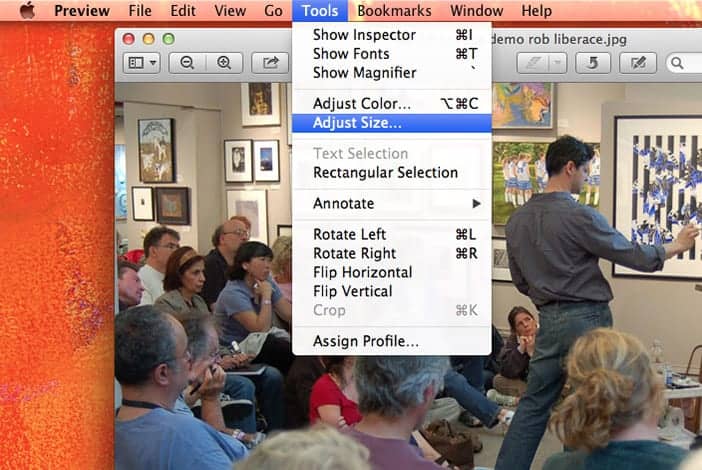
  • Use low-resolution images: You can try to find a happy medium between an image that’s large and clear enough to convey the sense of the artwork, but small enough to prevent people from getting a clear image if they hit “print.” While you’re editing images for your site, try lowering the resolution to 72 ppi (pixels per inch) instead of the 150 or 300 that your camera might save. Then, you can decrease the dimensions to whatever size you see fit: maybe 500 or 1000 pixels across in the larger dimension. Here’s where to change the image size in Preview and Photoshop (on a Mac):
    In Mac’s Preview application, go to “Tools” and then click on “Adjust Size…” below.
    In Photoshop, select “Image” from the top toolbar and then click on “Image Size…” below.

    As always, don’t forget to save your changes to a new copy so you don’t overwrite your original! For directions on resizing using Microsoft Paint in Windows 7, click here.

  • Watermark your images: This can be a painful option, since it mars your image, but might be something you want to do to prevent theft — especially for photographers, whose work can be more easily replicated off the Internet. Watermarking is fairly easy to do with an image editor like Photoshop, and there are also online tools to do it — see below for a link. Note that someone skilled in Photoshop can still reconstruct your image — even if it won’t be exactly the same, it might be good enough for their purposes.

Continue reading Repost: Protecting Images of Your Artwork Online

Meet Our Newest Instructors

Mark Thomas Anderson

We search all over to bring together the best art instructors we can find. This school year, we’re excited to welcome ten new artists to teach in our classrooms! Some will teach weekly classes, while others will be visiting to teach short workshops.

You can find them all in our shiny new catalog!

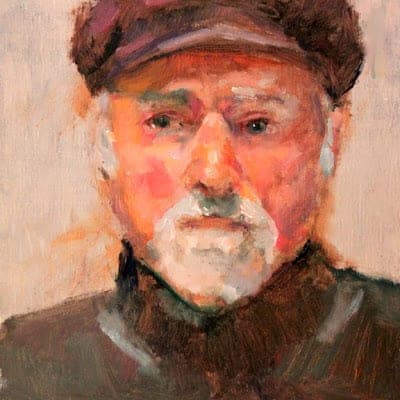
Self portrait by Mark Anderson

Mark Anderson | drawing

You may remember Anderson (markthomasanderson.com) from his 2011 summer residency at the Torpedo Factory. He received his MFA in painting from Boston University and also teaches at Georgetown University. Anderson writes in his artist statement: “I continuously search for new mediums, tools, additives, surfaces, and pigments in order to expand my descriptive methods. Some additional tools that I use are rulers, a calculator, rags, and at times, the tips of my fingers.”

Ceramics by Birdie Boone

Birdie Boone | ceramics

You’ll have to wait until June 2017 for this workshop from ceramicist Boone (birdiebooneceramics.com), whose signature “belly-bottomed” creations can be seen in the photo above. Read more about the inspiration and process behind these forms in this Ceramic Arts Daily article.

Deborah Clark | children’s classes

Maryland-based art teacher Deborah Clark received her BFA in painting and her BS in Art Education from Kutztown State University. Art Fun-damentals is our introductory class for ages 5–8 that focuses on the fun of art.

Timothy J. Clark | watercolor

Timothy Clark (tclarkart.com) is an accomplished watercolorist whose work can be found in museum collections including the Smithsonian’s. He’s visiting The Art League for a three-day workshop in watercolor that’s not to be missed!

Dan Finnegan | ceramics

Finnegan (danfinneganpottery.com) is based in Fredericksburg, VA and has been making pots for decades. This winter workshop is based around the idea of pottery used for serving and cooking — yum!

Painting by Catherine Hillis

Catherine Hillis | watercolor

Watercolorist Hillis (catherinehillis.com) is going to teach this introductory watercolor class. She is a member of numerous watercolor societies and one of 40 elected members of the Washington Society of Landscape Painters. You can read her blog here.

Tile by Yvette Jacobs

Yvette Jacobs | ceramics

Jacobs (faculty page) comes from an artistic family and worked as a broadcast animator, designer and creative director. Her tile work represents a move away from the computer-driven work she did for video. Her Tiles class will be offered once per term to students who want to make functional works of art for their backsplash, garden, or elsewhere!

By Tamryn McDermott
By Tamryn McDermott

Tamryn McDermott | fiber

McDermott (tamyrnmcdermott.com) will give two workshops on two basketry techniques each. Students can explore basketry’s potential for sculptural forms while learning traditional processes. Currently based in Alexandria, McDermott completed an artist residency in St. Louis this year.

Susan O’Neill | drawing

O’Neill (Facebook) is a longtime Art Leaguer who you may remember from her 2014 solo exhibit, “Figural Fine Lines.” Her new class, Expressive Figure Drawing, is all about capturing the human form with energy and confidence. To learn more about her artistic practice, read her Q&A on this blog.

David Skibiak | printmaking

“As I see it, exploration is the destination for an artist,” writes Skibiak (theframefactory1.com/skibiak.htm). He’s an artist with Discover Graphics Atelier on the second floor of the Torpedo Factory. The Printmaking Projects and Techniques class is for students with some printmaking experience who want to further explore intaglio, lithography, or monotype printmaking.

Browse the full 2016–17 catalog here!

Fall Registration is Open!

The Art League 2016/17 Catalog

The brand new Art League catalog has arrived and registration is now open for fall classes and workshops! Click here to virtually flip through the new catalog.

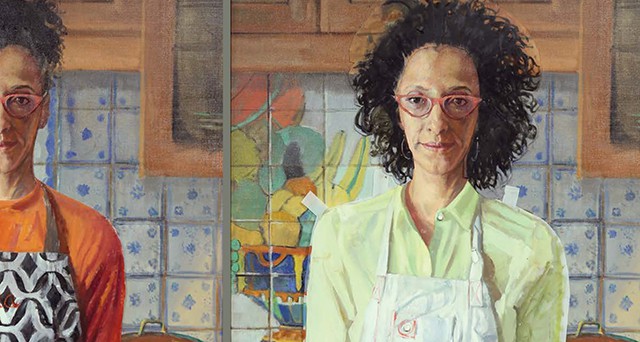
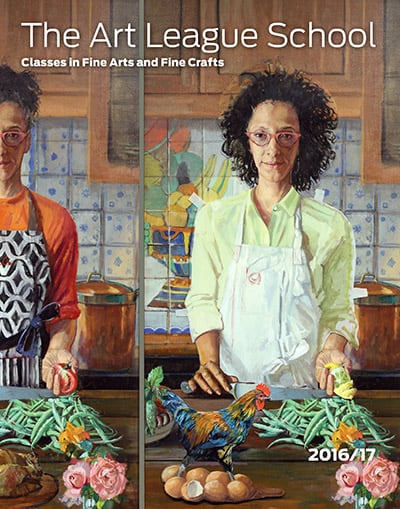
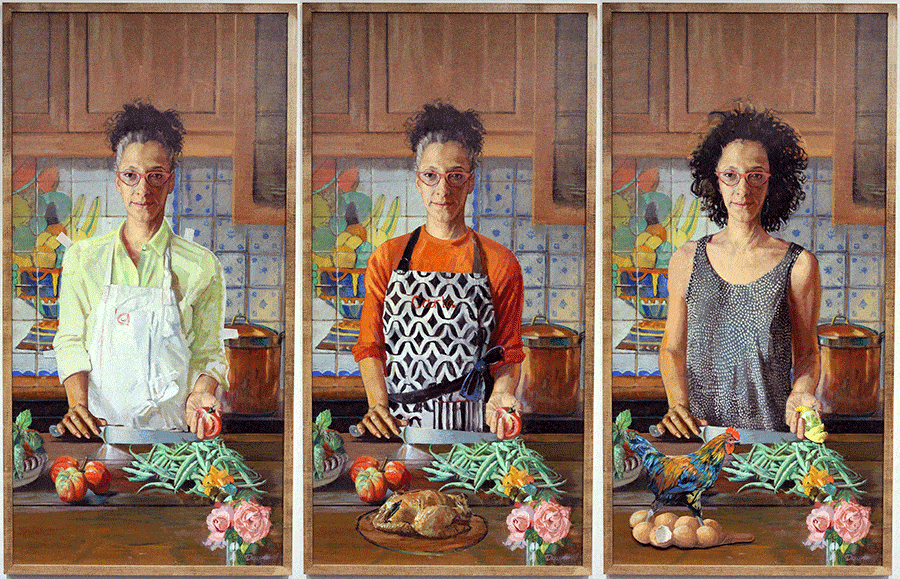
Danni Dawson’s Carla Hall Paper Doll graces this year’s catalog cover; a painting you might remember from the Student/Faculty Show in February or this earlier blog post. We love this fun painting and the fact that Carla was once an Art League model!

Carla-Hall-by-Danni-Dawson
Summer is still here but we’re looking forward to seeing where our imaginations and creativity will take us this fall. Whether it’s painting from a new perspective, working in the jewelry studio, or taking your camera out on the town, a fall art class is the perfect way to kick start your creativity. Browse our 201 fall classes and 47 workshops and see what’s right for you! The fall term starts the week of September 19.

Travel Art Workshops and FAQs for 2016–17


A student painting the lavender fields at Sault. Photo by Susan Abbott.

The Art League’s travel workshops include local day trips and international workshops. They’re your chance to learn more about art and culture while globetrotting with expert instructors!

With a new school year starting, we have a new slate of travel workshops coming up. Are you ready for Greece? How about Croatia? Or would you like to revisit the Phillips Collection here in DC — with a master framer?

Read to the end for our FAQ on travel workshops. For more information about any of these workshops, and to register, contact Travel Workshop Coordinator Margaret Cerutti: 703-683-1780 x13 or [email protected].

The 2016–17 schedule

The Sketchbook Traveler in Paris, France
Instructor: Alice Kale
Type: Watercolor painting and museum exploration
When: September 4–14, 2016

Plein Air Painting in the Chesapeake Area
Instructor: Peter Ulrich
Type: Plein air (outdoor) painting
When: Fall 2016

Master Framer’s Tour at the Phillips Collection
Instructor: William Adair
Type: Museum exploration
When: November 13, 2016, 2:00 pm

The Mansions of Newport, Rhode Island
Instructor: TBD
Type: Museum overnight trip
When: November 2016

Bahamas Winter Painting Retreat
Instructor: Susan Abbott
Type: Plein air painting/all media
When: February 2017

Venice, Italy Through the Eyes of the Artist
Instructor: Robert Liberace
Type: Drawing and museum exploration
When: Spring 2017

Croatia: The Island of Hvar
Instructor: Matt Pinney
Type: Plein air painting
When: June 2017

Drawing & Painting the Splendor of Greece
Instructor: Thanasi Papapostolou
Type: Plein air and historical site exploration
When: June 2017

FAQs

Here’s our Q&A with Travel Workshop Coordinator Margaret Cerutti with some background on what to expect:

Instructor Robert Liberace demos for students in Florence.

What’s included in the workshop price?
That varies by the workshop. Generally, accommodations with breakfast, group transportation and entrance fees to the sites on the agenda, and the price of instruction are included. Airfares aren’t usually included, but we try to arrange them at the lowest price available. This is optional; you can use your frequent flier miles instead if you prefer — many people do!

What’s the itinerary like? Will there be down time?
Every travel workshop is unique — it’s based on the instructor’s choice. If it’s a plein air painting workshop, there will be an initial demo (on a theme, such as atmospheric perspective in the landscape) with additional demos on subsequent days in different locations. Students will then work on their own pieces with instructor input. For a museum exploration or drawing workshop, usually a drawing/painting demo will follow the museum experience, either within the museum itself or at another location. Generally the schedule is pretty intense — depending on the workshop, the day is filled with activities. However, for the most part the evenings are free.


Oxford University in England.

How is transportation within the destination arranged?
On domestic local day trips (Virginia, Maryland, etc.), you’ll provide your own transportation. In general, group transportation for international workshops is arranged at the travel workshop location.

I’m not a very advanced artist — will I feel out of place? What if I don’t know anyone else who’s going and I’m not an Art League student or exhibiting artist?
Generally, travel workshops are not for beginners. Depending on the workshop, you should have some drawing/painting/photography experience. Call for further information if you aren’t sure. Some of our instructors have two- or three-day workshops you can take to gain experience prior to departure.

There are pre-departure information nights for all participants who are registered, so you’ll get to meet each other and further discuss supplies and the itinerary for the trip.


Workshops include visits to local attractions such as the Gallerie dell’Accademia in Venice.

Can my spouse or significant other come if they aren’t an artist?
Sometimes that can be arranged. Call for details.

How do you plan your trips and choose your destinations? Are the instructors experts on those cities?
Generally, our instructors choose the travel locations because they are familiar with them or that city has something in particular to offer the students — in particular, things like museums or painting the lavender fields in Provence in July.

How do I get my supplies? Can I take them on the plane?
Supplies may be purchased here in The Art League Store. Supplies can be carried in your checked luggage. Details can be explained before departure.


Instructor Susan Abbott captures Elbow Cay in the Bahamas.

Is there anything I need to do to prepare?
That depends on the location. Always keep your passport current!

I missed out on a trip I would have liked to go on. Are the same trips offered each year? How can I find out what’s coming up?
Some trips are offered on a yearly basis due to demand and their small size, though specific itinerary items may change. Current information is on The Art League website.

Artist Opportunities #332

Photograph by Art League instructor Katherine Akey

Every Tuesday, we gather a variety of artist opportunities around the DC area and beyond. Find one below and enter today — good luck! Click here for recent opportunities posts, and submit your opportunity listing here.

Fairfax 4-H

Artwork dropoff: August 4–5. The annual 4-H Fair at Frying Pan Farm Park in Herndon includes competitive departments for entry, to include divisions for Arts, Crafts, Photography (Color, B&W), Interior Design, and Short Film Creation, among many other things. The dates are August 4-7.

Exhibit proposals

Deadline: September 4. The Carver Center Gallery (Towson, MD) is now accepting exhibition proposals for the 2016-2017 school year. We are looking for a wide variety of solo or group exhibitions representing work from MFA graduates, emerging, and mid-career artists.

F.E.A.S.T.

Deadline: September 6. F.E.A.S.T. at VisArts 2016 (Funding Emerging Art with Sustainable Tactics) is a bridge between artists and the community.  F.E.A.S.T. is a public meal designed to use community-driven financial support to democratically fund projects that use art and creative thinking to impact the community. F.E.A.S.T. at VisArts 2016 will take place on September 25th on the Rooftop at VisArts in Rockville, Maryland, 11:30 to 3:00 PM.

Maryland residency

Deadline: September 30. VisArts invites applications and proposals from local, national, and international artists for a four month residency at VisArts at Rockville, MD.


Re-runs: These announcements have been posted here before, but it’s not too late to enter!

Blue Man Group

Deadline: August 8. Blue Man Group, the critically hailed theatrical phenomenon, will celebrate 25 years of living in full color with the launch of a unique art competition in Chicago open to professional and emerging artists. The competition will award six $2,500 cash prizes to the winning artists.

Pets and animals

Deadline: August 10. For “Fur, Feathers, and Fins” at Annmarie Sculpture Garden and Arts Center, the jury seeks works that explore the wide world of pets. All media welcome; small to large-scale installations; new media encouraged; indoor and outdoor works accepted; cash awards to be presented.

Games

Deadline: August 18. For “Games: From Marbles to Minecraft” at Annmarie Sculpture Garden and Arts Center, the jury invites artists to submit works that celebrate and explore the broad spectrum of game history, development and innovation, including game design, production, packaging, and marketing.

Athenaeum

Deadline: August 18. The Athenaeum Invitational in Alexandria, VA is a theme-based event featuring the works of both specially-invited artists who have exhibited in the Athenaeum Gallery in the past, as well as works selected through a call for submissions open to anyone living or working in Virginia, the District of Columbia, West Virginia, or Maryland.

Fairwood Arts Festival

Deadline: August 19; early bird discount before July 29. The Prince George’s County Dept. of Parks & Recreation is seeking art vendors for the Fairwood Arts Festival in Bowie, MD. The application fee is $50 through July 29.

Chalk contest

Event: August 20; advance registration required. As part of the Annual Riverfront Chalk Festival in Lynchburg, VA, adults and children are invited to register for a 4′ × 4′ space for chalk art and compete for cash prizes. First prize is $500.

Uplifting art

Deadline: August 22.  For “Light of Our Future” at Children’s National in DC, artists are invited to create artwork to uplift spirits of the children, families, hospital staff and visitors.

Exhibit proposals

Deadline: August 31. The Arts Club of Washington (DC) continues its support for the visual arts with the Call for Entries for the 2017–2018 gallery season. Exhibitions are scheduled monthly from September 2017 through May 2018.

Fall art show

Deadline: September 1. The 45th Annual Fall Foliage Art Show (Waynesboro, VA) is seeking fine artists and artisans for the annual two day outdoor juried fine art exhibition.

Digital Fabrication Residency

Deadline: September 1. Digital Fabrication Residency program residents learn and gain hands-on experience with laser cutting, CNC routing, FDM 3D printing, digital embroidery, 2D plotting and 3D scanning. Applications for the 3 Day Onsite Residency Program in Easton, MD must include a project proposal that outlines what the resident plans to work on while onsite.

The nude figure

Deadline: September 9. The Nude Figure at Wayne Art Center in Wayne, PA is juried by Paul DuSold and Scott Noel. Open to all artists working in painting, drawing and sculpture.

Public sculpture

Deadline: September 23. The Riverdale Park (MD) Public Art Initiative is announcing a Call for Artists. The initiative seeks five sculptures of various styles and sizes to display for a one year-long placement, at pre-determined, publicly-accessible sites within the Town of Riverdale Park. The stipend is $2,000 per selected work.

Art League solo exhibits

Deadline: September 23. Entry is now open for 2018 solo artist exhibits at The Art League. Entry is open to all Art League exhibiting artist members.

Paintings

Deadline: September 28. “Root to Bloom: Places Artists Call Home” at Principle Gallery (Alexandria, VA) will feature paintings representative of where the featured artists call “home.” Works must be paintings no more than 40 inches along the longest edge (measured unframed).

Contemporary craft

Deadline: September 30. The Greater Denton Arts Council announces the opening of its 2017 Call for Entries for the 30th Annual Materials: Hard + Soft Contemporary Craft Exhibition. This exhibition celebrates the evolving field of contemporary craft and the innovation of artists who push the boundaries of their chosen media.

Small works

Deadline: September 30. The Council for the Arts (Chambersburg, PA) presents “Miniature Art 2016.” 2-D artwork must have an image size no greater than 4″ by 6″, and sculpture should not exceed 5″ in any direction. No crafts, jewelry, photography, laser prints or computer-generated artwork.

Photography about homelessness

Deadline: October 1. For Picture This, organized by Flashlight Baltimore, entries can depict the homeless experience from around the country, however the Baltimore region is preferred. Entries must be original photography.

Bas-relief

Deadline: October 3. The Dexter Jones Award, an unrestricted prize of $5,000, is presented annually to a sculptor for an outstanding work of sculpture in bas-relief. Each competitor must be a United States sculptor between the ages of 18 and 39.

Figure & figurative

Deadline: October 11. Gallery Underground announces “Figuratively Speaking,” a national juried art competition. All-media artists, sculptors, and photographers are invited to create visual works that interpret the theme “Figuratively Speaking” in two different ways: by depicting human forms, faces and features in representational or abstract works (portraiture, sculpture and all subject matter including people); or works which depict a broader interpretation of the theme, such as figurative language and figures of speech.

Banff residency

Deadline: ongoing. Artists with a professional standing in their field and emerging artists of promising talent are encouraged to apply for Independent Residencies at the Leighton Artists’ Colony in Banff, Alberta.

Open Call

Deadline: Ongoing. Washington ArtWorks (Rockville, MD) is holding an Open Call for the Walls. Artists pay a fee to hang work for two-month periods in these unjuried exhibits.

Introducing the 2016–17 Class Catalog

It’s here!

It’s brand new!

And it’ll make you wish Summer were over so you could jump into a Fall class.

We’re talking, of course, about the new class catalog for The Art League. It comes out this time each year, and the 2016/17 edition landed online today. (The print version will be arriving in mailboxes and our offices soon.)

But before we get to all the new art classes, let’s take a moment to enjoy the art that is the catalog.

Drum roll, please …

The Art League 2016/17 Catalog

(You can click the image above to view a larger version.)

You may recognize the cover artwork from this year’s Faculty Show, when Danni Dawson’s interactive painting Carla Hall Paper Doll was on view. It’s an unconventional portrait of the Top Chef star, with multiple configurations on detachable Mylar sheets. You can see some of the different looks when you open up to the back cover:

Front and back covers

Open it up to page one, and you’ll find Fifth Circle by Robert Liberace.

Inside cover

Pretty stellar, right?

But you’re here for all the new classes scheduled for the fall and beyond! While you wait for the print catalog to arrive, explore the PDF and the schedule on this page to your heart’s content.

We will, of course, have more on this blog about our new teachers and courses. Registration for workshops and Fall classes begins Monday, August 8 at 9:30 am. Fall term starts September 19. For details about how registration works, see the bottom of this page.

Carla Hall Paper Doll, oil on canvas and mylar, by Danni Dawson.